
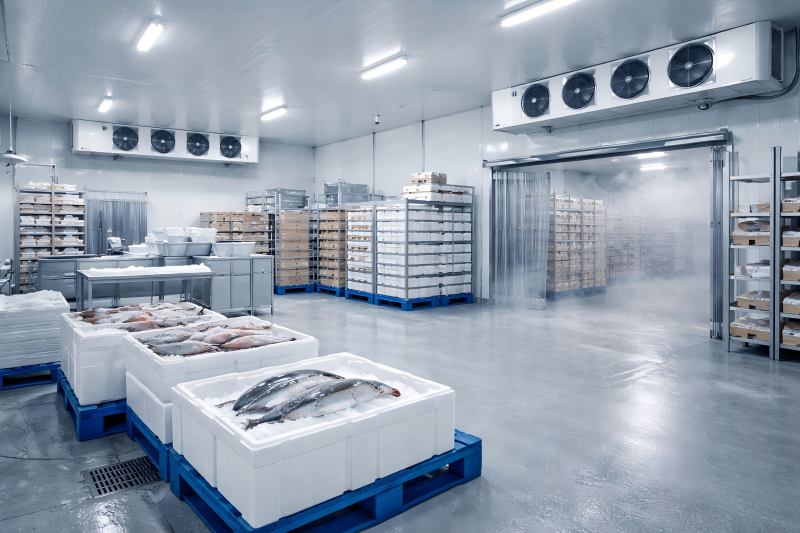
Designing a cold room for a fishing processing plant requires more than simply choosing a refrigeration unit and building insulated walls.
The design must match the plant’s production flow, product types, storage time, hygiene standards, loading patterns, packaging methods, and energy goals. A poorly designed cold room can lead to uneven temperature, excess moisture, product dehydration, floor icing, cross-contamination, high power consumption, and workflow bottlenecks.
A well-designed cold room improves freshness, preserves texture and appearance, reduces waste, and supports a more stable supply chain.
Why Cold Room Design Matters in Fish Processing
Fish and seafood deteriorate quickly because of their high water content, soft tissue structure, enzymatic activity, and microbial sensitivity. Even slight temperature increases can accelerate spoilage, odor formation, discoloration, and drip loss. In a fishing processing plant, cold rooms are used for several purposes, such as receiving raw fish, chilling after washing or filleting, temporary storage before packing, holding frozen products, and staging products before shipment.
A cold room must therefore do more than keep products cold. It must maintain the right temperature for each processing stage, avoid hot spots, ensure fast pull-down after product loading, and support sanitary handling. If the room is undersized, overloaded, or poorly ventilated, it may not remove heat quickly enough. If the room is oversized without proper control, it may operate inefficiently and cause unnecessary drying or frost problems.
For fish processors, good cold room design directly affects:
- Product freshness and shelf life
- Food safety and compliance
- Daily production efficiency
- Labor movement and handling speed
- Energy consumption and operating cost
- Maintenance frequency and equipment reliability
Step 1: Understand the Plant’s Processing Flow
Before any cold room dimensions or equipment are selected, the first task is to study the plant’s process flow. A fishing processing plant may handle whole fish, gutted fish, fillets, shellfish, shrimp, squid, or value-added frozen products. Each product type may require different storage temperatures, packaging formats, and turnover speeds.
A typical process flow may include:
- Raw material receiving
- Sorting and washing
- Gutting, trimming, or filleting
- Pre-chilling or icing
- Packing
- Chilled storage or freezing
- Frozen storage
- Dispatch staging and loading
The cold room design should follow this flow logically. Products should move from “warmer” process areas to “colder” storage zones with minimal backtracking. Clean product areas should be separated from raw receiving zones to reduce contamination risk. Traffic routes for staff, bins, pallets, and forklifts should also be planned early.
Example of process-based room planning
| Processing Stage | Recommended Cold Area | Purpose |
| Raw fish receiving | Chilled receiving room | Temporary holding before processing |
| Washed or sorted fish | Pre-chill room | Rapid temperature reduction |
| Packed fresh fish | Fresh product cold room | Short-term chilled storage |
| IQF or block frozen fish | Frozen storage room | Long-term low-temperature storage |
| Order consolidation | Dispatch cold room | Staging before loading |
When the process flow is clear, the cold room system can be divided into zones instead of trying to make one room perform all tasks.
Step 2: Define the Required Temperature Zones
Fish processing plants rarely need only one cold room. Different steps require different temperatures. Fresh fish storage is typically near 0°C, while frozen storage is much lower. Designing separate temperature zones improves control, efficiency, and hygiene.
Common temperature ranges in a fishing processing plant
| Cold Room Type | Typical Temperature Range | Main Use |
| Chilled receiving room | 0 to 4°C | Incoming raw fish, short holding |
| Pre-chill room | -1 to 2°C | Rapid cooling before packing |
| Fresh fish storage | 0 to 2°C | Packed chilled seafood |
| Ice room | -5 to 0°C | Ice holding and handling |
| Frozen product holding | -18 to -25°C | Long-term frozen storage |
| Dispatch cold room | 0 to 4°C or -18°C | Shipment staging, depending on product |
For fresh fish, the target is often as close to 0°C as possible without freezing the product unintentionally. For frozen seafood, the room temperature should keep the product core temperature stable and prevent thawing during door openings or loading operations.
If the plant handles both chilled and frozen products, separate cold rooms are strongly recommended. Combining them in one room creates control difficulties and reduces efficiency.
Step 3: Calculate the Required Capacity and Room Size
Cold room size should be based on real operational needs, not guesswork. The designer needs to estimate how much product will be stored, how long it will stay, how it will be packed, and how it will move داخل the room.
Important factors include:
- Daily fish intake
- Peak processing season volume
- Average storage duration
- Packaging type: crates, cartons, bins, pallets
- Stacking height
- Pallet size and aisle width
- Forklift or manual handling method
- Space for evaporators and air circulation
Simple sizing method
Start with the maximum quantity of product that may be stored at one time. After that, add aisle space, wall clearance, equipment clearance, and loading buffer space.
Example storage planning table
| Item | Example Value |
| Daily fresh fish processing | 20 tons/day |
| Chilled storage holding time | 1 day |
| Frozen storage holding time | 7 days |
| Pallet load | 800 kg/pallet |
| Chilled pallets needed | 25 pallets |
| Frozen pallets needed | 175 pallets |
| Space per pallet including access | 1.8 to 2.2 m² |
| Estimated chilled room floor area | 45 to 55 m² |
| Estimated frozen room floor area | 315 to 385 m² |
This is only a conceptual example. Final sizing depends on rack layout, room height, stacking method, and handling equipment. In fish plants, it is wise to include some spare capacity for seasonal surges, delayed shipment, or future business growth.
Step 4: Choose the Right Cold Room Layout
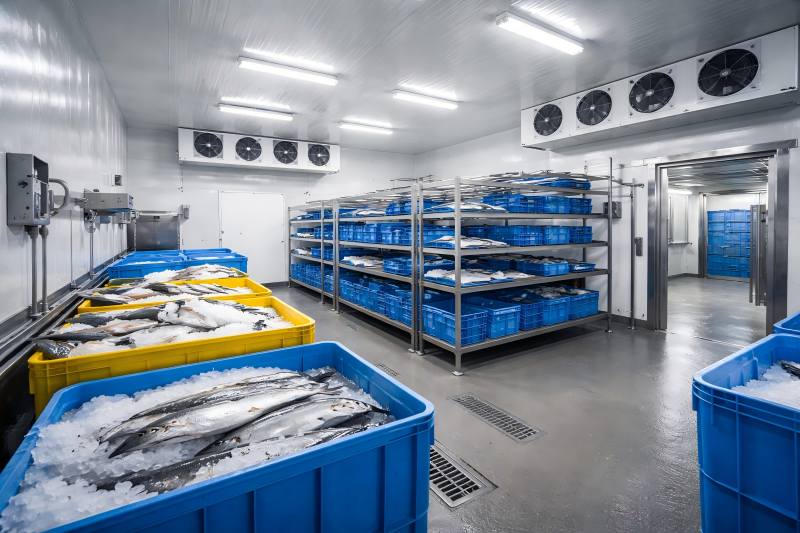
A well-planned layout improves sanitation and reduces handling time. Poor layout causes congestion, temperature loss, and damage to products or packaging.
The layout should consider:
- Entry and exit points
- Flow of raw and finished products
- Separation of fresh and frozen goods
- Access for workers and forklifts
- Drainage direction
- Evaporator placement
- Space for cleaning and inspection
A common best practice is to place the chilled receiving room close to the unloading area, the pre-chill room near processing lines, and the finished goods cold room close to packing and dispatch. Frozen storage should usually be placed in a lower-traffic area because the products stay longer and the room should not be opened frequently.
Layout design priorities
| Priority | Design Objective |
| Product flow | Minimize unnecessary handling distance |
| Hygiene zoning | Separate raw and packed product areas |
| Temperature stability | Reduce door opening frequency |
| Safety | Ensure clear aisle and anti-slip surfaces |
| Maintenance | Allow service access to equipment |
| Expansion | Leave room for future capacity increase |
Step 5: Select Suitable Insulation Materials and Panel Thickness
Insulation is one of the most important parts of cold room design. In a fishing processing plant, poor insulation leads to heat gain, condensation, ice formation, and energy waste. Panels must resist moisture, cleaning chemicals, and corrosion.
Cold room panels are commonly made with insulated cores and metal skins. Polyurethane or polyisocyanurate insulated sandwich panels are widely used because they offer strong thermal performance.
Typical insulation guidance
| Room Type | Suggested Panel Thickness |
| Chilled room 0 to 4°C | 75 to 100 mm |
| Pre-chill room near 0°C | 100 mm |
| Frozen room -18 to -25°C | 120 to 150 mm |
| Blast or very low temperature areas | 150 mm or more |
Panel thickness depends on ambient temperature, operating temperature, and energy targets. Floors also need insulation, especially in frozen rooms, to prevent frost heave and heat transfer from the ground.
Seafood plant panels should clean easily, resist corrosion, and use sealed joints against moisture. Hygienic corner details are also important because fish processing involves washdown and wet conditions.
Step 6: Design the Refrigeration System Correctly
The refrigeration system must match both the room size and the product heat load. In fish plants, the cold room does not only cool the air. It must also remove heat from incoming fish, packaging materials, workers, lighting, motors, and door openings.
The total cooling load usually includes:
- Product load
- Transmission load through walls, ceiling, and floor
- Infiltration load from door openings
- Internal load from people and equipment
- Lighting load
- Safety factor for peak operation
If warm fish enters the room frequently, the product load may be very high. If the room only stores already chilled fish, the load is lower. This is why pre-chill rooms and storage rooms should be designed differently.
Refrigeration design considerations
| Factor | Design Impact |
| Product entry temperature | Higher temperature requires more cooling capacity |
| Product mass per hour | Determines pull-down demand |
| Door opening frequency | Increases warm air infiltration |
| Room temperature setpoint | Affects compressor selection |
| Humidity requirement | Influences evaporator design |
| Defrost method | Important in humid seafood environments |
For chilled fish rooms, refrigeration should provide stable temperature without excessive air speed that dries the product. For frozen rooms, the system must maintain low temperature even during loading cycles. Evaporator placement, fan control, and defrost scheduling are essential.
Step 7: Control Airflow and Humidity
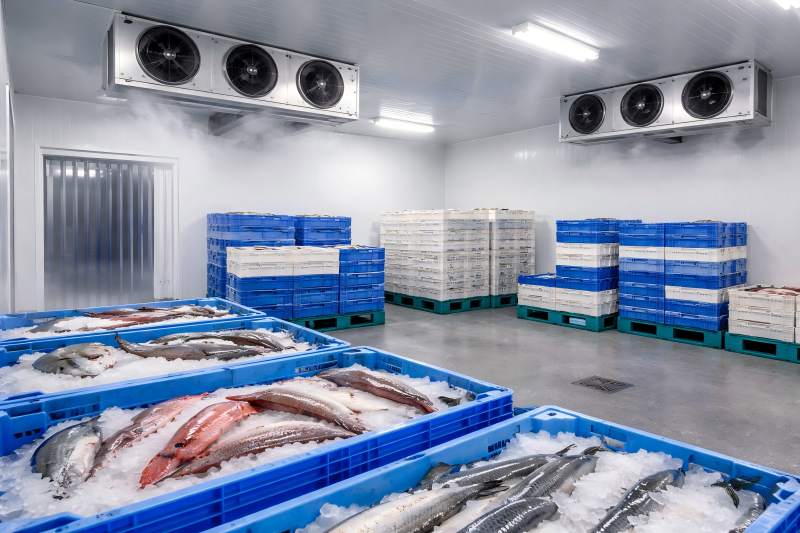
Airflow is often overlooked, but it strongly affects fish quality. If airflow is too weak, temperatures become uneven. If airflow is too strong, fresh fish may lose moisture, dry out, and suffer surface quality loss.
In a fishing processing plant, many products are stored in open crates, trays, or partially covered cartons. This makes humidity control especially important. Fresh fish benefits from high relative humidity to reduce dehydration.
Airflow and humidity goals
| Product Type | Recommended Condition |
| Fresh fish on ice | Very high humidity, gentle airflow |
| Packed chilled fish | High humidity, moderate airflow |
| Frozen seafood cartons | Controlled airflow, lower dehydration priority |
| High-turnover dispatch room | Fast recovery airflow after door opening |
Good design measures include:
- Proper evaporator sizing
- Even air distribution without direct blasting on products
- Adequate spacing between pallets and walls
- Strip curtains or rapid doors
- Humidity-aware control strategy in chilled rooms
For fresh fish, avoid placing products directly under evaporator discharge where localized drying may occur.
Step 8: Design Hygienic Floors, Walls, and Drainage
Fish processing environments are wet, organic-rich, and sanitation-sensitive. The cold room must be easy to wash and resistant to bacterial buildup. Floors must be durable, non-slip, and designed for drainage.
Key hygienic design points include:
- Smooth, washable wall surfaces
- Hygienic sealed joints
- Rounded internal corners where possible
- Anti-slip flooring
- Proper floor slope to drains
- Corrosion-resistant materials
- Drain traps and odor control
Flooring must also withstand pallet trucks, carts, or forklifts. In frozen rooms, anti-slip texture is especially important because ice may form near doors or loading zones.
Floor and drainage checklist
| Element | Recommended Design |
| Floor finish | Durable, food-grade, anti-slip |
| Floor slope | Enough for drainage, but safe for movement |
| Drain location | Away from product storage concentration |
| Wall-floor joint | Sealed and easy to clean |
| Drain type | Hygienic, cleanable, trapped |
| Frozen room floor | Insulated, vapor-protected, structurally reinforced |
A cold room that is difficult to clean will eventually affect both hygiene and operational efficiency.
Step 9: Choose the Right Doors and Access System
Doors are a major source of temperature loss. In fish processing plants, rooms may be opened frequently because of active production schedules. Door design should therefore support both energy saving and operational convenience.
Door options may include:
- Hinged insulated doors
- Sliding insulated doors
- High-speed roll-up doors
- Strip curtains
- Air curtains in certain areas
For forklift traffic, sliding or automatic doors are often better. For smaller access points, hinged doors may be sufficient. In frozen rooms, heated door frames or anti-condensation features may be needed to prevent icing and sealing problems.
Door design should consider:
- Opening frequency
- Size of carts or pallets
- Personnel traffic versus product traffic
- Need for visibility panels
- Emergency release from inside
- Ease of cleaning
Step 10: Plan Product Handling and Storage Method
The cold room must match how the product is actually stored. Fish may be stored in bins, stacked cartons, plastic crates, or palletized loads. Some plants use racking; others use floor stacking. The storage method changes the room dimensions, evaporator arrangement, and airflow planning.
Questions to answer include:
- Will products be stored loose, boxed, or palletized?
- What is the maximum stack height?
- Is FIFO important?
- Will the room use racks?
- Is manual handling or forklift handling planned?
Leaving too little aisle space reduces efficiency and safety. Leaving too much reduces storage density. The design should balance access and capacity.
Step 11: Add Temperature Monitoring and Control Systems
A modern fish processing cold room should include reliable monitoring. Manual temperature checks are not enough for consistent quality assurance. Continuous sensors and alarms help protect both product and business.
Recommended monitoring features include:
- Digital temperature sensors
- Door-open alarms
- High-temperature alarms
- Data logging
- Remote monitoring
- Humidity monitoring in chilled rooms
- Compressor and defrost status alarms
This is especially important in fish processing because spoilage losses can be significant if refrigeration fails or if a room drifts above target temperature overnight.
Monitoring table
| Monitoring Item | Purpose |
| Room temperature | Confirms storage condition |
| Product core temperature | Verifies product safety and quality |
| Door opening time | Helps reduce heat infiltration |
| Defrost cycle status | Prevents coil icing and poor performance |
| Humidity level | Supports chilled product quality |
| Alarm history | Improves maintenance response |
Step 12: Focus on Energy Efficiency Without Sacrificing Performance
Cold rooms consume substantial energy, especially in seafood plants with wet operations and frequent access. Useful strategies include:
- Good insulation and vapor sealing
- Correct refrigeration sizing
- Efficient evaporator fan control
- LED lighting with motion sensors
- Fast-closing insulated doors
- Reduced door-open time
- Night curtains or strip curtains
- Heat recovery where practical
- Preventive maintenance scheduling
Oversized systems may cycle inefficiently, while undersized systems struggle and consume more power under peak load. Good design finds the right balance.
Step 13: Prepare for Cleaning, Maintenance, and Expansion
A cold room is a long-term investment. Designers should make it easy to clean, inspect, and maintain. Access to evaporators, valves, drains, and panels should not be blocked by permanent storage layouts.
Plan for future expansion, as modular cold room design simplifies adding storage capacity or new temperature zones later.
Design review checklist
| Design Area | Key Question |
| Capacity | Can the room handle peak seasonal volume? |
| Temperature | Is each product zone correctly matched? |
| Hygiene | Are all surfaces easy to wash and sanitize? |
| Airflow | Will all product positions receive even cooling? |
| Flooring | Is the floor safe, insulated, and durable? |
| Access | Are doors suitable for the traffic pattern? |
| Monitoring | Are alarms and logging included? |
| Energy | Are heat gain and infiltration minimized? |
| Maintenance | Can equipment be serviced easily? |
| Expansion | Is future growth possible? |
Common Mistakes to Avoid
Many cold room problems begin at the design stage. Some common mistakes include using one room for too many temperature needs, underestimating product load, ignoring door traffic, choosing insufficient insulation, neglecting drainage, and placing evaporators where they blow directly on fresh fish.
Other frequent issues are:
- No buffer space for incoming peak loads
- Poor separation between raw and finished goods
- Inadequate humidity control
- Insufficient aisle width
- Weak vapor sealing in frozen rooms
- Lack of alarm and logging systems
- Design based only on room volume instead of process load
Avoiding these mistakes can save large amounts of money over the life of the plant.
The best design begins with process analysis, then divides the plant into suitable temperature zones, calculates real storage demand, selects the proper insulation and refrigeration system, and supports hygienic, efficient product movement. Good airflow, drainage, door design, monitoring, and energy-saving measures all play an important role. When these elements are designed correctly, the cold room helps preserve seafood quality, improve food safety, reduce waste, and support reliable plant operations.