
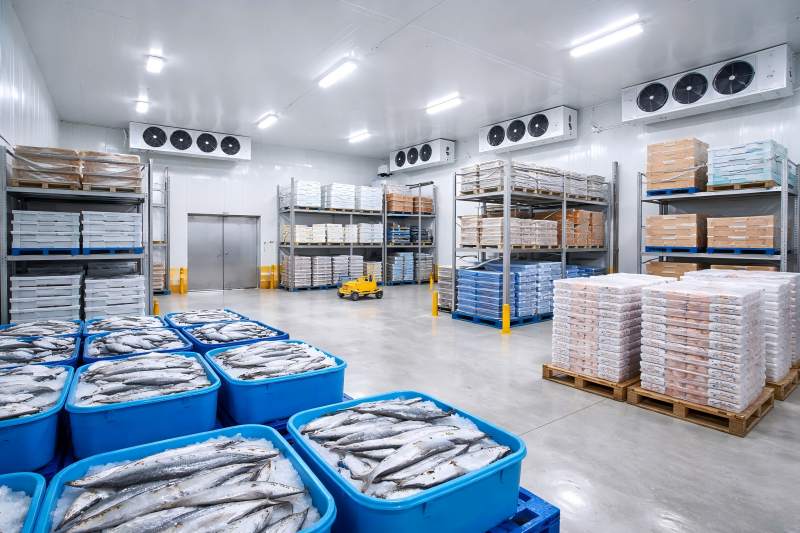
For seafood plants, cold room capacity planning should always begin with the production reality of the facility.
The correct solution depends on what products are being handled, how much volume moves through the plant each day, how long products stay in storage, how fast the doors are opened and closed, the packaging format, the plant layout, and the future growth plan.
Fresh fish, frozen shrimp, shellfish, fillets, live seafood holding, and value-added seafood products all have different storage needs, and those differences must be reflected in the cold room design.
Why Cold Room Capacity Matters
Compared with many other food products, seafood can lose freshness rapidly if it is exposed to fluctuating or insufficiently low temperatures. Improper storage capacity often causes more than a space problem. It can affect the entire production chain.
When cold room capacity is too small, several problems usually appear. Product stacks become too dense, airflow is restricted, workers have difficulty moving pallets, loading and unloading becomes slow, and temperature recovery after door opening takes longer. This creates higher spoilage risk and can reduce product quality.
When capacity is too large, the plant may invest in unnecessary construction area, oversize refrigeration equipment, and higher long-term energy consumption. A very large room with low utilization can also make internal operations inefficient if products are spread too far apart.
The right cold room capacity helps a seafood plant achieve the following goals:
- Maintain stable product temperature
- Protect freshness and food safety
- Improve stock rotation
- Support smooth production flow
- Reduce energy waste
- Leave room for future expansion
Step 1: Identify the Type of Seafood Products
The first step is to define what kind of seafood the plant processes clearly. Different products require different storage temperatures, handling times, and space arrangements. Capacity planning should never begin with room dimensions alone. It should begin with the product profile.
Common seafood categories and their storage implications
| Seafood Type | Typical Storage Condition | Capacity Planning Focus |
| Fresh whole fish | 0°C to 4°C | Fast turnover, ice storage, daily movement |
| Fresh fillets | 0°C to 2°C | Hygienic packaging, short holding time |
| Frozen shrimp | -18°C or below | Dense pallet storage, longer storage duration |
| Frozen fish blocks | -18°C to -25°C | High stacking efficiency |
| Live shellfish | Species-specific chilled holding | Water systems or special holding areas |
| Cooked/value-added seafood | Chilled or frozen depending on product | Packaging volume and finished goods flow |
A seafood plant that mainly handles fresh fish for next-day shipment needs a different cold-room strategy than a plant exporting frozen shrimp for several weeks of storage. Fresh product facilities usually need strong short-term cooling performance and rapid product turnover. Frozen product facilities often require larger holding capacity and more emphasis on pallet density.
Step 2: Calculate Daily Throughput
Daily throughput is one of the most important factors in determining cold room capacity. This refers to how much seafood enters, moves through, or leaves the plant in a day. Capacity should be based on actual production and logistics patterns, not rough guesses.
A seafood plant should collect at least the following data:
- Daily raw material intake in tons
- Daily processed output in tons
- Peak-season volume
- Average shipment frequency
- Maximum inventory held at one time
- Time products remain in cold storage
Example of throughput data collection
| Item | Example Value |
| Raw fish received per day | 20 tons |
| Finished seafood products per day | 16 tons |
| Peak season intake | 28 tons |
| Average storage duration | 2 days |
| Shipment frequency | Daily |
| Maximum inventory during peak | 40 tons |
If the plant receives 20 tons of seafood daily and stores products for two days before shipment, then the cold room capacity must support not just one day’s volume, but overlapping inventory. During peak season, this overlap becomes even more important.
A simple planning approach is:
Required storage load = Daily volume × Storage days × Peak factor
For example:
- Daily volume = 20 tons
- Storage days = 2
- Peak factor = 1.2 to 1.5
Estimated storage load = 20 × 2 × 1.3 = 52 tons
This gives a more realistic starting point than simply designing for 20 tons.
Step 3: Determine the Required Storage Duration
Not every seafood plant stores products for the same amount of time. Some plants operate on a rapid turnover model where seafood arrives, is processed, chilled, packed, and shipped within 24 hours. Others may hold frozen products for one week, two weeks, or even longer.
Storage duration has a major impact on required capacity.
Typical storage duration by plant type
| Plant Operation Type | Typical Storage Duration |
| Fresh seafood distribution plant | 0.5 to 2 days |
| Fresh fillet processing plant | 1 to 3 days |
| Frozen seafood export plant | 7 to 30 days |
| Seasonal seafood processing plant | Varies, often higher buffer required |
| Value-added ready-to-cook seafood plant | 2 to 7 days |
A seafood plant that ships every day may need less holding capacity but faster loading and unloading access. A plant that consolidates export containers once or twice a week will need much more storage space.
It is also important to calculate storage needs separately for:
- Raw seafood holding
- Pre-cooling or chilling
- Processing buffer storage
- Finished goods storage
- Frozen holding
Many seafood plants require more than one cold room rather than a single large room. This often improves hygiene, workflow, and temperature control.
Step 4: Convert Product Weight into Storage Volume
Cold room capacity is often discussed in tons, but the room itself is designed in cubic meters or square meters. So the next step is converting product weight into physical storage volume.
This is where packaging and palletization matter. Ten tons of frozen boxed shrimp may occupy less space than ten tons of iced whole fish in bins. Capacity planning must reflect the real packaging method.
Approximate storage density examples
| Product Form | Approximate Storage Density |
| Frozen boxed seafood on pallets | 350 to 500 kg/m³ |
| Fresh seafood in crates with ice | 200 to 350 kg/m³ |
| Bulk fish bins | 250 to 400 kg/m³ |
| Cartoned value-added seafood | 300 to 450 kg/m³ |
For example, if a seafood plant needs to store 40 tons of frozen seafood and the packaging density is about 400 kg/m³:
40,000 kg ÷ 400 kg/m³ = 100 m³ of net product volume
But this is only net product volume, not the final room size. The plant must also allow for:
- Pallets
- Aisles
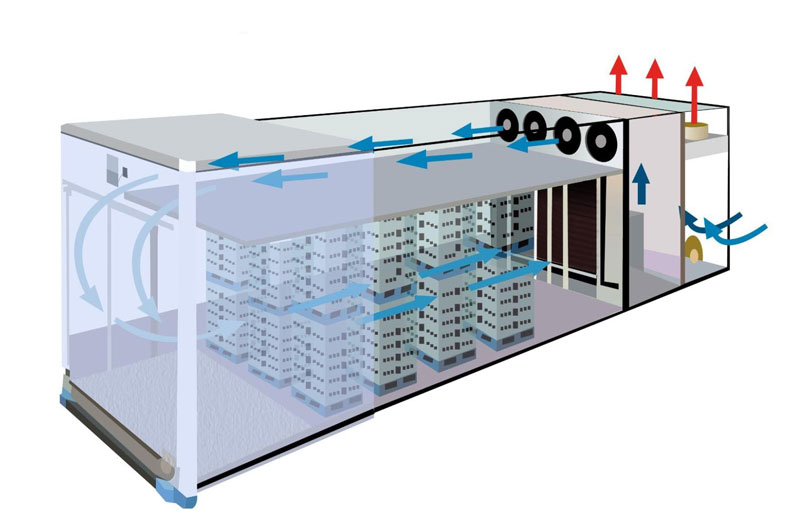
- Air circulation
- Wall clearance
- Evaporator clearance
- Worker and forklift movement
Because of this, usable storage volume is always lower than total room volume.
Step 5: Account for Space Utilization Efficiency
A cold room is never filled 100 percent with product. Real operations require clearances for airflow, safety, and handling.
Typical cold room utilization rates
| Storage Method | Typical Space Utilization |
| Floor stacking | 35% to 50% |
| Selective pallet racking | 40% to 55% |
| Drive-in racking | 55% to 70% |
| Mobile racking | 60% to 80% |
If the plant needs 100 m³ of net product storage and the expected utilization rate is 50%, the room may need a total internal volume of about 200 m³.
This is one reason why seafood plants should not size cold rooms based only on total product weight. Storage style changes the room size dramatically.
Example calculation
| Item | Value |
| Required net product volume | 100 m³ |
| Expected utilization rate | 50% |
| Required gross room volume | 200 m³ |
If the room height is 4 meters, then:
200 m³ ÷ 4 m = 50 m² floor area
This provides a rough first estimate. In practice, additional factors such as equipment position and aisle widths may increase the final floor area requirement.
Step 6: Separate Chilling Capacity from Storage Capacity
A common mistake is confusing cold room storage capacity with refrigeration pull-down capacity. These are not the same.
Storage capacity refers to how much product the room can hold. Cooling capacity refers to how much heat the refrigeration system can remove within a certain time. In a seafood plant, both are essential.
For example, a room may be large enough to hold 30 tons of seafood, but if 15 tons of warm product enter quickly from processing, the refrigeration system may struggle to bring the temperature back down. The result is slow cooling and temperature instability.
Seafood plants should evaluate:
- Product entry temperature
- Target storage temperature
- Daily product loading schedule
- Frequency of door openings
- Ambient temperature around the room
- Internal lighting and equipment heat load
- Number of workers entering the room
Main heat load sources in a seafood cold room
| Heat Load Source | Description |
| Product load | Heat from newly loaded seafood |
| Transmission load | Heat entering through walls, floor, ceiling |
| Infiltration load | Warm air entering during door opening |
| Internal load | Lighting, motors, workers, equipment |
| Defrost load | Temporary heat introduced during defrost cycles |
A seafood plant handling high daily throughput may need a room with moderate storage size but strong refrigeration capacity. A frozen storage warehouse may need larger storage size but a different cooling profile.
Step 7: Plan for Peak Season and Production Growth
Seafood processing is often seasonal. Catch volumes, species availability, and export demand can vary greatly during the year. If cold room capacity is designed only for average volume, the plant may face serious bottlenecks during peak season.
It is usually wise to include a safety margin. In many projects, a growth and seasonal buffer of 15% to 30% is reasonable, depending on the plant’s business model.
Suggested capacity planning buffer
| Operating Situation | Recommended Extra Capacity |
| Stable year-round production | 10% to 15% |
| Moderate seasonal variation | 15% to 25% |
| Strong seasonal peaks | 25% to 40% |
| Rapid business growth expected | 20% to 35% |
For example, if the current required storage load is 50 tons and the business expects strong seasonal peaks, designing for 62.5 to 70 tons may be more practical than building only for 50 tons.
Oversizing should still be controlled, but underestimating future demand can be far more expensive because later expansion may disrupt plant operations and require additional civil work.
Step 8: Match Cold Room Capacity to Process Flow
Cold room planning should support the real movement of seafood through the plant. Capacity is not only about how much fits inside. It is also about how efficiently the room works with the rest of the production line.
A seafood plant may need several temperature-controlled zones, such as:
- Raw material receiving chill room
- Pre-processing holding room
- Blast chilling or freezing area
- Finished product cold storage
- Dispatch cold room
Using one room for all purposes may create hygiene and workflow problems. Products with different turnover speed, packaging form, or target temperature should often be separated.
Example of cold room zoning in a seafood plant
| Zone | Main Function | Typical Temperature |
| Raw seafood holding | Temporary holding before processing | 0°C to 4°C |
| Chilled finished goods room | Short-term dispatch storage | 0°C to 2°C |
| Frozen finished goods room | Medium or long-term storage | -18°C to -25°C |
| Packing material cold area if needed | Sensitive packaging or ingredients | Depends on product |
| Loading buffer room | Reduces temperature shock during dispatch | 0°C to 5°C or frozen as needed |
This zoning approach often leads to better product quality than a single oversized room.
Step 9: Consider Handling Equipment and Layout
Cold room capacity must also account for the way products are handled inside the room. Manual handling, hand pallet trucks, and forklifts all require different aisle widths and turning areas.
A room that looks large on paper may feel very crowded once equipment starts moving inside.
Typical layout considerations
| Factor | Capacity Impact |
| Forklift turning radius | Requires wider aisles |
| Door width and height | Affects loading speed and pallet movement |
| Pallet size | Changes storage density |
| Evaporator location | Reduces usable upper space in some areas |
| Drainage slope | May affect floor stacking patterns |
| Column placement | Can reduce practical storage area |
If the seafood plant uses pallets and forklifts, cold room capacity planning should include realistic aisle widths. Ignoring this can reduce practical capacity by a large margin.
Step 10: Avoid the Most Common Sizing Mistakes
Many seafood plants encounter similar cold room design problems. These usually come from planning based on rough assumptions rather than operating data.
Common mistakes to avoid
| Mistake | Result |
| Sizing only by floor area | Capacity becomes unrealistic |
| Ignoring packaging type | Product volume is underestimated |
| No peak-season allowance | Room becomes overloaded during busy periods |
| Confusing refrigeration power with storage volume | Poor temperature control |
| No allowance for aisles and airflow | Reduced usable capacity |
| Designing one room for all functions | Poor workflow and hygiene control |
| Forgetting future expansion | Costly retrofitting later |
The best approach is to base decisions on real throughput, real packaging dimensions, real storage duration, and real handling methods.
Practical Example of Cold Room Capacity Selection
Imagine a seafood plant with the following profile:
- Processes fresh and frozen shrimp
- Daily finished output: 18 tons
- Frozen products stored for 5 days
- Peak season increase: 25%
- Packaging density: 420 kg/m³
- Storage system: palletized floor stacking
- Estimated utilization rate: 45%
Step-by-step estimate
- Base storage load
18 tons/day × 5 days = 90 tons - Peak season allowance
90 × 1.25 = 112.5 tons - Convert to volume
112,500 kg ÷ 420 kg/m³ = about 268 m³ net product volume - Adjust for utilization
268 ÷ 0.45 = about 596 m³ gross room volume
If the internal room height is 5 meters:
596 ÷ 5 = about 119 m² floor area
This means the plant may require approximately 119 m² of internal cold room floor area for this frozen storage function, subject to final layout, evaporator arrangement, and aisle design.
Summary of example calculation
| Calculation Step | Result |
| Daily output | 18 tons |
| Storage duration | 5 days |
| Base storage load | 90 tons |
| Peak factor | 1.25 |
| Peak storage load | 112.5 tons |
| Net product volume | 268 m³ |
| Utilization rate | 45% |
| Gross room volume | 596 m³ |
| Room height | 5 m |
| Approximate floor area | 119 m² |
This example shows that accurate cold room sizing requires several linked calculations, not just a guess based on daily tonnage.
How to Decide Whether One Large Room or Multiple Rooms Is Better
For seafood plants, the answer depends on product diversity and workflow complexity.
One large room may be suitable when
- The plant handles one main product category
- Storage temperature is consistent
- Product turnover pattern is simple
- Operational management is straightforward
Multiple rooms are often better when
- The plant handles fresh and frozen seafood
- Raw and finished goods need separation
- Hygiene zoning is important
- Different departments load products at different times
- Expansion may happen in phases
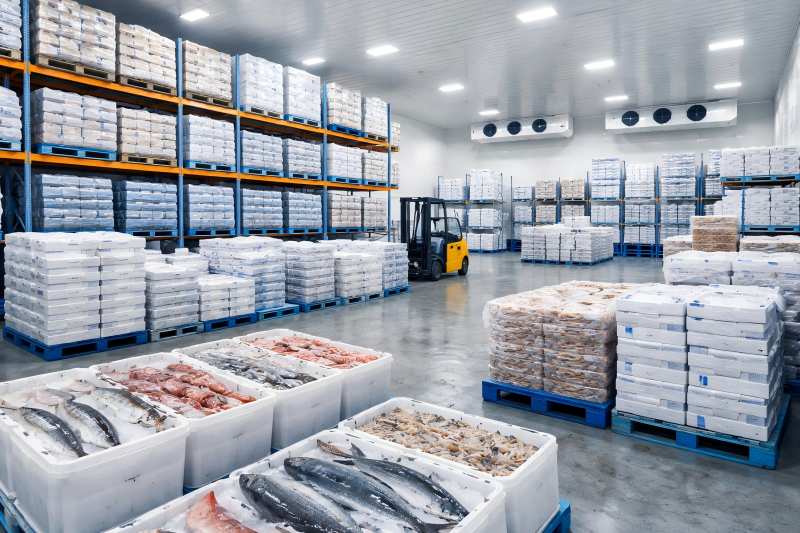
In many seafood processing plants, multiple rooms provide better control, even if the total volume is similar.
Final Tips for Choosing the Right Cold Room Capacity
Before finalizing the design, seafood plants should prepare a clear capacity planning checklist:
- What seafood products are stored
- How many tons arrive and leave daily
- How long products stay in storage
- What packaging format is used
- Whether pallets, racks, or floor stacking will be used
- What aisle widths are needed
- What peak season volume should be planned
- Whether fresh and frozen products need separate rooms
- Whether future expansion should be reserved
It is also wise to validate the calculations with both the processing team and the refrigeration engineer. The processing team understands product flow, while the refrigeration engineer can evaluate the cooling load and system performance. The best results come when storage planning and refrigeration design are coordinated from the start.