
There are many types of cold room condensing units, and each type is designed for different refrigeration needs. Air-cooled units are simple and widely used. Water-cooled and evaporative units are better for large-capacity systems. Monoblock units are convenient for small cold rooms, while split-type and remote systems offer more flexibility. Hermetic, semi-hermetic, scroll, and inverter units provide different choices based on compressor design and efficiency requirements.
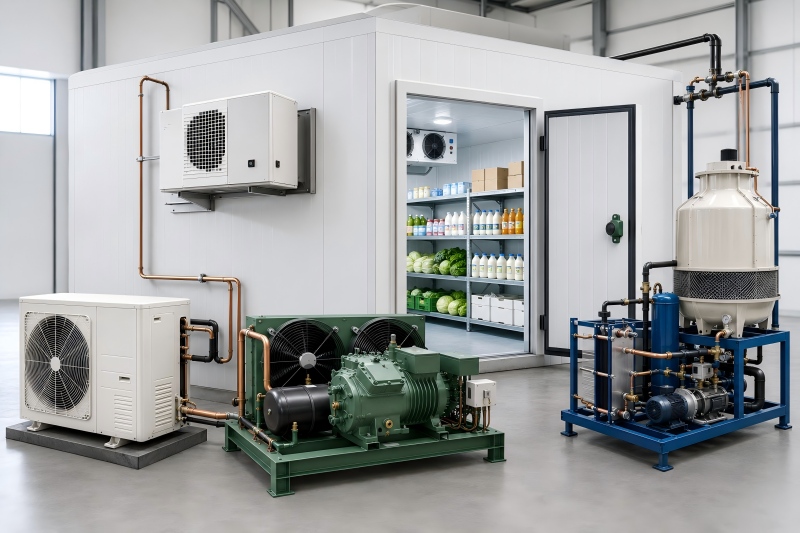
Main Types of Cold Room Condensing Units
Cold room condensing units can be divided into several common types. Each type serves different cooling needs, installation conditions, and project requirements.
Air-Cooled Condensing Unit
An air-cooled condensing unit releases refrigeration heat through airflow. Its condenser fan improves heat rejection, ideal for small and medium cold rooms.
| Pros | Cons |
| No cooling water required | Performance is affected by ambient temperature |
| Simple installation | Requires good ventilation |
| Lower initial cost | May consume more energy in hot climates |
| Easy maintenance | Condenser coil needs regular cleaning |
| Flexible installation location | Noise may be higher if installed near working areas |
| Suitable for small and medium cold rooms | Not ideal for very large-capacity refrigeration systems |
Common Applications
Common applications of air-cooled condensing units include:
- Restaurant cold rooms
- Supermarket cold storage
- Hotel kitchens
- Food processing rooms
- Beverage storage rooms
- Small freezer rooms
- Fruit and vegetable storage
For most standard cold room projects, an air-cooled condensing unit is a practical and cost-effective choice.
Water-Cooled Condensing Unit
A water-cooled unit removes refrigerant heat through circulating cooling water. The system usually needs a cooling tower, water pump, and water circulation pipeline.
Compared with air-cooled units, water-cooled systems can offer better heat exchange efficiency in certain conditions, especially for larger refrigeration projects.
| Pros | Cons |
| Higher cooling efficiency in many conditions | Requires stable water supply |
| More stable performance in hot environments | Needs cooling tower and water pump |
| Lower condensing temperature | Higher installation cost |
| Suitable for large-capacity refrigeration systems | More maintenance work |
| Less affected by outdoor air temperature | Risk of scaling, corrosion, and water quality problems |
Common Applications
Typical applications of water-cooled condensing units include:
- Large cold storage warehouses
- Food factories
- Meat processing plants
- Seafood processing facilities
- Industrial refrigeration systems
- Central refrigeration plants
If the project has large cooling demand and stable water supply, a water-cooled condensing unit may be a good option.
Evaporative Condensing Unit
An evaporative condensing unit combines air cooling and water evaporation. It sprays water over the condenser coil while fans move air through the unit.
This type is often used in medium and large refrigeration systems where energy efficiency is important.
| Pros | Cons |
| High heat exchange efficiency | Requires water supply |
| Lower condensing temperature | Needs regular cleaning |
| Energy-saving for large systems | Water quality must be controlled |
| Suitable for high ambient temperature areas | Higher installation complexity |
| More efficient than standard air-cooled units in many conditions | Possible scaling and biological growth |
| Good for industrial cold storage projects | Not suitable for all environments |
Common Applications
Evaporative condensing units are often used in:
- Large refrigerated warehouses
- Food processing plants
- Distribution centers
- Industrial freezing systems
- Large meat and seafood cold storage
- High-capacity refrigeration projects
For large cold rooms with high energy consumption, evaporative systems can help reduce operating costs.
Monoblock Condensing Unit
A monoblock condensing unit is an integrated refrigeration unit. The evaporator and condensing unit are built into one compact machine. It is usually installed directly through the cold room wall or ceiling.
| Pros | Cons |
| Compact structure | Limited cooling capacity |
| Easy installation | Usually suitable for small rooms only |
| No long refrigerant piping required | Heat and noise may be close to the cold room area |
| Factory-assembled design | Less flexible than split systems |
| Simple maintenance | Not ideal for large industrial cold storage |
| Fast project installation | Replacement options may be limited by unit structure |
Common Applications
Monoblock condensing units are suitable for:
- Small restaurant cold rooms
- Small supermarkets
- Convenience stores
- Small beverage rooms
- Flower storage rooms
- Small dairy storage rooms
For users who need a simple and fast cold room solution, a monoblock unit can be a good choice.
Split-Type Condensing Unit
A split-type condensing unit separates the indoor evaporator and outdoor condensing unit. The evaporator cools the room, while the condensing unit operates outside.
This structure is widely adopted in commercial cold room projects.
| Pros | Cons |
| Flexible installation | Refrigerant piping is required |
| Lower heat and noise near the cold room | Installation quality affects performance |
| Suitable for different room sizes | Higher installation cost than monoblock systems |
| Easy to match with different evaporators | Needs proper refrigerant charging |
| Good cooling performance | Requires professional commissioning |
| Suitable for medium and larger cold rooms | More complex than integrated units |
Common Applications
Split-type condensing units are used in:
- Commercial cold rooms
- Supermarkets
- Food storage facilities
- Meat and seafood storage
- Pharmaceutical cold rooms
- Medium freezer rooms
- Fruit and vegetable storage
For most customized cold room projects, split-type systems are a common and reliable solution.
Remote Condensing Unit
A remote condensing unit is installed away from the cold room, usually outdoors, on a roof, or in a machine room. It connects to one or more evaporators through refrigerant piping.
This type is useful when heat, noise, or installation space must be separated from the storage area.
| Pros | Cons |
| Keeps heat away from the cold room area | Longer refrigerant piping required |
| Reduces indoor noise | More complex installation |
| Flexible installation location | Higher installation cost |
| Good for multiple cold rooms | Oil return must be considered |
| Suitable for commercial and industrial systems | Requires professional design and commissioning |
| Easier heat rejection outdoors | More space may be needed for equipment placement |
Common Applications
Remote condensing units are commonly used in:
- Supermarket refrigeration systems
- Food distribution centers
- Large commercial kitchens
- Warehouses
- Multi-room cold storage projects
- Industrial refrigeration systems
Remote units are ideal when the refrigeration equipment needs to be placed far from the storage area.
Hermetic Condensing Unit
A hermetic condensing unit uses a hermetic compressor. In this design, the motor and compressor are sealed inside one welded shell.
Hermetic units are commonly used in small and medium refrigeration systems.
| Pros | Cons |
| Compact design | Compressor shell cannot be opened for internal repair |
| Lower cost | Usually replaced instead of repaired |
| Low refrigerant leakage risk | Limited capacity range |
| Simple operation | Not ideal for very large systems |
| Suitable for small refrigeration systems | Less serviceable than semi-hermetic units |
| Quiet performance in many applications | May not be suitable for heavy-duty operation |
Common Applications
Hermetic condensing units are often used in:
- Small cold rooms
- Display refrigeration
- Beverage coolers
- Small freezer rooms
- Commercial refrigeration cabinets
Semi-Hermetic Condensing Unit
A semi-hermetic condensing unit uses a compressor with a bolted shell. Semi-hermetic compressors feature an openable design for easier inspection, servicing, and repair.
This type is widely used in medium and large cold room systems.
| Pros | Cons |
| Repairable compressor structure | Higher initial cost |
| Stronger capacity range | Larger size |
| Suitable for medium and large cold rooms | More maintenance requirements |
| Long service life | Professional service needed |
| Good reliability | More complex structure |
| Better for heavy-duty applications | Not necessary for small cold rooms |
Common Applications
Semi-hermetic condensing units are suitable for:
- Medium cold rooms
- Large freezer rooms
- Meat cold storage
- Seafood storage
- Food processing plants
- Industrial cold rooms
For demanding cold storage applications, semi-hermetic systems are often preferred.
Scroll Condensing Unit
A scroll condensing unit uses a scroll compressor. Scroll compressors are known for smooth operation, high efficiency, and relatively low noise.
| Pros | Cons |
| High energy efficiency | Not suitable for all low-temperature applications |
| Low vibration | More sensitive to liquid refrigerant return |
| Quiet operation | Repair is usually limited |
| Compact design | Must be correctly matched with the system |
| Fewer moving parts | May have limitations in heavy-duty freezer applications |
| Good reliability | Requires proper system protection |
Common Applications
Scroll condensing units are used in:
- Chiller rooms
- Beverage cold rooms
- Dairy storage
- Fruit and vegetable storage
- Commercial refrigeration systems
Inverter Condensing Unit
An inverter condensing unit uses variable-speed technology to adjust compressor operation according to cooling demand. Instead of running only at full speed, the compressor can increase or decrease speed.
It enhances cooling efficiency while keeping temperatures more consistent.
| Pros | Cons |
| Better temperature control | Higher initial cost |
| Lower energy consumption | More complex control system |
| Reduced compressor start-stop frequency | Requires qualified technicians |
| Quieter operation at partial load | Electronic components need protection |
| Longer compressor life | Not always necessary for simple storage rooms |
| Suitable for variable cooling demand | Maintenance may be more technical than standard units |
If stable temperature and low energy consumption are important, an inverter condensing unit can be a strong option.
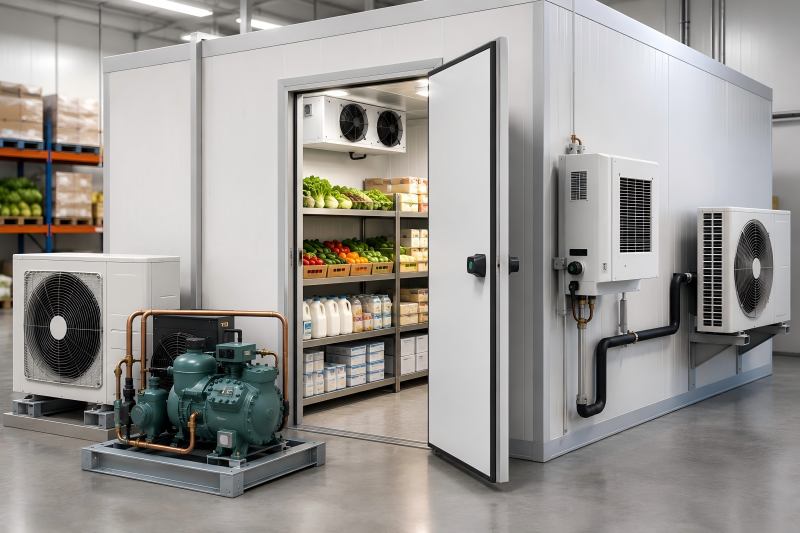
Comparison Table of Common Cold Room Condensing Units
| Type | Main Feature | Advantages | Suitable Applications |
| Air-cooled | Uses air to reject heat | Easy installation, low cost | Small and medium cold rooms |
| Water-cooled | Uses water for heat rejection | Stable and efficient | Large cold storage systems |
| Evaporative | Uses air and water evaporation | Energy-saving for large systems | Industrial refrigeration |
| Monoblock | Integrated compact design | Fast installation | Small cold rooms |
| Split-type | Separate indoor and outdoor units | Flexible and widely used | Commercial cold rooms |
| Remote | Installed away from cold room | Low noise, flexible location | Multi-room projects |
| Hermetic | Sealed compressor | Compact and economical | Small systems |
| Semi-hermetic | Serviceable compressor | Durable and repairable | Medium and large systems |
| Scroll | Scroll compressor | Quiet and efficient | Chiller rooms |
| Inverter | Variable-speed control | Energy-saving and stable | High-efficiency systems |
How to Choose the Right Type
When selecting a cold room condensing unit, users should consider several factors:
- Cold room size
- Required temperature range
- Stored product type
- Daily loading quantity
- Door opening frequency
- Local ambient temperature
- Installation space
- Noise requirements
- Energy efficiency target
- Maintenance ability
- Project budget
For example, a small restaurant cold room may only need a monoblock or small air-cooled split unit. A large frozen food warehouse may require a semi-hermetic, water-cooled, or evaporative condensing unit. A pharmaceutical cold room may benefit from an inverter system because of its stable temperature control.