
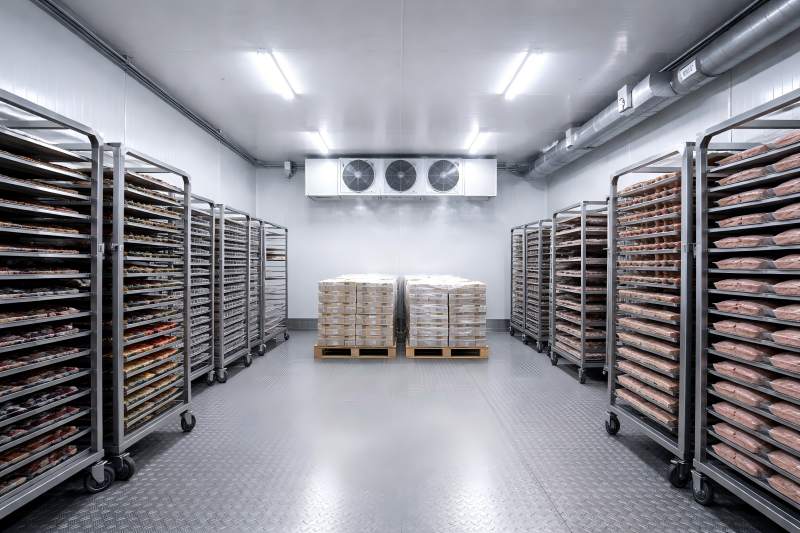
In food processing, cold storage, and commercial kitchens, blast freezers serve as a critical link between production and preservation. Their ability to rapidly reduce the temperature of food products helps lock in freshness, extend shelf life, minimize bacterial growth, and maintain texture and quality — far beyond what traditional refrigeration alone can achieve. However, selecting the right size and capacity for your blast freezer room isn’t a simple “bigger is better” decision: it requires careful planning, accurate calculation of throughput, and sound understanding of how freezer size affects energy usage, efficiency, and workflow.
This guide helps you make those decisions wisely — whether you are building a small walk-in blast room for a bakery or designing industrial-scale freezing facilities for meat, seafood, ready-to-eat meals, or other products.
Blast Freezing and Its Impact
Before we dive into size and capacity calculations, it helps to understand what makes a blast freezer different from other refrigeration systems.
What Is a Blast Freezer?
A blast freezer is a type of cold room engineered to rapidly freeze products by circulating very cold air at high velocity around the product surface. Traditional freezers often cool slowly at around -18 °C or higher, but blast freezers reach much lower temperatures, typically -25 °C to -40 °C, depending on the application.
Key features include:
- Very low target temperatures
- High-velocity air circulation
- Insulated walls and energy-efficient design
- Fast throughput per hour
Blast freezers can be small walk-in rooms, containerized units, or large industrial tunnel systems integrated with conveyors.
Why Size and Capacity Matter
Choosing the proper size and capacity isn’t only about physical dimensions — it influences:
- Freezing performance and product quality
- Energy costs and ongoing operating expenses
- Workflow efficiency and throughput
- Scalability for future business growth
- Total cost of ownership, including installation
If the freezer room is too small, you may not freeze enough product in peak periods, slowing production. If it is too large, you’ll incur higher energy and construction costs unnecessarily.
Key Factors in Sizing Your Blast Freezer Room
Here are the core considerations when selecting an appropriate blast freezer room:
Processing Volume and Flow
Determine the volume of product that requires freezing:
- Daily tons or kilograms of food processed
- Batch sizes
- Peak vs. off-peak periods
For industrial processors, this may vary from hundreds of kilograms to tons daily. For example, a typical fish blast freezer designed for 15–18 tons per day may measure about 10 m × 4.8 m × 3.5 m.
Freezing Time Requirements
Different products require different freezing times:
- Thin items cool faster than thick blocks
- Density, moisture content, and packaging influence thermal conductivity
- Consider how long products must remain inside the room
Standard rapid freezing targets range from minutes to a few hours for industrial operations.
Temperature Targets
Your target temperature will guide insulation thickness and refrigeration capacity:
- Typical blast freeze: -18 °C core temperature
- Commercial applications: -25 °C or colder to achieve rapid freeze goals
Production Workflow
The freezer should seamlessly align with:
- Preparation areas
- Packaging stations
- Cold storage areas (for post-freezing holding)
Accessibility and layout are essential for efficiency.
Space and Physical Constraints
Available floor area, ceiling height, door access, and forklift maneuverability all influence feasible size.
Energy Load and System Efficiency
Energy consumption scales with volume and cooling capacity — bigger rooms need more power and insulation quality to maintain low temperatures.
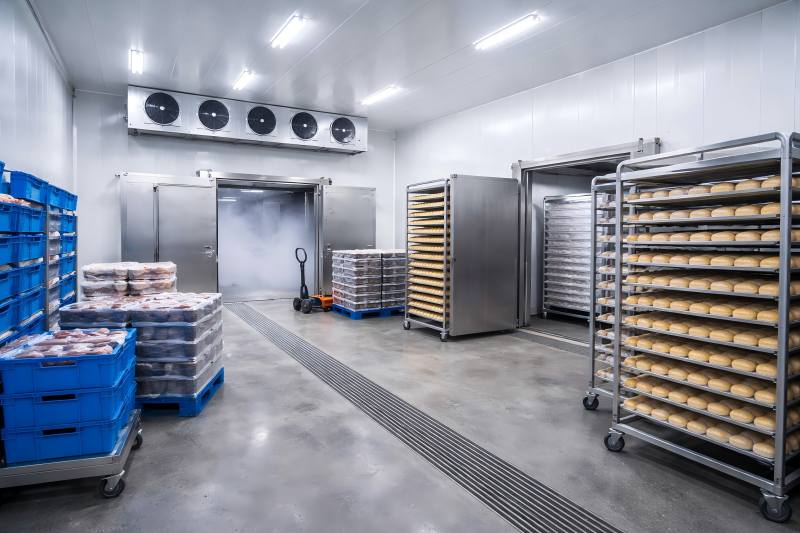
Calculating Blast Freezer Size
The fundamental calculation starts with product load:
Required Capacity (kg/hr) = (Daily Throughput × Safety Margin) / Operating Hours
A safety margin of 10–20% is commonly advised to accommodate fluctuations in demand and allow for future expansion.
Example Calculation
Suppose your facility processes 4,000 kg of product per day and you operate 16 hours daily:
Required capacity = (4,000 × 1.2) / 16 = 300 kg/hr
From industry products, many modular blast freezers are rated from roughly 100 kg/hr up to 1,200 kg/hr or more, depending on design and airflow capacity.
Blast Freezer Room Dimensions and Capacity Table
Below is a representative table showing typical blast freezer room dimensions and their approximate daily throughput capacity for walk-in models. These figures are illustrative; always consult engineers and manufacturers for precise design.
| Room Dimensions (L×W×H) | Approx. Volume (m³) | Typical Throughput (kg/day) | Notes |
| 4 × 3 × 2.8 m | 33.6 m³ | 1,000–2,000 kg | Small walk-in for bakery or catering |
| 8 × 4 × 3 m | 96 m³ | 3,000–5,000 kg | Medium catering / small processing |
| 10 × 4.8 × 3.5 m | 168 m³ | 15,000–18,000 kg | Industrial fish/meat processing |
| 12 × 6 × 4 m | 288 m³ | 20,000 kg+ | Larger industrial capacity |
Capacity Considerations
Below is another table describing real blast freezer capacity ratings from a typical series of industrial blast freezers:
| Model | Capacity (kg/hr) | Internal Volume (L) | Power (kW) |
| BST-100 | 100 | 495 L | 1 kW |
| BST-300 | 300 | 1,275 L | 3 kW |
| BST-600 | 600 | 2,380 L | 6 kW |
| BST-1200 | 1,200 | 4,420 L | 9 kW |
These modular systems are useful for smaller facilities, prep kitchens, and mid-range commercial operators.
Temperature and Insulation Requirements
The desired target temperature significantly affects design:
- -18 °C: Standard freezer storage threshold
- -30 °C to -40 °C: True blast freezing environment
- Tunnel blast freezers: Can achieve even lower temps
Proper panel thickness (typically 150–200 mm) and high-density insulation reduce unwanted heat gain, thus improving freeze efficiency and lowering operating costs.
Layout and Workflow Tips for Maximizing Capacity
Optimizing freezer layout improves throughput without costly expansion:
Door Placement
Locate doors near production and dispatch areas to minimize transit time.
Pallet Flow
Plan traffic for forklifts or carts — ensure adequate space for loading and unloading.
Pallet Racking
Use stackable racks or shelves to increase usable volume.
Airflow Distribution
Uniform air circulation prevents cold spots and ensures even freezing.
Energy Efficiency & Operational Considerations
Blast freezers naturally consume significant energy due to:
- Low target temperatures
- High airflow circulation
- Insulated room volume
However, careful planning can reduce costs:
- Select right-sized compressors
- Use variable-speed fans
- Install high-quality insulation
- Minimize door openings during operation
Manufacturers also offer energy-efficient models and controls to reduce excess usage.
Common Mistakes in Sizing Blast Freezers
Avoid these pitfalls:
Oversizing Based Only on Floor Space
Don’t assume available space = appropriate capacity. Always calculate according to production needs.
Ignoring Seasonal Peaks
Consider unavoidable peak periods (e.g., holidays) that might double or triple load.
Neglecting Future Growth
Build in 10–30% extra capacity if expansion is likely.
Underestimating Freezing Time
The efficiency of freezing depends on product density, not just volume; heavy or dense goods take longer and require stronger refrigeration power.
Special Cases — Tunnel and Conveyor Systems
For very large operations, static rooms aren’t sufficient. Instead:
- Tunnel blast freezers with conveyors offer continuous freezing
- Throughput is dictated by conveyor speed and freezer length
- These systems reach very high capacities (tens of tons per day)
They require advanced engineering and precise airflow design to ensure uniform results across all products.
Integrating Blast Freezers with Cold Storage
Often, products are moved directly from the blast freezer into cold storage at around -18 °C for long-term holding. This means planning both areas in tandem — often via:
- Door adjacency
- Compatible pallet racks
- Shared workflow paths
- Proper planning reduces bottlenecks.
Real-World Example — Medium-Sized Facility
A bakery producing frozen pastries plans to freeze 3 tons (3,000 kg) daily.
Estimate capacity needs:
- Daily throughput: 3,000 kg
- Operating hours: 12 hrs
- Safety margin: 15%
- Required: (3,000 × 1.15) / 12 = 288 kg/hr
Select freezer model or room size:
- A walk-in blast freezer with a design capacity of ~300 kg/hr is appropriate.
Room size planning:
A medium room around 8 × 4 × 3 m provides adequate volume and workflow space.
Refrigeration selection:
- Choose compressors and air circulation units sized for that tonnage and temperature target.
This level of detailed planning helps avoid costly redesigns later.
Summary and Best Practices
To select the right size and capacity for a blast freezer room, follow these key steps and factors for accurate decision-making:
- Estimate actual daily throughput and peak requirements.
- Calculate required freezing capacity (kg/hr or tons/day) with safety margin.
- Choose room dimensions and refrigeration load based on volume and airflow needs.
- Inset insulation and panel thickness for your temperature target.
- Plan workflow and layout to optimize loading/unloading.
- Consider energy usage and refrigeration efficiency.
- Future-proof your design with extra capacity and scalable options.
Blast freezer rooms are vital assets for any food production or cold storage facility. The correct sizing impacts not only quality and throughput but also long-term operational costs and business scalability. By understanding your product volume, production rhythm, freezer dynamics, and the interplay of size with energy costs, you can choose a solution that meets both current needs and future growth — ensuring efficiency and product quality for years to come.