
From carcass chilling to long-term freezing, abattoirs rely heavily on well-designed cold storage systems to maintain strict temperature control and prevent microbial growth.
When planning or upgrading a slaughterhouse facility, one critical decision is choosing between modular cold rooms and traditional (conventional) cold rooms. Each system has distinct advantages, limitations, and ideal use cases.
Understanding Cold Room Requirements in Abattoirs
Before comparing systems, it’s important to understand how cold rooms function in slaughterhouses.
Key Cold Room Applications
- Pre-cooling rooms (0–4°C): Rapidly reduce carcass temperature
- Chilling rooms (0–7°C): Short-term fresh meat storage
- Freezer rooms (-18°C or below): Long-term preservation
- Processing rooms (0–10°C): Cutting, packaging, handling
Each stage requires:
- Precise temperature and humidity control
- Hygienic surfaces
- Efficient airflow
- Reliable refrigeration systems
Cold rooms must also match production capacity to avoid bottlenecks and ensure compliance with food safety standards.
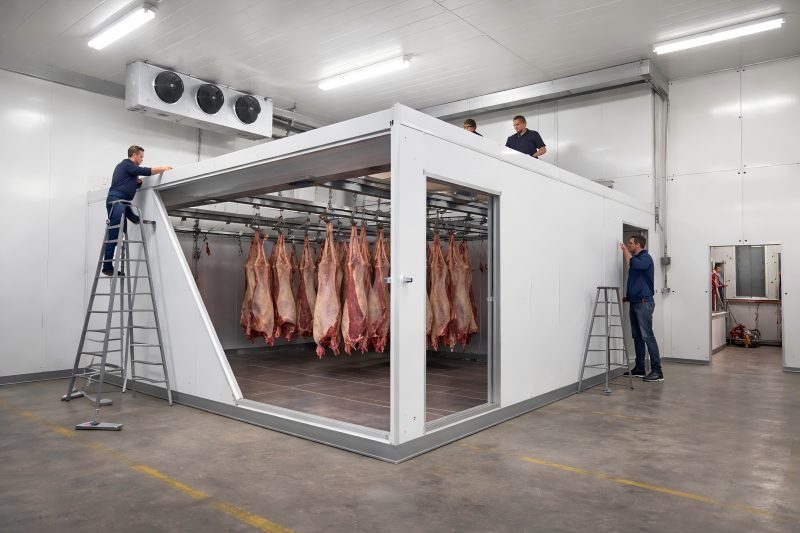
What Are Modular Cold Rooms?
Modular cold rooms are pre-engineered units made of insulated panels, assembled quickly on-site for refrigeration purposes.
Key Features
- Pre-engineered insulated panels (PU/PIR)
- Quick assembly and disassembly
- Scalable and customizable
- Relocatable design
Typical Use in Abattoirs
- Small to medium slaughterhouses
- Expansion projects
- Temporary or seasonal operations
- Satellite processing units
| Pros | Cons |
| Fast installation | Limited size compared to large warehouses |
| Lower cost | Standardized design constraints |
| Flexible and scalable | |
| Easy maintenance | |
| Energy efficient |
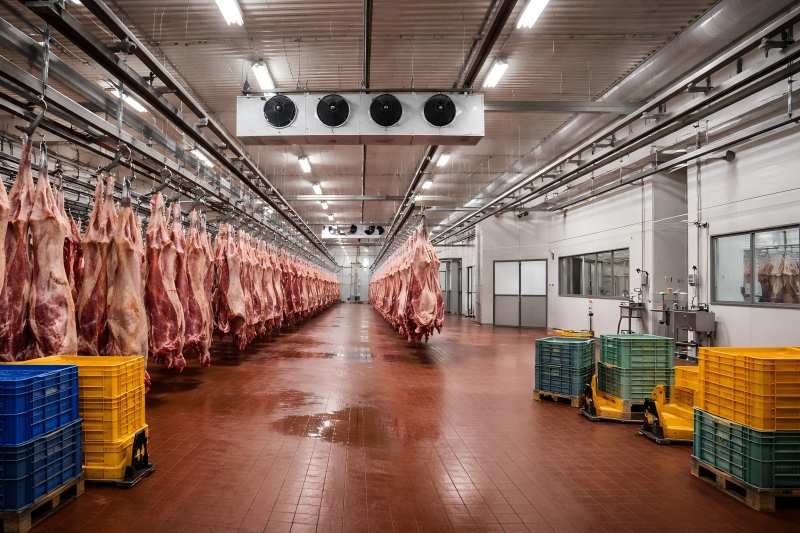
What Are Traditional Cold Rooms?
Traditional cold rooms are permanent structures built using concrete, steel, and custom insulation systems integrated into the building.
Key Features
- Fixed, large-scale infrastructure
- Fully customized layout
- Integrated refrigeration plant
- Designed for long-term use
Typical Use in Abattoirs
- Large industrial slaughterhouses
- Export-oriented meat processing plants
- Centralized cold storage hubs
| Pros | Cons |
| High capacity | High cost |
| Fully customized design | Long construction time |
| Long-term durability | Limited flexibility |
| Suitable for industrial scale | Complex maintenance |
Modular vs Traditional Cold Rooms: Key Differences
Here is a direct comparison tailored specifically for slaughterhouse applications.
Comparison Table
| Aspect | Modular Cold Rooms | Traditional Cold Rooms |
| Construction Type | Prefabricated insulated panels | Concrete/steel permanent structure |
| Installation Time | Days to weeks | Weeks to months |
| Initial Cost | Lower, predictable | High capital investment |
| Scalability | Easily expandable | Difficult and costly |
| Mobility | Relocatable | Fixed location |
| Energy Efficiency | High with modern panels | Depends on build quality |
| Maintenance | Easy component replacement | Complex repairs |
| Customization | Moderate (panel-based) | Fully customizable |
| Best Fit | Small–medium abattoirs | Large industrial facilities |
Key Insight
Modular systems prioritize speed, flexibility, and cost-efficiency, while traditional systems focus on scale, durability, and long-term capacity.
Installation and Project Timeline
Modular Cold Rooms
A major benefit is its quick and efficient installation process.
- Prefabricated components reduce construction complexity
- Minimal civil work required
- Installation can be completed in a few days to weeks
For abattoirs needing quick startup (e.g., new facilities or urgent expansion), this is a major benefit.
Traditional Cold Rooms
Traditional systems involve:
- Structural construction
- Insulation layering
- Refrigeration system integration
This leads to longer timelines—often several months
Verdict
- Fast project? → Modular wins
- Long-term infrastructure planning? → Traditional may be justified
Cost Analysis: CAPEX vs OPEX
Initial Investment (CAPEX)
- Modular cold rooms generally have lower upfront costs due to reduced labor and construction
- Traditional cold rooms require significant capital investment in building and equipment
Operating Costs (OPEX)
- Modular systems often have better insulation efficiency, reducing energy consumption
- Traditional systems can be efficient but depend heavily on build quality
Maintenance Costs
- Modular: Replace individual panels/components easily
- Traditional: Repairs may involve structural work and downtime
Cost Comparison Table
| Cost Factor | Modular Cold Rooms | Traditional Cold Rooms |
| Initial Investment | Low to Medium | High |
| Installation Cost | Low | High |
| Energy Consumption | Low to Moderate | Moderate to High |
| Maintenance Cost | Low | Medium to High |
| Lifecycle Cost | Flexible | Stable but higher upfront |
Flexibility and Scalability
Modular Cold Rooms
- Expand by adding panels
- Reconfigure layouts easily
- Relocate to new sites if needed
This is ideal for:
- Growing abattoirs
- Seasonal meat processing
- Changing production volumes
Traditional Cold Rooms
- Fixed design
- Expansion requires major construction
- Not relocatable
Verdict
- Dynamic operations → Modular is superior
- Stable, high-volume operations → Traditional works well
Hygiene and Food Safety Considerations
In abattoirs, hygiene is non-negotiable.
Modular Cold Rooms
- Smooth panel surfaces → easy cleaning
- Fewer joints → reduced contamination risk
- Factory-controlled manufacturing ensures consistency
Traditional Cold Rooms
- May have more structural joints and surfaces
- Quality depends on construction standards
Important Note
Regardless of type, cold rooms must:
- Maintain stable temperature (0–4°C for chilling)
- Control humidity (85–90%)
- Ensure proper airflow and drainage
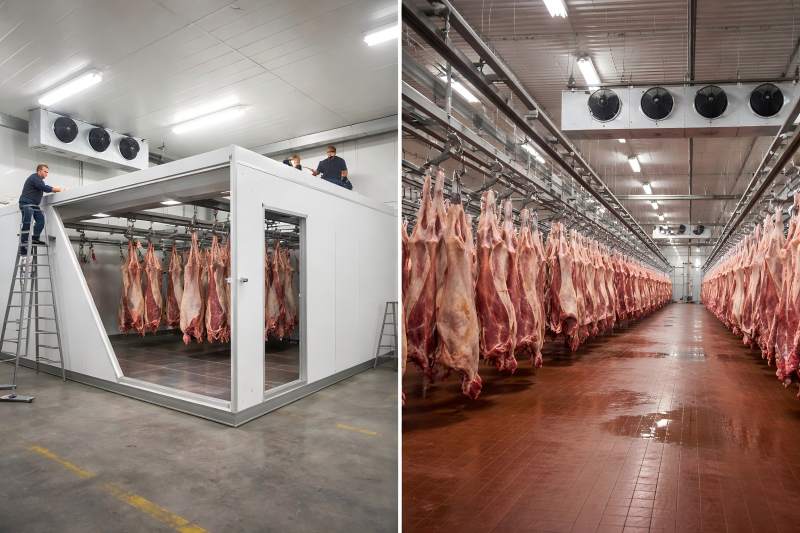
Energy Efficiency and Sustainability
Energy usage represents a significant operational cost in slaughterhouse facilities.
Modular Systems
- High-performance insulation (PU panels)
- Airtight design reduces thermal loss
- Often more energy-efficient in smaller setups
Traditional Systems
- Efficiency varies widely
- Older systems may suffer from heat loss
- Can be optimized with advanced engineering
Verdict
- Modern modular = highly efficient
- Large traditional systems = efficient only if well-designed
Suitability by Abattoir Size
Small Abattoirs
- Limited budget
- Lower throughput
- Need flexibility
Medium Abattoirs
- Growing production
- Need expansion capability
Large Industrial Abattoirs
- High volume processing
- Long-term infrastructure
- Export requirements
Hybrid Approach: The Best of Both Worlds
Many modern slaughterhouses use a hybrid system, combining both technologies:
Modular cold rooms for:
- Pre-cooling
- Processing areas
- Expansion zones
Traditional cold storage for:
- Large freezer warehouses
- Bulk storage
This approach balances:
- Flexibility
- Scalability
- Long-term efficiency
Final Verdict: Which Is Better for Abattoirs?
There is no one-size-fits-all answer—the best choice depends on your operational needs.
Choose Modular Cold Rooms If:
- You need quick installation
- Your operation is small or growing
- Flexibility is a priority
- Budget is limited
Choose Traditional Cold Rooms If:
- You operate a large-scale industrial abattoir
- You need high-volume storage
- Long-term infrastructure is planned
- Custom design is critical
Conclusion
Cold rooms are central to maintaining meat quality, safety, and compliance in abattoirs. Modular and traditional systems both serve this purpose effectively—but in different ways.
- Modular cold rooms offer speed, flexibility, and cost-efficiency
- Traditional cold rooms provide scale, durability, and long-term stability
For many modern slaughterhouses, the smartest solution is not choosing one over the other—but integrating both into a hybrid cold chain system that adapts to current needs while supporting future growth.