
Potatoes need darkness to limit light-induced greening, and ventilation to manage the heat, moisture and gases released by living tubers. In a commercial store, those two requirements must be designed together: opening a door to “give the potatoes air” can introduce light and unsuitable outdoor conditions without delivering useful airflow through the crop.
For a LINBLE potato room, the brief should identify market use, cultivar, storage stage and whether the crop is in bags, bins or bulk. Those details determine the air-distribution arrangement and operating programme far more reliably than a single instruction to keep the room cold.
1. Why Does Darkness Need to Be a Building Detail?
Because light reaches the crop through more routes than the main room lights. Door openings, inspection windows, ventilation openings and poorly enclosed intake areas all deserve attention.
The University of Minnesota’s potato guidance identifies light exposure as the cause of green skin. Greening is a quality and handling concern, so the store should prevent unnecessary exposure rather than rely on sorting it out at dispatch.
Use an opaque envelope and arrange ventilation openings so they do not create a direct light path to the crop. A screened opening may stop insects while still admitting daylight; screening and light exclusion are different design tasks.
Keep lighting adequate for safe occupied work, then control it according to actual use. Darkness during storage should not require staff to inspect equipment or move loads in unsafe conditions.
What Happens at Receiving and Dispatch?
Include those areas in the exposure review. A dark chamber offers limited protection if potatoes wait for hours beneath a bright loading canopy or beside an open doorway.
Batch loading, covered staging and a workable door sequence can reduce exposure while preserving throughput. Select these arrangements around the site’s workflow instead of asking operators to make an impractical door-closing rule work during the busiest hour.
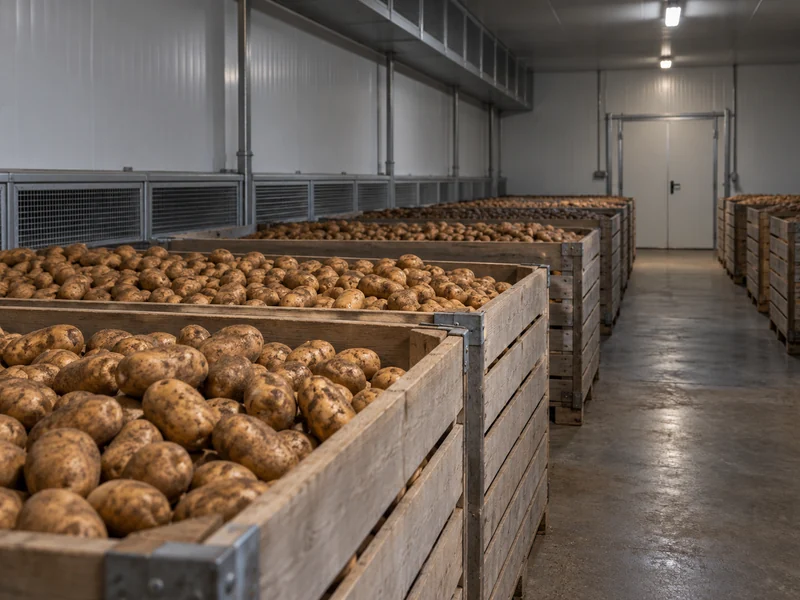
2. Why Must Air Travel Through the Potatoes?
It has to remove heat where the crop produces it. Air circulating around the outside of a dense load may leave the interior warmer than the room sensor suggests.
The University of Idaho’s potato storage ventilation principles connect tuber respiration with heat, moisture and carbon dioxide release. Their central engineering point is distribution: the right quantity of air is useful only when it reaches the stored crop.
Bulk piles, palletised bags and vented bins present different resistance and bypass routes. Select fan duty against the resistance of the proposed ducts and potato load, then check whether the plenum distributes that delivery to the intended crop positions.
- Define the maximum pile depth or bin-stack configuration.
- Identify the intended supply and return paths.
- Account for resistance through the crop and distribution equipment.
- Prevent large gaps from becoming easy bypass routes.
- Locate product probes where warm pockets are most likely.
For a modular store, this may mean reserving space for a plenum or ducts before the insulated-room dimensions are fixed. Those components consume real space and cannot be added to a fully occupied drawing without a consequence.
LINBLE’s explanation of cold room airflow dynamics helps frame the circulation questions. A potato design then needs the crop-specific distribution detail that a general pallet-store illustration cannot supply.
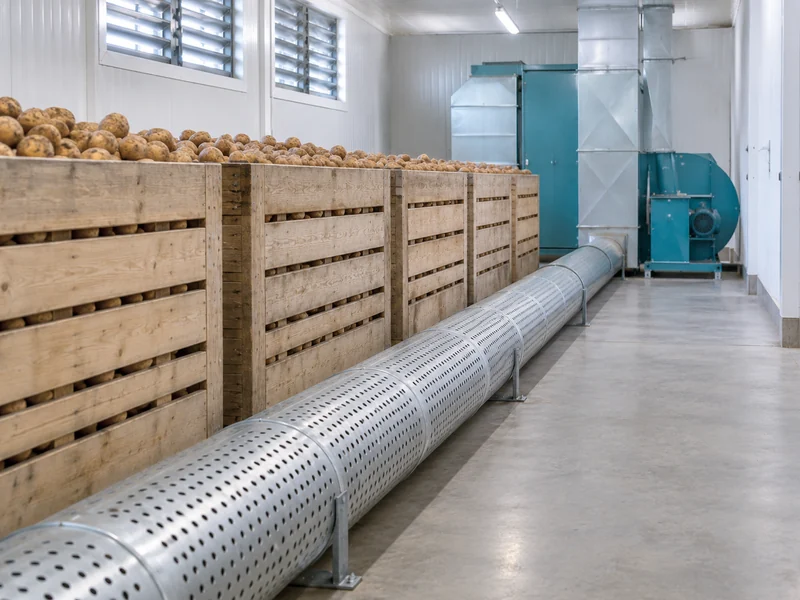
3. Why Is Moisture Removal Different From Drying the Crop?
The aim is to avoid persistent wet surfaces and condensation while limiting unnecessary water loss from sound tubers. Running the maximum fan speed continuously can move the room away from that balance.
At receiving, a wet crop may require a different programme from sound potatoes already settled into long-term holding. Disease, damage and harvest conditions also affect what the storage adviser recommends.
Keep those stages explicit in the control description. “High humidity” does not mean that liquid water should remain on the potatoes or collect on the ceiling above them.
Compare supply-air condition, crop temperatures and condensation locations. If warm moist air meets a colder surface, simply increasing the RH setting will not resolve the underlying temperature relationship.
LINBLE’s humidity-control discussion can support the equipment review. Ask how the selected coil and ventilation programme interact through receiving, curing where applicable, cooling and holding.
4. Why Is Recirculation Different From Fresh-Air Exchange?
Recirculation redistributes conditions within the store; controlled exchange replaces some room air. A fan moving internal air does not, by itself, remove the gases accumulating in that enclosed space.
Conversely, an uncontrolled outside-air opening does not guarantee uniform ventilation through the potatoes. It may introduce air with an unsuitable temperature or moisture content while much of the crop receives little benefit.
Define how fresh air is admitted, mixed and exhausted, including the conditions that enable or limit the exchange. Where gas monitoring is part of the specification, state the measurement location, control response and maintenance requirements.
| Function | Design Question |
| Internal circulation | Does air reach the load evenly at the intended depth and occupancy? |
| Fresh-air exchange | How are gases removed without uncontrolled heat, moisture or light entry? |
| Refrigeration | Can the system remove the crop and building loads under the agreed ventilation programme? |
| Light exclusion | Do doors and ventilation paths preserve darkness when the store is unattended? |
Keep the personnel-entry and occupational-safety assessment separate from crop control. A crop monitoring system should not be assumed to provide every alarm or procedure required for people entering a storage space.
5. Why Does the Potato’s Market Change the Storage Programme?
Fresh-market, processing and seed potatoes are stored for different outcomes. Darkness and ventilation support all three, but their temperature, duration and quality criteria should not be collapsed into one universal recipe.
Processing buyers may be concerned about sugar accumulation and fry colour, while seed storage has different priorities for dormancy and subsequent planting. Cultivar and intended holding duration influence the programme in each case.
A colder setting is therefore not automatically a better setting. The room must be capable of the agreed stages and control range, with the crop specialist or buyer defining the quality requirements it is meant to preserve.
Do not routinely share the potato room with other produce simply because both products fit the same approximate temperature band. Review the handling and compatibility issues described in mixed-produce storage planning before combining flows.
What Changes as the Potato Store Empties?
Air can take an easier route when a bulk store is partly emptied or rows of bins are removed. The fan may continue to deliver its expected volume while a larger share bypasses the remaining potatoes.
Include partial-load arrangements in the distribution plan. Depending on the system, that may involve an approved way to isolate unused ducts, reposition bins or manage gaps without obstructing service access.
Map the remaining crop rather than rely on the original full-room drawing. A probe that represented the centre of a full store may represent an empty aisle after several weeks of dispatch.
For a bin-based LINBLE room, ask how the operator should rebuild the layout as inventory falls. For bulk storage, involve the specialist responsible for the floor ducts and pile geometry so that the room and ventilation proposals remain consistent.
Review the outgoing crop’s condition and the next buyer’s requirements before changing the temperature programme near unloading. A warmer dispatch preparation stage, where prescribed, has different ventilation implications from steady long-term holding.
Keep a short record of crop position, fan operation and measurements through that transition. It can reveal whether a quality difference comes from a particular lot, a changed air path or a handling decision, and it gives the next season’s room review a firmer basis than a recollection that the store worked well until it was almost empty.
How Should These Five Reasons Become a Room Specification?
Turn them into a loading drawing, an air-route drawing and a stage schedule. For each stage, define the crop condition, intended outcome, control method and evidence used to decide when to move on.
For the enclosure, select insulated panels with the complete building arrangement in mind, including penetrations, doors and the local climate. Thermal performance, light exclusion and air-distribution access need to coexist in the final detail.
A LINBLE enquiry for a potato and vegetable cold room should include crop tonnage, market use, cultivar, package or pile geometry, intake condition and utilities. Ask the proposal to show usable crop capacity after ducts, access and service clearances are deducted.
During the first representative load, compare temperatures within the crop, inspect condensation-prone areas and verify the ventilation sequence. The result should be a store that keeps potatoes dark and evenly managed without depending on open doors or improvised fan operation.