
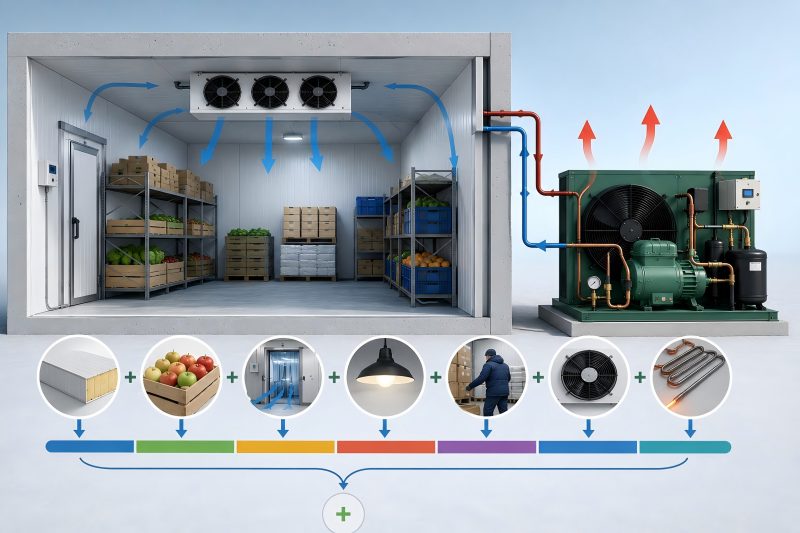
Cold room condensing unit capacity calculation is based on total cooling load. This includes heat from walls, products, air infiltration, lighting, people, fans, equipment, and defrosting. After calculating these loads, a suitable safety factor should be added.
For simple cold storage projects, estimated capacity tables may help with preliminary selection. However, for commercial and industrial cold rooms, a detailed heat load calculation is strongly recommended.
What Is Cold Room Condensing Unit Capacity?
Cold room condensing unit capacity refers to the refrigeration capacity needed to remove heat from the cold room. It is usually expressed in:
- kW
- W
- BTU/h
- HP
In refrigeration design, capacity means how much heat the system can remove within a certain period. A cold room does not “create cold.” Instead, it removes heat from the room, stored products, air, walls, lights, people, and equipment.
The condensing unit must have enough capacity to remove all these heat loads and maintain the required storage temperature.
Why Capacity Calculation Is Important
Correct capacity calculation helps the cold room operate efficiently and reliably.
A properly calculated condensing unit can:
- Maintain stable storage temperature
- Reduce compressor running time
- Lower power consumption
- Protect stored products from spoilage
- Extend compressor service life
- Reduce system breakdowns
- Improve overall refrigeration performance
Incorrect sizing can cause serious problems. An undersized unit may run continuously but still fail to cool the room. An oversized unit may cool too quickly, stop frequently, and increase compressor wear.
Main Heat Loads in a Cold Room
To calculate condensing unit capacity, you need to understand the main sources of heat entering the cold room.
Transmission Load
Transmission load is the heat that enters through the cold room walls, ceiling, floor, and doors. It depends on insulation quality, panel thickness, room size, and temperature difference between inside and outside.
For example, a cold room at 0°C in a 35°C environment has a larger temperature difference than a room at 8°C in a 25°C environment. Therefore, it needs more cooling capacity.
Important factors include:
- Wall, ceiling, and floor area
- Insulation panel thickness
- Insulation material
- Ambient temperature
- Required room temperature
Product Load
Product load is the heat removed from products stored inside the cold room. It strongly affects the required cooling capacity.
If products enter the cold room at a high temperature, the refrigeration system must remove more heat. For example, cooling fresh vegetables from 25°C to 4°C requires much more capacity than storing vegetables that are already pre-cooled.
Product load depends on:
- Product type
- Product weight
- Initial product temperature
- Final storage temperature
- Daily loading quantity
- Required cooling time
Cold rooms used for product cooling need more capacity than cold rooms used only for storage.
Air Infiltration Load
Air infiltration load is caused by warm air entering the cold room when the door opens. This is common in restaurants, supermarkets, food factories, and distribution centers.
The more often the door opens, the greater the cooling load.
Factors affecting air infiltration include:
- Door size
- Door opening frequency
- Door opening duration
- Indoor and outdoor temperature difference
- Use of strip curtains or air curtains
Good door management can significantly reduce cooling loss.
Internal Load
Internal load is generated by equipment, lights, and activity inside. Common internal heat sources include:
- Lighting
- Evaporator fan motors
- Workers
- Forklifts or handling equipment
- Electrical devices
- Defrost heaters
For small cold rooms, internal load may be relatively low. For large industrial cold rooms, it can become an important part of total load calculation.
Defrost Load
Freezer rooms usually need regular evaporator defrosting. Electric defrost heaters add heat into the cold room, so this heat must also be considered.
Defrost load is especially important for:
- Freezer rooms
- Low-temperature storage
- High-humidity applications
- Seafood cold rooms
- Meat freezing rooms
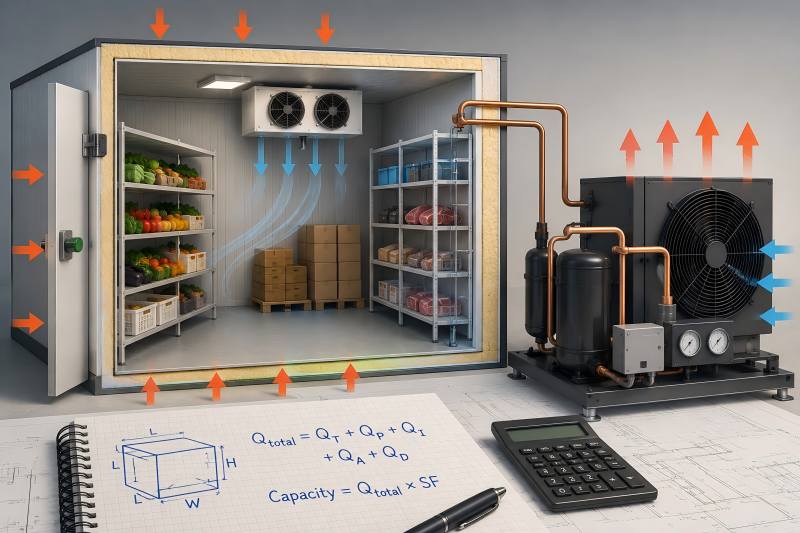
Basic Formula for Cold Room Capacity Calculation
A simplified cold room cooling load calculation can be expressed as:
Total Cooling Load = Transmission Load + Product Load + Air Infiltration Load + Internal Load + Defrost Load
After calculating the total cooling load, a safety factor is usually added.
Required Condensing Unit Capacity = Total Cooling Load × Safety Factor
The safety factor is commonly 1.1 to 1.3, depending on project conditions.
For example, if the calculated total cooling load is 8 kW and the safety factor is 1.2:
Required Capacity = 8 kW × 1.2 = 9.6 kW
In this case, a condensing unit with about 10 kW cooling capacity may be considered.
Step-by-Step Calculation Method
Step 1: Calculate Cold Room Volume
First, calculate the internal volume of the cold room.
Volume = Length × Width × Height
| Item | Value |
| Length | 5 m |
| Width | 4 m |
| Height | 2.5 m |
| Volume | 50 m³ |
Example:
So the cold room volume is:
5 × 4 × 2.5 = 50 m³
Cold room volume is useful for preliminary selection, but it is not enough for accurate sizing.
Step 2: Confirm Storage Temperature
Different products require different temperature ranges.
| Application | Common Temperature Range |
| Fruits and vegetables | 2°C to 8°C |
| Dairy products | 2°C to 6°C |
| Fresh meat | 0°C to 4°C |
| Beverages | 2°C to 8°C |
| Frozen food | -18°C to -25°C |
| Ice cream | -22°C to -30°C |
| Pharmaceuticals | 2°C to 8°C |
Lower temperature means higher cooling demand. A freezer room needs more capacity than a chiller room of the same size.
Step 3: Estimate Transmission Load
Transmission load depends on the temperature difference and insulation performance.
A simple way to estimate it is:
Transmission Load = Surface Area × Heat Transfer Rate × Temperature Difference
For practical project estimation, many suppliers use experience-based values according to panel thickness and room temperature.
General panel thickness reference:
| Cold Room Type | Suggested Panel Thickness |
| Chiller room, 0°C to 10°C | 75 mm to 100 mm |
| Freezer room, -18°C to -25°C | 100 mm to 150 mm |
| Low-temperature freezer | 150 mm or thicker |
Better insulation reduces transmission load and lowers energy consumption.
Step 4: Calculate Product Load
Product load can be estimated by:
Product Load = Product Weight × Specific Heat × Temperature Drop ÷ Cooling Time
For example:
| Item | Value |
| Product | Fresh fruit |
| Daily loading weight | 1,000 kg |
| Initial temperature | 25°C |
| Storage temperature | 5°C |
| Temperature drop | 20°C |
| Cooling time | 24 hours |
If the product has high water content, it may require more cooling energy. For frozen products, the calculation is more complex because it also includes freezing heat and latent heat.
In many cold room projects, product load is the main reason why two rooms of the same size may need different condensing unit capacities.
Step 5: Estimate Air Infiltration Load
Door opening can greatly increase cooling demand.
| Door Usage | Cooling Load Impact |
| Low frequency | Small impact |
| Medium frequency | Moderate impact |
| High frequency | Large impact |
| Door left open often | Very large impact |
For high-traffic cold rooms, extra capacity should be considered. Installing strip curtains, air curtains, self-closing doors, or fast doors can reduce air infiltration.
Step 6: Add Internal Load
Internal load includes heat from lights, people, fans, and equipment.
A basic estimate can include:
| Source | Example |
| Lighting | LED lights inside cold room |
| Workers | Heat from people during loading |
| Fans | Evaporator fan motor heat |
| Equipment | Forklifts, carts, electrical devices |
Although these loads may seem small, they add up in larger rooms or busy facilities.
Step 7: Add Safety Factor
After calculating all heat loads, add a safety factor.
| Project Condition | Suggested Safety Factor |
| Stable storage, low door opening | 1.1 |
| Normal commercial use | 1.15 to 1.2 |
| Frequent loading or hot climate | 1.2 to 1.3 |
| Heavy-duty industrial use | Project-specific calculation required |
The safety factor helps the system handle real operating conditions. Too much margin may cause short cycling and unstable humidity control.
Example Calculation
Assume a cold room is used for fruit storage.
| Item | Value |
| Cold room size | 5 m × 4 m × 2.5 m |
| Volume | 50 m³ |
| Storage temperature | 2°C to 8°C |
| Ambient temperature | 35°C |
| Product | Fresh fruit |
| Daily loading | 1,000 kg |
| Door opening | Medium frequency |
| Panel thickness | 100 mm |
Estimated heat loads:
| Heat Load Type | Estimated Load |
| Transmission load | 1.5 kW |
| Product load | 3.5 kW |
| Air infiltration load | 1.0 kW |
| Internal load | 0.5 kW |
| Defrost/load allowance | 0.3 kW |
| Total load | 6.8 kW |
Add safety factor:
6.8 kW × 1.2 = 8.16 kW
So, the recommended condensing unit capacity may be around 8 kW to 9 kW, depending on compressor model, refrigerant, evaporating temperature, and ambient condition.
This is only a simplified example. The final selection should be confirmed by a professional refrigeration engineer or supplier.
Capacity Conversion Reference
Condensing unit capacity may be shown in different units.
| Unit | Approximate Conversion |
| 1 kW | 3,412 BTU/h |
| 1 HP | About 0.75 kW motor power |
| 1 refrigeration ton | About 3.517 kW |
| 1 refrigeration ton | About 12,000 BTU/h |
It is important to note that compressor horsepower is not the same as cooling capacity. A 3 HP condensing unit does not always mean 2.25 kW cooling capacity. Actual refrigeration capacity depends on operating conditions, refrigerant, compressor model, evaporating temperature, and condensing temperature.
Common Capacity Selection Mistakes
Choosing Only by Room Size
Cold room volume is only one factor. Product load, door opening, ambient temperature, and insulation also matter.
Ignoring Product Loading Temperature
If warm products are placed into the room every day, capacity must be increased. Otherwise, the room may cool too slowly.
Oversizing Too Much
A larger unit is not always better. Oversizing may cause frequent start-stop operation, unstable temperature, and higher equipment cost.
Ignoring Ambient Temperature
A condensing unit installed in a hot or poorly ventilated place will have lower performance. Installation environment must be considered.
Confusing HP with Cooling Capacity
HP is not a direct measure of refrigeration capacity. Always check the cooling capacity under actual working conditions.
Practical Tips for Better Capacity Design
To improve cold room performance, consider these tips:
- Use proper insulation panel thickness
- Reduce unnecessary door opening
- Install strip curtains or air curtains
- Choose high-efficiency evaporator fans
- Keep condenser coils clean
- Ensure good ventilation around the condensing unit
- Use a reliable temperature controller
- Match the evaporator and condensing unit correctly
- Consider future storage expansion
- Work with an experienced refrigeration supplier
Good design is not only about choosing a bigger unit. It is about balancing cooling capacity, energy efficiency, installation conditions, and operating cost.