
Cold rooms are one of the most critical components in any slaughterhouse, directly affecting meat safety, product quality, and operational efficiency. Proper sizing is essential—not only to handle production volume but also to ensure correct airflow, temperature control, and hygiene compliance.
Cold rooms in slaughterhouses are mainly utilized for:
- Carcass chilling
- Short-term storage
- Freezing and long-term storage
Fresh carcasses must be cooled from around 37°C to below 4°C within 24 hours to prevent bacterial growth and maintain quality . Therefore, cold room capacity must match processing throughput and cooling timelines.
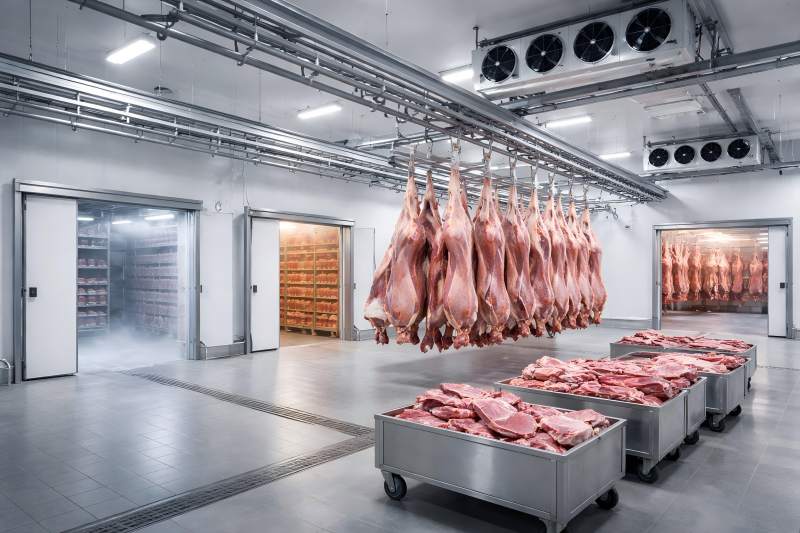
Cold Room Functions in Slaughterhouses
Before calculating size, it’s essential to understand the types of cold rooms used:
Main Cold Room Types
| Cold Room Type | Function | Typical Temperature |
| Chilling Room | Rapid cooling after slaughter | 0°C to 4°C |
| Holding Cooler | Short-term storage | 0°C to 4°C |
| Freezing Room | Rapid freezing | -25°C to -40°C |
| Frozen Storage | Long-term storage | ≤ -18°C |
- Chilling rooms reduce carcass temperature quickly to inhibit bacteria
- Frozen storage preserves meat for months at -18°C or below
- Proper humidity (85–90%) prevents dehydration and weight loss
Key Factors Affecting Cold Room Size
Cold room sizing is not random—it depends on several operational variables.
Slaughter Capacity
The daily processing capacity determines how much meat must be cooled and stored simultaneously.
Typical categories:
| Slaughterhouse Type | Capacity (Animals/Day) |
| Small | 5 – 50 |
| Medium | 50 – 300 |
| Large | 300 – 2000+ |
Carcass Weight
Different animals produce different storage requirements:
| Animal Type | Average Carcass Weight (kg) |
| Chicken | 1.5 – 2.5 |
| Sheep/Lamb | 15 – 25 |
| Pig | 70 – 100 |
| Cattle | 250 – 400 |
Chilling Time Requirement
- Meat must reach ≤7°C core temperature within 24 hours
- This means cold rooms must hold at least one full day’s production, often more.
Hanging vs Stacked Storage
- Carcasses are usually hung on rails
- Spacing requirements:
- Minimum 15 cm between carcasses
- Hook spacing ~30 cm
This significantly affects space utilization.
Airflow and Clearance
Proper air movement is crucial:
- Air velocity is typically 5–2 m/s
- Adequate spacing ensures uniform cooling
Storage Duration
| Storage Type | Duration | Impact on Size |
| Immediate processing | 0–1 day | Smaller |
| Short-term storage | 2–5 days | Medium |
| Long-term frozen | Weeks–months | Large |
General Rules for Cold Room Size Planning
When planning slaughterhouse cold rooms, practical guidelines greatly enhance sizing accuracy and efficiency. These rules help ensure that the facility can handle production demands while maintaining proper cooling performance and food safety standards.
Capacity Buffer Rule
Cold room capacity should always exceed daily production volume. In most cases, planners recommend designing for 1.2 to 2 times the daily slaughter capacity. This buffer accounts for delays in transportation, peak production days, and operational inefficiencies. Without sufficient buffer space, overcrowding can occur, leading to poor airflow and uneven cooling.
Space per Carcass Guideline
Each type of animal requires a specific amount of space due to differences in size and hanging methods. For example, cattle need significantly more room than pigs or sheep. Proper spacing ensures that cold air can circulate freely around each carcass, which is essential for uniform chilling and preventing spoilage.
Vertical Space Utilization
Ceiling height plays a critical role in maximizing storage capacity. Small facilities typically use 3–4 meters, while larger industrial plants may use 5–8 meters or more. Higher ceilings allow for multi-level rail systems and improved airflow distribution, increasing overall efficiency without expanding floor area.
Zoning Instead of Single Space
Rather than relying on one large cold room, it is more effective to divide the facility into multiple functional zones—such as pre-chilling, chilling, and storage areas. This approach improves workflow, reduces temperature fluctuations, and enhances hygiene control.
Allowance for Airflow and Access
Adequate spacing between carcasses, walls, and equipment is essential. Space must also be reserved for worker movement and maintenance access. Ignoring these factors often results in reduced usable capacity and compromised cooling performance.
Key Factors Affecting Cold Room Size
Cold room sizing in slaughterhouses is not a simple estimation—it requires a comprehensive understanding of operational, biological, and engineering factors. Each variable directly influences not only the total storage area but also the efficiency of cooling, product safety, and long-term operational costs.
Below are the most critical factors explained in detail:
Slaughter Capacity
Daily processing volume is the key factor determining required cold room capacity:
- Chilled within a limited time window
- Stored before distribution
- Possibly frozen for long-term preservation
Practical Insight
If a facility processes:
- 100 cattle/day → the cold room must accommodate 100–200 carcasses simultaneously
- Seasonal demand spikes (e.g., holidays) may require additional buffer
Key Recommendation
Always design cold room capacity based on:
- Maximum daily throughput, not average
Carcass Size and Weight
Different animals require vastly different storage space due to:
- Physical size
- Hanging method
- Cooling characteristics
Space Impact by Animal Type
| Animal | Weight Range (kg) | Space Requirement | Storage Type |
| Chicken | 1.5 – 2.5 | Very low | Crates/racks |
| Sheep | 15 – 25 | Moderate | Hanging |
| Pig | 70 – 100 | Medium | Hanging |
| Cattle | 250 – 400 | High | Hanging |
Practical Insight
Even if two plants process the same number of animals:
- A cattle plant may need 3–4× more spacethan a poultry plant
Chilling Time and Cooling Rate
Freshly slaughtered meat must be cooled rapidly to prevent bacterial growth.
Industry Requirement
- Core temperature must drop from ~37°C to ≤4–7°C within 24 hours
Impact on Cold Room Size
This requirement creates a time-based bottleneck:
- All carcasses processed in one day must remain in the chilling room simultaneously
- Slow cooling = longer occupancy = larger room needed
Additional Considerations
- High-density loading slows down cooling
- Poor airflow increases chilling time
Key Insight
Faster chilling systems (e.g., blast chilling):
- Reduce required space
- Increase throughput efficiency
Storage Duration
How long meat stays in the cold room significantly impacts total capacity.
Typical Storage Scenarios
| Storage Type | Duration | Space Requirement |
| Immediate dispatch | <24 hours | Low |
| Short-term storage | 2–5 days | Medium |
| Frozen storage | Weeks–months | High |
Example
- 100 animals/day × 3 days storage = 300 carcass capacity required
Key Recommendation
Always align cold room size with:
- Logistics capability
- Market demand cycles
Hanging System and Layout Design
Most slaughterhouses use overhead rail systems to hang carcasses.
Space Requirements
- Minimum spacing between carcasses: ~15 cm
- Hook spacing: ~30 cm
- Clearance from walls: ≥30 cm
Layout Types
- Single rail system → simple but less efficient
- Double rail system → higher density
- Multi-level rails → used in large facilities
Practical Insight
Efficient rail design can:
- Increase capacity by 20–30%
- Improve workflow and hygiene
Airflow and Ventilation Requirements
Consistent air circulation ensures even temperature distribution throughout the cold room. Key Parameters
- Air velocity: typically 0.5–2 m/s
- Even airflow distribution across all carcasses
Design Implications
Cold rooms must include:
- Adequate spacing between rows
- Proper evaporator placement
- Air return pathways
Key Insight
Airflow design often determines:
- Whether a cold room performs efficiently or fails
Cold Room Function (Chilling vs Freezing vs Storage)
Different cold room types require different sizes due to operational roles.
Comparison
| Room Type | Function | Space Impact |
| Chilling Room | Rapid cooling | Large |
| Holding Room | Temporary storage | Medium |
| Freezing Room | Quick freezing | Compact but powerful |
| Frozen Storage | Long-term storage | Large |
Operational Workflow and Processing Speed
Production line efficiency directly influences the required cold room capacity and size.
Key Factors
- Slaughter speed (animals/hour)
- Loading/unloading time
- Labor efficiency
Practical Insight
Automation (e.g., conveyor rails):
- Reduces bottlenecks
- Improves space utilization
Future Expansion and Safety Buffer
Many slaughterhouses underestimate future growth.
Recommended Buffer
- Add 20%–30% extra capacity
Practical Insight
Modular cold rooms allow:
- Easy expansion
- Lower long-term costs
Regulatory and Hygiene Requirements
Food safety standards influence cold room size and layout.
Requirements May Include
- Separation of clean and dirty zones
- Minimum spacing between carcasses
- Temperature control compliance
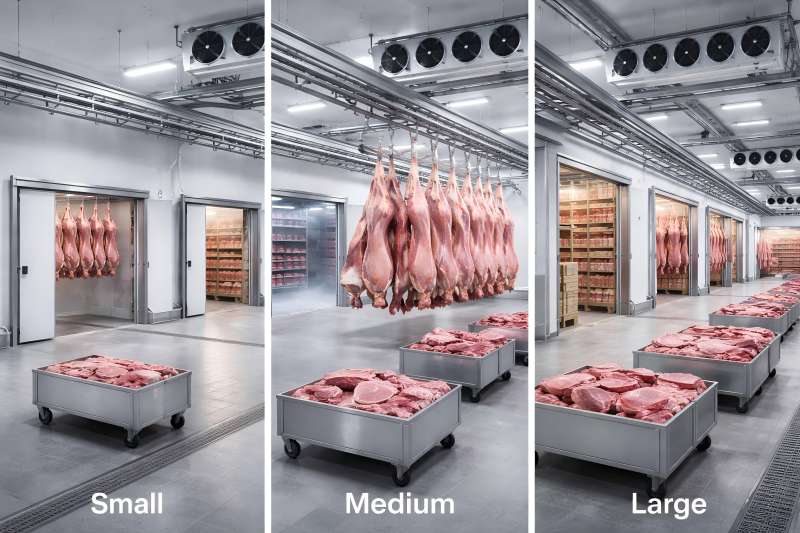
Cold Room Size Calculation for Small Slaughterhouses
Typical Characteristics
- Capacity: 5–50 animals/day
- Limited automation
- Mostly local distribution
Example Scenario
Case: Small cattle slaughterhouse
- 20 cattle/day
- Average weight: 300 kg
Space Estimation
| Parameter | Value |
| Carcasses per day | 20 |
| Space per carcass | 2 m² |
| Required area | 40 m² |
| With buffer (1.5×) | 60 m² |
Recommended Cold Room Layout
| Room Type | Suggested Size |
| Chilling Room | 40–60 m² |
| Small Freezer | 10–20 m² |
| Total | 50–80 m² |
Key Design Tips
- Use compact walk-in coolers
- Combine functions (chilling + storage)
- Use Freon systems (cost-effective for small scale)
Cold Room Size Calculation for Medium Slaughterhouses
Typical Characteristics
- Capacity: 50–300 animals/day
- Mixed species (cattle + pigs + sheep)
- Regional distribution
Example Scenario
Case: Mixed livestock plant
- 100 pigs/day
- 50 cattle/day
Space Estimation
| Animal | Quantity | Space per Unit | Total Space |
| Cattle | 50 | 2 m² | 100 m² |
| Pigs | 100 | 1 m² | 100 m² |
| Total | — | — | 200 m² |
| With buffer (1.5×) | — | — | 300 m² |
Recommended Cold Room Distribution
| Room Type | Area |
| Pre-chilling | 100 m² |
| Main chilling | 150 m² |
| Storage | 100 m² |
| Freezing | 50–100 m² |
| Total | 350–450 m² |
Design Considerations
- Separate zones for hygiene control
- Rail systems for carcass movement
- Improved airflow systems
Cold Room Size Calculation for Large Slaughterhouses
Typical Characteristics
- Capacity: 300–2000+ animals/day
- High automation
- Export-oriented
Example Scenario
Case: Industrial beef plant
- 500 cattle/day
Space Estimation
| Parameter | Value |
| Carcasses/day | 500 |
| Space per carcass | 2 m² |
| Base area | 1000 m² |
| With buffer (2×) | 2000 m² |
Recommended Layout
| Room Type | Area |
| Rapid chilling (blast) | 500–800 m² |
| Main chilling | 800–1200 m² |
| Storage | 800–1500 m² |
| Freezing | 500–1000 m² |
| Total | 2600–4000 m² |
Industrial Design Features
- Multi-room modular layout
- Ammonia refrigeration systems (high efficiency)
- Automated rail systems
- Zoned airflow management
Comparative Overview: Small vs Medium vs Large
| Parameter | Small | Medium | Large |
| Capacity (animals/day) | 5–50 | 50–300 | 300–2000+ |
| Cold room size | 50–80 m² | 350–450 m² | 2600–4000 m² |
| Cooling system | Freon | Mixed | Ammonia |
| Automation | Low | Medium | High |
| Layout | Single room | Multi-zone | Multi-stage |