
A chiller room is used to keep products at a controlled low temperature before processing, storage, or distribution. Correctly calculating chiller room size and cooling capacity is important because an undersized room may fail to maintain temperature, while an oversized system increases investment cost and energy consumption.
This guide explains how to calculate chiller room dimensions, storage volume, product capacity, and refrigeration capacity step by step.
Basic Purpose of the Chiller Room
Before calculating the size, you need to know what the chiller room will store. Different products require different temperatures, storage density, airflow, and cooling speed.
Common chiller room applications include:
- Food storage
- Meat and seafood chilling
- Fruit and vegetable storage
- Dairy product storage
- Beverage storage
- Pharmaceutical storage
- Processing plant temporary storage
- Hotel, restaurant, or supermarket cold storage
A chiller room is usually designed for temperatures above freezing, commonly between 0°C and 10°C.
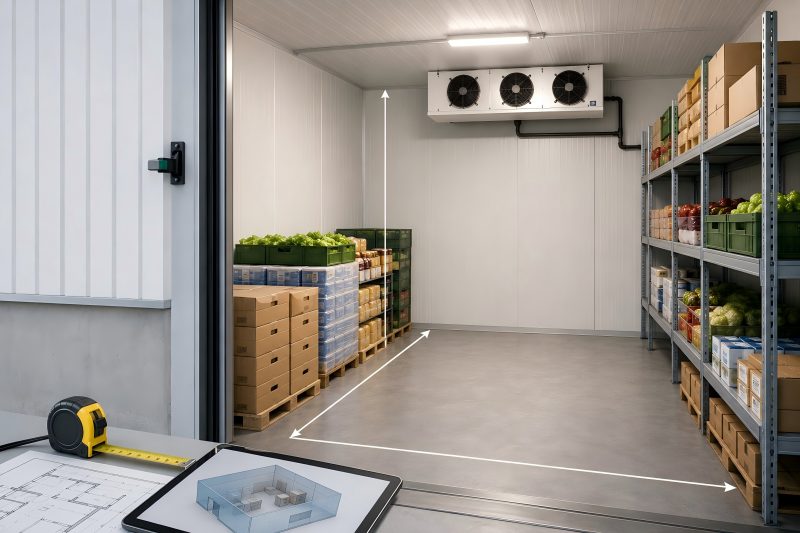
Key Factors That Affect Chiller Room Size
Chiller room size is not only about floor area. It depends on product quantity, storage method, air circulation, loading frequency, and future expansion needs.
Main factors include:
- Type of product
- Daily storage volume
- Maximum storage quantity
- Storage temperature
- Incoming product temperature
- Required cooling time
- Pallet size or shelf layout
- Worker access space
- Door opening frequency
- Insulation thickness
- Ambient temperature
- Refrigeration equipment efficiency
For example, a vegetable chiller room may need more airflow and humidity control, while a meat chiller room may require faster temperature pull-down.
Step 1: Calculate Required Storage Capacity
The first step is to determine how much product the chiller room needs to store at one time.
Basic formula:
Required Storage Capacity = Daily Product Volume × Storage Days
Example:
If a food factory stores 2 tons of product per day and needs 3 days of storage, then:
2 tons/day × 3 days = 6 tons
So the chiller room should be designed to store at least 6 tons of product.
It is also common to add a safety margin of 10%–20% for peak seasons or unexpected storage needs.
Step 2: Estimate Storage Density
Storage density means how much product can be stored in each cubic meter of chiller room space. It depends on product type and storage method.
Common Storage Density Reference
| Product Type | Typical Storage Density | Notes |
| Fresh vegetables | 250–400 kg/m³ | Requires good airflow |
| Fruits | 300–500 kg/m³ | Avoid overstacking |
| Meat products | 350–600 kg/m³ | Often stored in cartons or racks |
| Seafood | 400–700 kg/m³ | May require ice or boxes |
| Dairy products | 350–550 kg/m³ | Stable temperature needed |
| Beverages | 500–800 kg/m³ | High-density storage possible |
| Packaged food | 400–650 kg/m³ | Depends on carton size |
For general packaged food storage, a practical estimate is often 400–600 kg/m³.
Step 3: Calculate Chiller Room Volume
After confirming storage quantity and density, you can calculate the required room volume.
Formula:
Room Volume = Product Weight ÷ Storage Density
Example:
A factory needs to store 6,000 kg of packaged food.
Assume storage density is 500 kg/m³.
6,000 ÷ 500 = 12 m³
This means the usable storage volume should be at least 12 m³.
However, this only shows usable storage volume. You still need to add space for:
- Air circulation
- Shelves or pallets
- Walkways
- Door opening area
- Evaporator space
- Operation space
A common design factor is to multiply the net storage volume by 1.3 to 1.8, depending on layout.
If using a factor of 1.5:
12 m³ × 1.5 = 18 m³
So the actual chiller room volume should be about 18 m³.
Step 4: Decide Room Dimensions
Once the total room volume is known, you can decide the length, width, and height.
Formula:
Room Volume = Length × Width × Height
Example:
If the required room volume is 18 m³, one possible design is:
3 m × 3 m × 2 m = 18 m³
However, a height of 2 m may be too low for some operations. A more practical design may be:
3 m × 2.5 m × 2.4 m = 18 m³
When designing dimensions, consider:
- Pallet size
- Forklift or trolley access
- Shelf height
- Evaporator installation space
- Product loading direction
- Drainage and cleaning needs
For commercial and industrial use, the room height is often between 2.4 m and 4.5 m.
Step 5: Calculate Refrigeration Capacity
Chiller room size determines the space, but cooling capacity determines whether the room can maintain the target temperature.
Cooling capacity is affected by several heat loads:
- Heat entering through walls, ceiling, and floor
- Heat from warm products
- Heat from door openings
- Heat from workers
- Heat from lights and equipment
- Heat from fans and evaporators
- Heat from air infiltration
The total cooling load can be estimated as:
Total Cooling Load = Transmission Load + Product Load + Air Infiltration Load + Internal Load + Safety Factor
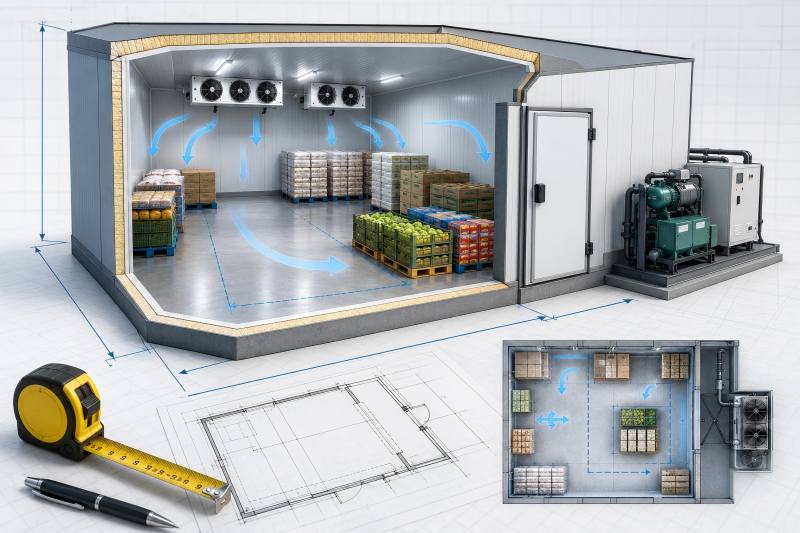
Main Cooling Load Sources
Transmission Load
This is heat entering through insulated panels.
It depends on:
- Room surface area
- Insulation thickness
- Temperature difference
- Panel material
- Ambient temperature
Better insulation reduces heat gain and lowers energy consumption.
Product Load
This is the heat removed from products when they enter the chiller room.
For example, if vegetables enter at 25°C and need to be cooled to 5°C, the refrigeration system must remove that heat within the required cooling time.
Product load is often the largest part of the total cooling capacity.
Air Infiltration Load
Warm air enters through open doors. This depends on:
- Door size
- Door opening frequency
- Loading method
- Use of air curtains or strip curtains
- Worker traffic
Frequent loading requires higher cooling capacity.
Internal Load
Internal heat comes from:
- Lighting
- Workers
- Motors
- Fans
- Packaging equipment
- Forklifts or trolleys
Although smaller than product load, internal load should not be ignored.
Quick Cooling Capacity Estimate
For early planning, you can use a simple estimate based on room volume. This is not a final engineering design, but it helps with budget planning.
Rough Chiller Room Capacity Reference
| Chiller Room Volume | Typical Cooling Capacity | Suitable Application |
| 10–20 m³ | 1.5–3 kW | Small restaurant or retail storage |
| 20–50 m³ | 3–6 kW | Food shop, small factory storage |
| 50–100 m³ | 6–12 kW | Medium food processing storage |
| 100–200 m³ | 12–25 kW | Industrial cold storage |
| 200–500 m³ | 25–60 kW | Large warehouse or processing plant |
For accurate selection, product load and operating conditions must be calculated separately.
Example Calculation
Suppose a food processing company needs a chiller room for packaged vegetables.
Basic data:
- Product quantity: 5,000 kg
- Storage time: 2 days
- Storage temperature: 5°C
- Incoming product temperature: 20°C
- Storage density: 350 kg/m³
- Room height: 2.8 m
Step 1: Calculate Storage Volume
5,000 kg ÷ 350 kg/m³ = 14.3 m³
Step 2: Add Space Factor
Assume 1.6 space factor for airflow and access.
14.3 × 1.6 = 22.9 m³
So the chiller room should be around 23 m³.
Step 3: Choose Dimensions
Possible size:
3.5 m × 2.5 m × 2.8 m = 24.5 m³
This size is close to the required volume and allows space for shelves or pallet storage.
Step 4: Estimate Cooling Capacity
From the rough reference table, a room of about 25 m³ may need around 3–5 kW of cooling capacity.
If products enter warm and need fast cooling, the system may need a higher capacity, such as 5–7 kW.
Chiller Room Size Planning Table
Example Room Size by Product Quantity
| Product Quantity | Estimated Room Volume | Example Room Size | Suggested Use |
| 1 ton | 4–8 m³ | 2 m × 2 m × 2 m | Small food storage |
| 3 tons | 10–18 m³ | 3 m × 2.5 m × 2.4 m | Restaurant or small factory |
| 5 tons | 18–30 m³ | 3.5 m × 3 m × 2.8 m | Food processing storage |
| 10 tons | 35–60 m³ | 5 m × 4 m × 3 m | Medium industrial storage |
| 20 tons | 70–120 m³ | 8 m × 5 m × 3 m | Large processing plant |
Actual size may change depending on product density, packaging, rack layout, and airflow requirements.
Important Design Tips
Keep Enough Air Circulation Space
Do not fill the room completely. Cold air must circulate around products. Poor airflow can cause uneven temperature, hot spots, and product spoilage.
Leave space between:
- Product and wall
- Product and ceiling
- Product and evaporator
- Product stacks
- Pallets and door area
Consider Loading Frequency
If the door opens often, heat gain increases. For busy operations, consider:
- Fast-opening doors
- Strip curtains
- Air curtains
- Separate loading areas
- Larger refrigeration capacity
Choose Proper Insulation Thickness
For chiller rooms, common insulation panel thickness is usually 75 mm to 100 mm. For lower temperatures or hot environments, thicker panels may be needed.
Good insulation helps reduce compressor running time and electricity cost.
Plan for Future Expansion
If your production volume may increase, design the chiller room slightly larger or reserve space for expansion. Rebuilding a cold room later can be more expensive than planning ahead.
Common Mistakes in Chiller Room Sizing
Many chiller room problems come from poor early calculation.
Common mistakes include:
- Only calculating floor area, not room volume
- Ignoring product incoming temperature
- Underestimating door opening frequency
- Choosing refrigeration units only by room size
- Not leaving enough airflow space
- Using poor insulation panels
- Overloading shelves or pallets
- Ignoring future storage growth
- Installing evaporators in the wrong position
These mistakes can lead to unstable temperature, high energy use, compressor overload, product damage, and higher maintenance costs.