
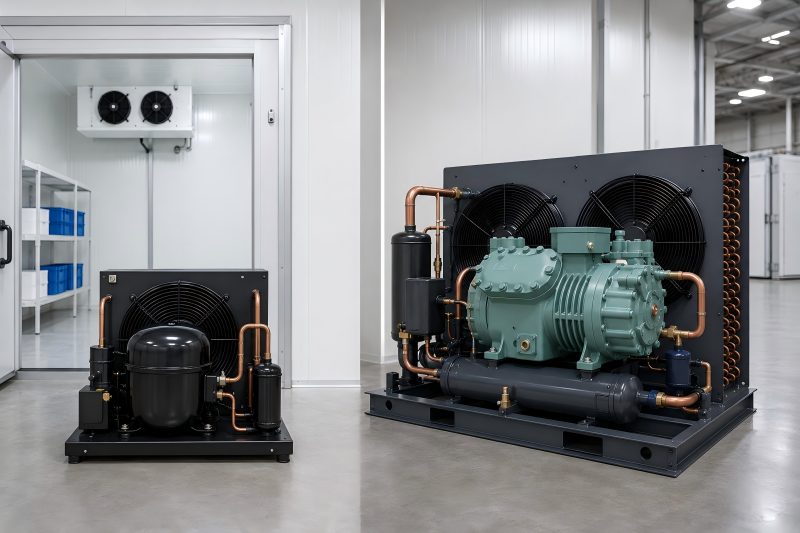
A hermetic condensing unit is better for small cold rooms, light commercial refrigeration, compact installation, and budget-sensitive projects.
A semi-hermetic condensing unit is better for medium and large cold rooms, freezer rooms, industrial refrigeration, and heavy-duty applications. It costs more at the beginning, but it offers higher capacity, better serviceability, and stronger long-term reliability.
In simple terms:
Choose hermetic for small, simple, low-cost cold room projects.
Choose semi-hermetic for larger, demanding, long-term cold storage projects.
What Is a Hermetic Condensing Unit?
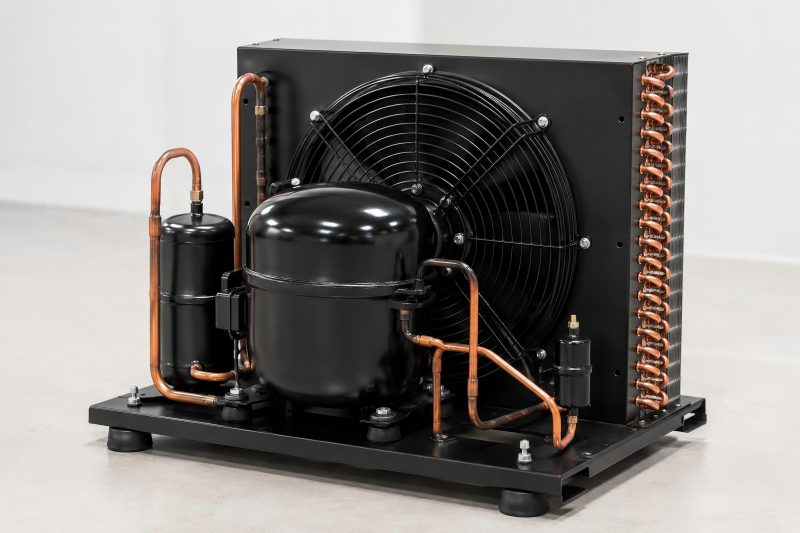
A hermetic condensing unit uses a hermetic compressor. In this design, the motor and compressor are sealed inside a welded steel shell. The compressor body cannot normally be opened for internal repair. If the compressor fails seriously, it is usually replaced as a complete unit instead of being repaired internally.
Hermetic condensing units are common in small and medium refrigeration systems. They are often used in small cold rooms, display cabinets, beverage coolers, refrigerators, and light commercial refrigeration equipment.
The main idea behind the hermetic design is simplicity. Since the compressor is fully sealed, the risk of refrigerant leakage is relatively low. The structure is compact, the cost is usually lower, and installation is easier.
| Pros | Cons |
| Lower initial cost | Internal parts are not easy to repair |
| Compact structure | Usually replaced when compressor fails |
| Lower refrigerant leakage risk | Limited capacity range |
| Simple installation | Not ideal for large cold rooms |
| Good for small cold rooms | May not handle heavy-duty continuous operation well |
| Lower noise in many small systems | Less flexible for long-term maintenance |
| Easy replacement | Shorter practical service life in demanding applications |
What Is a Semi-Hermetic Condensing Unit?
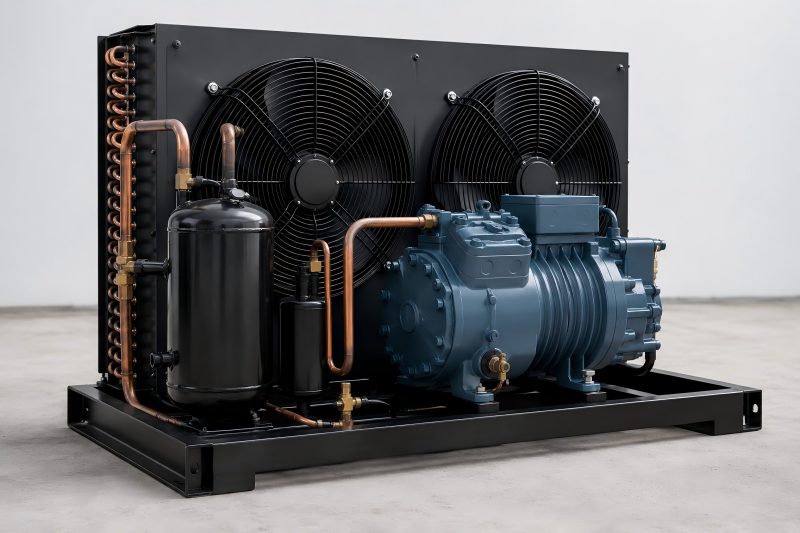
A semi-hermetic condensing unit uses a semi-hermetic compressor. Internal components such as valves, pistons, bearings, and motor parts may be repaired or replaced by professional technicians.
Semi-hermetic condensing units are usually used for medium and large refrigeration systems. They are common in cold storage warehouses, freezer rooms, meat processing plants, seafood storage, supermarkets, food factories, and industrial refrigeration applications.
The main advantage of the semi-hermetic design is serviceability. Instead of replacing the whole compressor immediately after a major failure, technicians may repair the damaged components. This can reduce long-term operating cost for larger systems.
| Pros | Cons |
| Repairable compressor structure | Higher initial cost |
| Suitable for larger capacity systems | Larger size |
| Strong long-term durability | Requires skilled technicians |
| Better for heavy-duty operation | More complex maintenance |
| Internal parts can be inspected and replaced | Higher installation and service requirements |
| Good choice for commercial and industrial cold rooms | Not necessary for very small cold rooms |
| Can reduce long-term replacement cost | Needs more space for installation |
Quick Comparison Table
| Item | Hermetic Condensing Unit | Semi-Hermetic Condensing Unit |
| Compressor shell | Fully welded and sealed | Bolted and serviceable |
| Repairability | Usually replaced as a complete unit | Internal parts can be repaired or replaced |
| Initial cost | Lower | Higher |
| Size | Compact | Larger |
| Capacity range | Small to medium | Medium to large |
| Maintenance | Simple but limited | More professional maintenance required |
| Service life | Good for light and medium duty | Better for heavy-duty operation |
| Common use | Small cold rooms, display cases, beverage storage | Large cold rooms, freezer rooms, industrial refrigeration |
| Best for | Budget-sensitive small projects | Long-term commercial and industrial projects |
Key Differences Between Semi-Hermetic and Hermetic Condensing Units
Compressor Structure
The biggest difference is the compressor shell structure.
A hermetic compressor is fully sealed. The motor and compressor are enclosed in one welded shell. The sealed design saves space and limits leakage, but internal servicing is difficult.
A semi-hermetic compressor is also enclosed, but the shell can be opened. It uses bolts and gaskets, allowing technicians to access internal parts. This makes maintenance easier for larger refrigeration systems.
For small systems, the sealed design of a hermetic unit is convenient. For larger systems, the serviceable design of a semi-hermetic unit is more practical.
Repair and Maintenance
Hermetic condensing units are usually easier to maintain at a basic level because there are fewer serviceable parts. However, once the compressor has a serious internal failure, replacement is often the only practical solution.
Semi-hermetic condensing units require more professional maintenance, but they offer more repair options. Internal components can often be inspected, cleaned, repaired, or replaced. This is valuable for cold rooms that must operate continuously.
For example, if a small beverage cold room uses a hermetic unit, replacing the compressor may be acceptable. But if a large freezer warehouse depends on a high-capacity refrigeration system, complete compressor replacement can be costly and disruptive. In that case, a semi-hermetic unit is usually more suitable.
Capacity Range
Hermetic condensing units are more common in small and medium refrigeration applications. They are suitable for small walk-in cold rooms, display refrigerators, small freezer rooms, and commercial storage areas with moderate cooling demand.
Semi-hermetic condensing units are commonly selected for heavier-duty applications and broader performance requirements. Some commercial refrigeration suppliers describe semi-hermetic compressor units as suitable for heavier-duty cold room applications.
If the cold room is small and the load is stable, a hermetic unit may be enough. If the room is large, used frequently, or requires low-temperature freezing, a semi-hermetic unit is usually safer.
Initial Cost
Hermetic condensing units usually have a lower purchase cost. Their compact structure and mass production make them economical for small projects.
Semi-hermetic units usually require a higher upfront investment. The compressor structure is heavier, stronger, and more serviceable. Installation may also require more professional design and commissioning.
For larger cold rooms, a semi-hermetic unit may offer better long-term value because it can be repaired instead of replaced completely.
Long-Term Operating Cost
For a small cold room, the lower cost of a hermetic unit can be attractive. If the system is not heavily loaded and does not run under extreme conditions, it can provide reliable performance with simple maintenance.
For a large cold room, long-term operating cost becomes more important. A semi-hermetic unit may cost more upfront, but its repairability and durability can reduce long-term replacement expenses. This is especially important for food factories, logistics warehouses, and industrial cold storage projects where downtime can cause product loss.
Installation Space
Hermetic condensing units are usually more compact. They are easier to install in limited spaces and are suitable for small restaurants, convenience stores, small supermarkets, and compact storage rooms.
Semi-hermetic condensing units are larger and heavier. They need more installation space, better ventilation, and easier access for service. For a professional cold room project, enough maintenance space should be planned around the unit.
Noise and Vibration
Hermetic units are often quieter in small systems because of their compact sealed structure. They are ideal for noise-sensitive areas such as shops and restaurants.
Semi-hermetic units can produce more noise and vibration because they are often larger and used for higher-capacity systems. However, with proper installation, vibration pads, good piping design, and suitable machine room placement, noise can be controlled effectively.
Application Temperature
Both hermetic and semi-hermetic condensing units can be used for refrigeration, but semi-hermetic units are often preferred for more demanding temperature conditions.
For chiller rooms, such as fruit storage, beverage storage, dairy storage, and fresh food storage, hermetic units may work well if the room is small or medium-sized.
For freezer rooms, meat storage, seafood storage, frozen food warehouses, and low-temperature applications, semi-hermetic units are often a stronger option because they are better suited for larger loads and longer operation.
Which Is Better for Small Cold Rooms?
For small cold rooms, a hermetic condensing unit is often better.
It is suitable for:
- Small restaurant cold rooms
- Small beverage storage rooms
- Convenience stores
- Small fruit and vegetable rooms
- Small dairy storage rooms
- Display refrigeration systems
- Small freezer rooms with moderate load
The main reasons are simple: lower cost, compact size, easy installation, and enough capacity for light-duty use.
If the cold room is not very large, the door is not opened too frequently, and the product load is stable, a hermetic condensing unit can be a cost-effective choice.
Which Is Better for Large Cold Rooms?
For large cold rooms, a semi-hermetic condensing unit is usually better.
It is suitable for:
- Large cold storage warehouses
- Medium and large freezer rooms
- Meat processing cold rooms
- Seafood cold storage
- Food processing plants
- Supermarket refrigeration systems
- Logistics and distribution centers
- Industrial refrigeration projects
The main reasons are higher capacity, better durability, and repairable compressor structure. In large cold room projects, refrigeration equipment is not just a purchase cost. It is part of the whole operating system. Stability, serviceability, and downtime control are very important.
A semi-hermetic unit is often a better long-term investment for these applications.
How to Choose Between Semi-Hermetic and Hermetic Units
Before choosing, consider these factors:
Cold Room Size
Small cold room: hermetic unit may be enough.
Medium to large cold room: semi-hermetic unit is usually better.
Temperature Requirement
Chiller room above 0°C: hermetic or semi-hermetic can both work, depending on size.
Freezer room below -18°C: semi-hermetic is often preferred for larger systems.
Daily Product Load
If products are already pre-cooled and the load is stable, a hermetic unit may be suitable.
If warm products are loaded frequently, a semi-hermetic unit may handle the load better.
Door Opening Frequency
Low door opening: hermetic may be enough.
Frequent door opening: semi-hermetic may provide better reliability for higher load conditions.
Maintenance Budget
If the project needs low initial cost, hermetic may be better.
If the project focuses on long-term maintenance and repairability, semi-hermetic is better.
Downtime Risk
For small cold rooms, replacing a hermetic compressor may not be a major issue.
For large cold rooms storing valuable products, downtime can be expensive. A serviceable semi-hermetic unit can reduce risk.
For commercial and industrial cold room projects, the final choice should be based on cooling load calculation, room temperature, product type, daily loading, installation environment, and maintenance plan. A properly selected condensing unit will help the cold room maintain stable temperature, reduce operating cost, and protect stored products over the long term.