
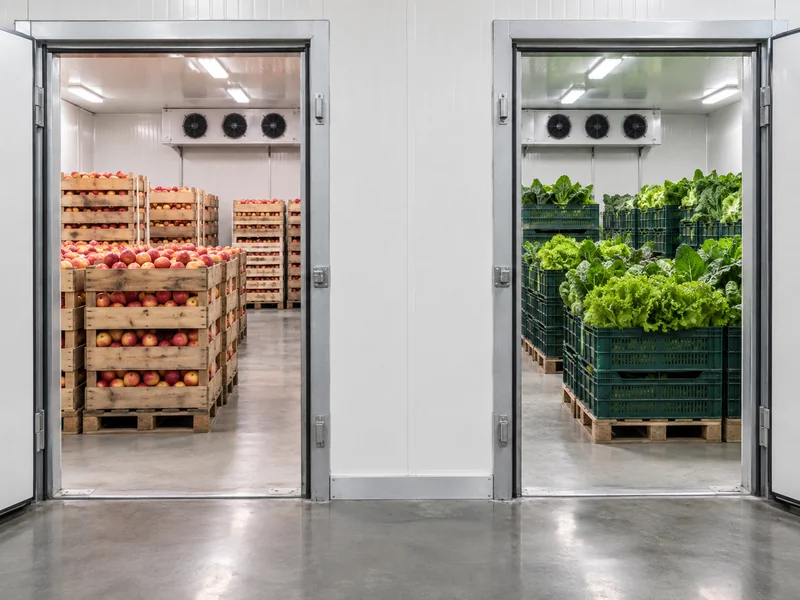
Fruits and vegetables should not share a cold room when their temperature needs, humidity requirements or sensitivity to ethylene are incompatible. Apples and pears can damage nearby ethylene-sensitive vegetables, while chilling-sensitive crops may deteriorate in conditions suitable for leafy greens. A mixed-produce plan must also account for maturity, packaging, odors and how long the products will remain together.
Warehouse allocation should follow the crop’s storage tolerances and ripening behavior; classifying a pallet as fruit or vegetables does not provide enough information to choose its neighbors. The same commodity may need different conditions at different stages of ripeness or for different market destinations. Build the room allocation from product requirements rather than from whatever pallet space happens to be empty.
Why Can Produce with Similar Temperatures Still Be Incompatible?
Temperature is only the first screening step. A fruit that releases ethylene can affect a sensitive vegetable even when both tolerate similar cold conditions. Strong odors and incompatible moisture needs can create further conflicts that a thermostat cannot solve.
Ethylene is a natural plant signaling gas, not a visible contaminant that staff can reliably detect by looking at a room. Its effect depends on the crop, concentration, exposure period and condition of the produce. The absence of immediate visible damage does not prove that an extended mixed-storage arrangement is suitable.
Texas A&M’s postharvest handling guidance considers temperature, humidity, ethylene and odor interactions when discussing mixed commodities. These are separate checks, and passing one does not cancel a failure in another.
Which Combinations Deserve Particular Caution?
Use the following examples as an initial screening tool, then verify commodity-specific instructions for the actual variety and maturity. The table identifies common conflicts without claiming that every short exposure inevitably causes rejection. Longer holding periods generally leave less room for compromise.
| Proposed Combination | Main Concern | Practical Approach |
| Apples or pears with lettuce, broccoli or carrots | Ethylene exposure can reduce quality in sensitive vegetables | Use separately managed air spaces for routine storage |
| Ripening tomatoes with sensitive greens | Ethylene and potentially different temperature needs | Separate ripening activity from vegetable holding |
| Bananas with produce held near freezing | Chilling injury in the bananas | Provide conditions appropriate to banana maturity and handling |
| Cucumbers or eggplants with very cold leafy greens | Chilling sensitivity and different preferred holding conditions | Assign compatible temperature zones after checking product guidance |
| Dry onions with high-humidity leafy vegetables | Conflicting moisture requirements and odor concerns | Keep cured dry produce in its own suitable environment |
| Strong-smelling produce with odor-absorbing crops | Transfer of undesirable odors | Check compatibility instead of relying on separate shelves |
Ripening rooms deserve particular separation because their intended function differs from holding produce in its current condition. Do not let a temporary ripening activity become an undocumented exposure source for neighboring stock. The room plan should show where products go before, during and after ripening.
Are All Fruits High Ethylene Producers?
No, production rates and responses differ substantially between commodities and stages of maturity. A rule that separates every fruit from every vegetable wastes space and still misses some incompatible fruit combinations. Classify the actual crop rather than relying on the department name printed on the purchase order.
Does Moving Sensitive Produce to the Opposite Wall Help?
Distance within a shared recirculating air space is not reliable gas separation. Evaporator fans can distribute the room atmosphere between storage positions. Separate shelves help organize stock, but they do not create independent ethylene conditions.
How Does Chilling Injury Change the Storage Decision?
Some produce suffers physiological damage at low temperatures above its freezing point. This is chilling injury, which is different from ice forming inside the tissue. Symptoms can become clearer after the product leaves storage, so a good-looking pallet at dispatch does not always establish that the holding conditions were suitable.
Near-freezing storage that suits many leafy vegetables can be unsuitable for tropical or otherwise chilling-sensitive crops. Variety, maturity and exposure time all matter. Avoid selecting one low room setting on the assumption that colder always preserves every product longer.
The UC Davis guidance on consolidating mixed produce loads illustrates why compatibility requires commodity-specific judgment. A short distribution movement and prolonged warehouse storage should not automatically use the same compromise.
Our article on selecting a cold-storage temperature range provides broader planning context. For a mixed-produce room, narrow that assessment to the actual crops and their expected holding periods.
Why Must Humidity Be Checked Separately?
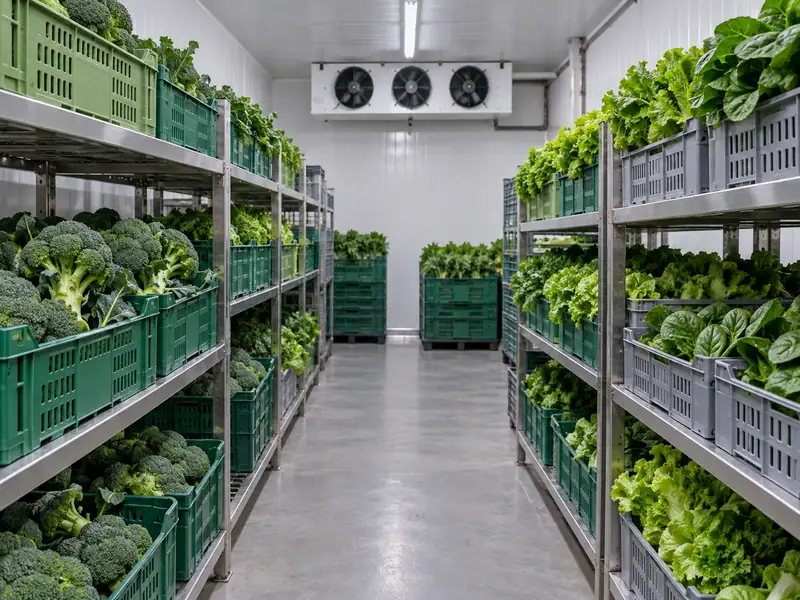
Leafy vegetables lose saleable quality when they lose too much water, whereas cured dry commodities need conditions that avoid unwanted moisture accumulation. A common room humidity can therefore favor one group while undermining another. Packaging modifies the local environment but does not automatically eliminate the conflict.
Humidity management also needs to distinguish moist air from water accumulating on produce or packaging. Condensation and wet surfaces can signal an operating problem even if the room’s average humidity appears appropriate. Incoming warm loads, door activity and changing temperature all deserve attention.
The existing guide to food-specific cold room humidity expands on moisture requirements. Use it alongside current commodity instructions rather than treating a broad food category as a complete storage specification.
How Should a Facility with Only a Few Rooms Allocate Produce?
Start with a product list covering the busiest expected period, not just today’s inventory. For each item, record permitted temperature, humidity needs, ethylene behavior, maturity and intended dwell time. Then group only products whose requirements overlap under the proposed conditions.
A practical layout may require separate spaces for cold-tolerant sensitive vegetables, compatible fruits and warmer-held chilling-sensitive produce. These are planning categories, not universal temperature bands. Confirm the crop mix before specifying setpoints or deciding how many independently managed rooms are needed.
- Keep deliberate ripening away from sensitive holding stock.
- Use room assignments and receiving instructions that staff can follow.
- Record exceptions with a defined maximum holding period and responsible decision-maker.
- Reserve capacity for seasonal arrivals that would otherwise force unsuitable mixing.
- Review shared air paths when subdividing an existing room.
A solid partition does not create independent conditions if large openings or shared return paths continually mix the air. The refrigeration and ventilation arrangement must match the intended separation. Discuss these needs when planning a fruit and vegetable cold room.
Can Ventilation or Ethylene Removal Replace Separation?
They may support a designed storage strategy, but they do not correct incompatible temperature or humidity requirements. Their effectiveness also depends on actual gas generation, airflow, capacity and maintenance. Avoid assuming that adding an absorber makes every crop combination acceptable.
Ventilation introduces outside air that may add heat and moisture, so its operation must be coordinated with refrigeration and product requirements. A supplier should explain the design basis and how performance will be checked. An unverified device rating is not evidence of suitable conditions at every pallet.
What Matters When Loading the Room?
Maintain the airflow clearances defined for the room and packaging. Crates with ventilation openings cannot perform as intended if those openings are blocked by tightly packed neighboring loads. Keep storage locations clear of door swings, return-air paths and areas excluded during commissioning.
Record arrival condition and temperature so a quality problem is not automatically blamed on the room. A holding room may not have the capacity to remove field heat from a large incoming harvest at the required rate. Receiving, precooling and storage should be treated as connected but distinct operations.
For stock rotation, our guide to food storage lifespan considerations provides additional context. Actual dispatch decisions should still reflect the product’s remaining quality, arrival history and customer requirements.
How Can You Tell Whether a Mixed-Storage Plan Is Working?
Track quality alongside room conditions: unexpected yellowing, softening, dehydration, pitting and odor complaints all deserve investigation. Record which commodities shared the room and for how long. A temperature chart alone may not explain deterioration caused by an incompatible neighboring product.
When damage appears, compare receiving records, dwell time, sensor data and room assignments before changing the setpoint. Lowering temperature to solve one complaint can harm another crop. Remove decayed stock promptly and review whether the current mixture still matches the approved plan.
Send LINBLE your seasonal crop list and storage schedule when discussing a new facility or revised room layout. Include daily volumes, arrival temperatures, packaging and desired holding periods so the design can address compatibility as well as total capacity.