
A blast chiller brings a product down to a chilled condition while keeping it unfrozen; a blast freezer room takes the product through freezing to an agreed core temperature. That difference changes the heat load, airflow arrangement, controls and room construction. For a LINBLE project, the useful starting point is the food leaving the room and its next destination, rather than the lowest temperature shown on a controller.
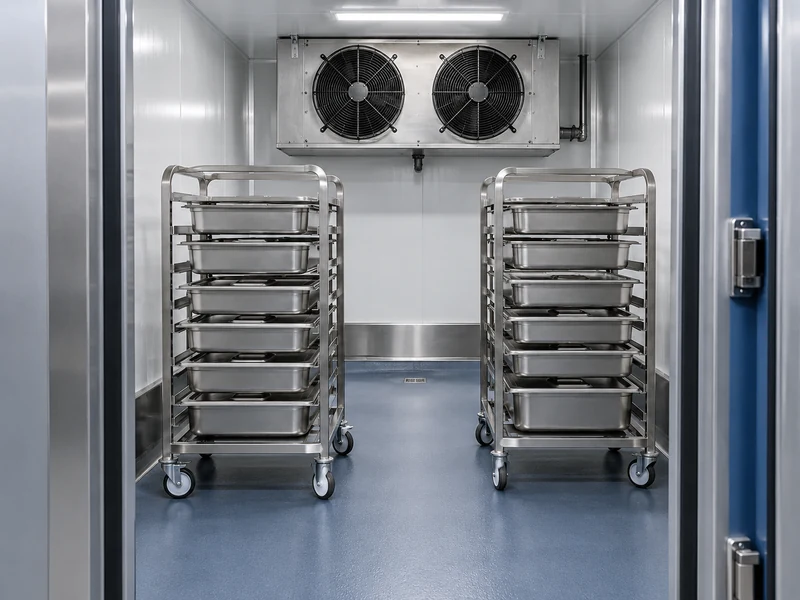
What Must the Product Be Ready for After the Cycle?
Choose blast chilling when the next operation needs chilled food, and blast freezing when the next operation requires a frozen product. A hotel preparing tomorrow’s refrigerated meal components has a different duty from a processor making frozen portions for distribution. Similar-looking insulated rooms can therefore need quite different equipment schedules.
Write the outgoing condition beside the incoming condition: product description, entry temperature, batch mass, pack dimensions, required core temperature and available time. Include the time between unloading and final storage. Otherwise, an impressive cooling cycle may simply deliver food to a warm corridor with nowhere ready to receive it.
LINBLE’s blast freezer room range is the relevant starting point for a freezing process. A standard chilled holding room should be discussed separately from a room that repeatedly receives warm production batches. The words “cold room” alone do not describe that distinction clearly enough for a quotation.
Why Is Freezing More Than a Colder Chilling Cycle?
A freezing calculation must cover the energy released as the food’s water changes into ice. During that stage, the core temperature can change slowly even though the refrigeration system is working hard. A calculation based only on batch weight and the difference between entry and exit temperature will miss an important part of the duty.
Penn State’s explanation of food freezing describes how freezing rate affects ice crystal size and tissue damage. That supports the quality argument for a properly designed freezing process; it does not establish a universal cycle time for every tray, carton or meat block. Packaging and the distance from the surface to the centre still matter.
A thin layer of sauce and a deep container of the same sauce are two different cooling tasks. Doubling the product mass by adding more identical trays is also different from doubling the depth in each tray. In a project brief, keep those changes separate so the supplier can identify whether capacity, surface heat transfer or internal heat movement is limiting the result.
| Planning Question | Blast Chilling | Blast Freezing |
| Required Product Condition | Chilled, without unintended freezing | Frozen to the specified core condition |
| Important Product Detail | Pan depth and risk of surface freezing | Thickness, packaging and freezing behaviour |
| Cycle Verification | Product cooling curve and applicable time limits | Core freezing curve and batch uniformity |
| Next Destination | Chilled holding, assembly or dispatch | Frozen storage, packing or dispatch |
How Should Air Reach the Batch?
The circulation loop needs a working route across the loaded trays, followed by an unobstructed path back to the coil. A clear aisle is necessary for handling, but it can also become an easy bypass route if the batch arrangement leaves little resistance anywhere else. Large fan volume does not prove that the middle trolley receives enough moving air.
For chilling delicate or exposed products, the balance may favour controlled air movement that limits drying and surface freezing. For freezing, the design may require a stronger, deliberately guided path through the loaded racks. Neither case is solved by putting the largest available fan at one end of the room.
LINBLE offers different cold room evaporator configurations; the arrangement should follow the load geometry and operating duty. Give the designer actual trolley width, tray spacing and loaded height. A photograph of a typical loaded rack is often more useful than an estimate of room volume.
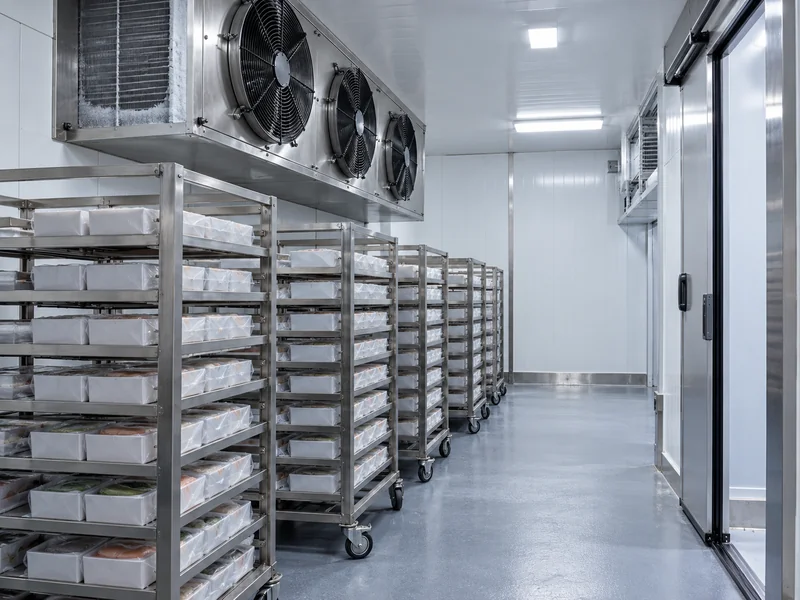
For a proposed layout, ask where the supply air enters the batch, where it leaves, and how it returns to the coil. Then ask what happens when only half the planned trolleys are loaded. Partial batches can open new shortcuts and deserve an operating arrangement of their own.
Which Construction Details Change at Lower Temperatures?
A freezing room needs an envelope and floor suitable for its actual low-temperature service. Panel joints, vapour control, door-frame heating where specified, drainage and floor design all deserve review. Turning down the setpoint of an existing chiller does not establish that these details are adequate.
Check the door against the loaded trolley, including the operator’s turning movement and any threshold. Consider where meltwater goes during defrost and how the drain remains functional. A freezer that cools well but cannot be cleaned, defrosted or unloaded reliably will interrupt the production schedule.
A longer daily freezing programme also leaves fewer convenient maintenance windows. Include defrost, drip time, fan restart, cleaning and recovery in the available operating hours. The useful output is the number of compliant batches that fit into the working day, rather than the number that fit into an uninterrupted theoretical cycle.
Can One Room Handle Both Chilling and Freezing?
It can be considered if the refrigeration system, controls and construction are designed for both duties, and each programme is validated on the intended load. Ask for separate performance statements. A freezing rating cannot be treated as proof of gentle chilling performance, or vice versa.
Check how the two duties will alternate during an actual shift. Alternating warm, moist chilling batches with low-temperature freezing may change frosting, sanitation and recovery needs. If one programme regularly waits for the other to finish, separate process rooms may offer better usable capacity even when the combined room initially appears cheaper.
Keep ordinary storage out of that conflict. Stock held in the process room occupies the positions needed for the next batch and may experience repeated temperature changes. LINBLE’s discussion of products that need blast freezing helps frame the process duty before holding capacity is added.
What Should a Meaningful Acceptance Trial Include?
Test the agreed product in its normal packaging and loading arrangement, at a realistic entry temperature. Measure representative cores, including the likely slow positions, and record room conditions through the cycle. An empty room reaching its setpoint is a useful equipment check, but it does not demonstrate batch performance.
- Record batch mass, tray depth, carton type and trolley positions.
- Identify probe locations before starting, including the suspected warmest product positions.
- Agree the release criterion and the person responsible for judging the result.
- Include the transfer to chilled or frozen holding in the trial.
- Repeat the relevant assessment after substantial changes to packaging, loading or recipes.
For freezing, the relationship between room air and product centre is explored further in LINBLE’s guide to blast freezing time and core temperature. For construction and operating checks, use the cold room commissioning checklist alongside the product trial. These are complementary checks, with different evidence to collect.
How Should You Compare Two Supplier Proposals?
Put both proposals beside the same batch description and draw attention to any different assumptions. One may allow a longer cycle, a lower entry temperature or a smaller tray depth. Those differences can explain a lower equipment price without demonstrating better value for the intended process.
Consider an illustrative kitchen that needs a chilled batch for morning assembly and a separate frozen batch before afternoon dispatch. Ask each supplier to place both jobs on a daily timetable, including loading, unloading, cleaning and defrost. If the second job finishes only when the first is assumed to start unusually early, the apparent combined capacity deserves another look.
Check what the stated batch weight includes and how it is distributed. Food mass, trolley mass and packaging create different loads, and a capacity statement should identify its basis. Keep the accepted tray pattern with the proposal so that a later change to deeper pans does not silently become an expectation of unchanged performance.
Finally, compare the scope supplied around the room: controls, probes, drainage details, commissioning and operating instructions. A lower initial price can leave essential interfaces with the installer or kitchen operator. Assign them explicitly before comparing the complete installed solutions.
What Information Should You Send LINBLE?
Give LINBLE two load descriptions: your routine production batch and the most demanding one the room must handle. Include the largest product thickness, warmest entry condition, busiest production day and any fixed dispatch deadline. State whether products will be exposed, covered, vacuum packed or boxed before the cycle.
Add a room sketch showing building columns, available height, door approach, drain route and condensing-unit location. Mark the destination of completed batches and the cleaning window. LINBLE can then assess the process-room duty, specify the associated components and identify the operating sequence needed for the stated food.