
Blast freezing time must be evaluated against the temperature reached inside the product, not simply the air temperature shown on the freezer controller. The outside can become cold while the slowest-cooling region remains warmer, particularly in thick products or tightly packed loads. A dependable production cycle therefore combines an agreed product endpoint with a validated loading pattern and representative measurements.
For procurement, ask how much of your actual product can reach that endpoint within the available shift. Room volume and a low air-temperature setting are useful specifications, but they do not independently establish that output.
What Does Each Freezer Temperature Reading Tell the Operator?
Air temperature describes the cooling environment; product core temperature describes what is happening within the food. The operating record needs both values: the air reading describes the environment delivered by the equipment, while the product measurement helps determine whether the selected food item has reached its specified endpoint.
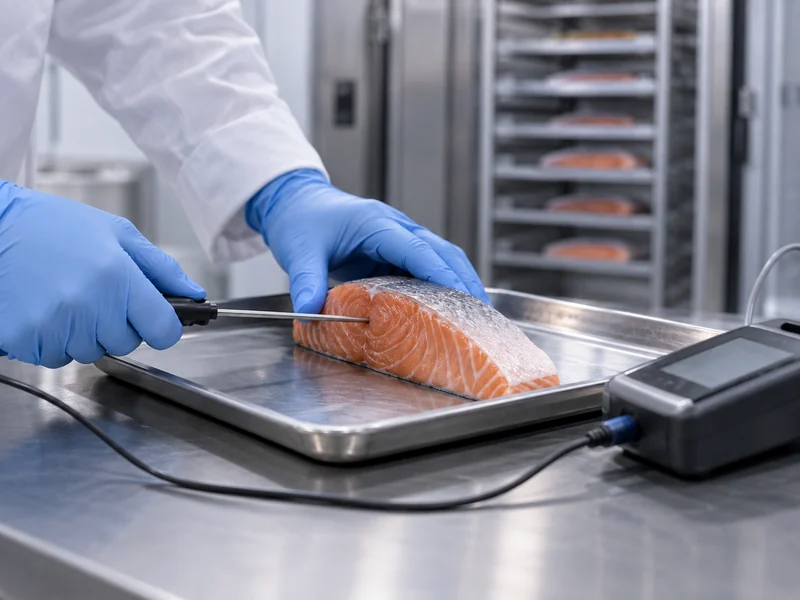
The controller normally regulates conditions at its air-sensing location. A product probe checks the response of a selected item, and the test plan must identify where within that item the relevant temperature should be measured.
The thermal centre is the region that cools most slowly under the particular freezing conditions. It may be near the geometric centre of a regular, uniformly exposed product, but irregular shapes and uneven exposure require more careful assessment.
FAO’s explanation of variables affecting freezing time defines the process in relation to a specified temperature at the thermal centre. Its examples also show why product dimensions, starting conditions, and packaging belong in any meaningful freezing-time claim.
Which Endpoint Should a Buyer Specify?
Specify the endpoint required by the product, subsequent storage plan, customer requirements, and applicable food-safety process. Avoid treating a commonly quoted temperature as a universal acceptance criterion for every food and market.
LINBLE’s blast freezer room options describe a commonly used core target of approximately −18°C or a project-specific requirement. The project specification should resolve that choice and state how completion will be verified.
Agree whether the acceptance condition concerns the measured core at unloading, a defined stabilized condition, or another validated requirement. Also define the permitted transfer time and the receiving storage conditions.
Freezing performance and a complete food-safety process are different matters. A temperature endpoint used for production quality should not be presented as proof that every relevant biological hazard has been controlled.
Why Do Apparently Similar Loads Take Different Times?
The freezer must remove heat from inside each item through its surfaces and into the moving air. Changes anywhere along that path can alter the time needed, even when the total batch weight remains unchanged.
How Do Thickness and Shape Affect the Cycle?
A thick portion gives heat a longer route to the surface than a thin one. Two batches with the same mass can therefore require different cycles when one consists of individual portions and the other contains dense blocks.
For purchasing discussions, provide the maximum relevant thickness as well as weight. A statement such as “500 kg per batch” leaves an important question unanswered if the supplier does not know whether that mass is spread across trays or concentrated in cartons.
Do not assume that halving thickness will always halve freezing time. Geometry and the relative resistance inside and outside the product determine the response.
What Do Packaging and Starting Temperature Change?
Packaging becomes part of the heat-transfer path, while the product’s entry temperature determines part of the heat load. Document both rather than allowing different departments to use different assumptions.
A close-fitting wrap and a bulky package with trapped air are not interchangeable test conditions. Trials should use the commercial pack, including liners and carton arrangement where these are present during freezing.
Likewise, chilled incoming product and warmer incoming product should not be assigned the same guaranteed cycle without supporting evidence. If arrivals vary, agree the most demanding permitted condition and validate against it.
How Does Loading Affect Freezing Time?
The air must reach the load in the arrangement used during validation. Packing more product into an available space can reduce the practical output if it lengthens the cycle or creates slow-freezing locations.
| Loading Change | Question to Investigate | Useful Trial Record |
| More trays per trolley | Are the intended air gaps preserved? | Tray spacing and photographs |
| Thicker packages | Has the heat-transfer path changed? | Pack dimensions and core trends |
| More trolleys in the room | Can air still pass through each load? | Position plan and slowest measured locations |
| Different incoming temperature | Does the original cycle remain adequate? | Measured entry temperatures |
Keep clearances and air channels consistent with the selected freezer design. The objective is a repeatable path through the product arrangement, not simply an impressive fan speed measured at an empty outlet.
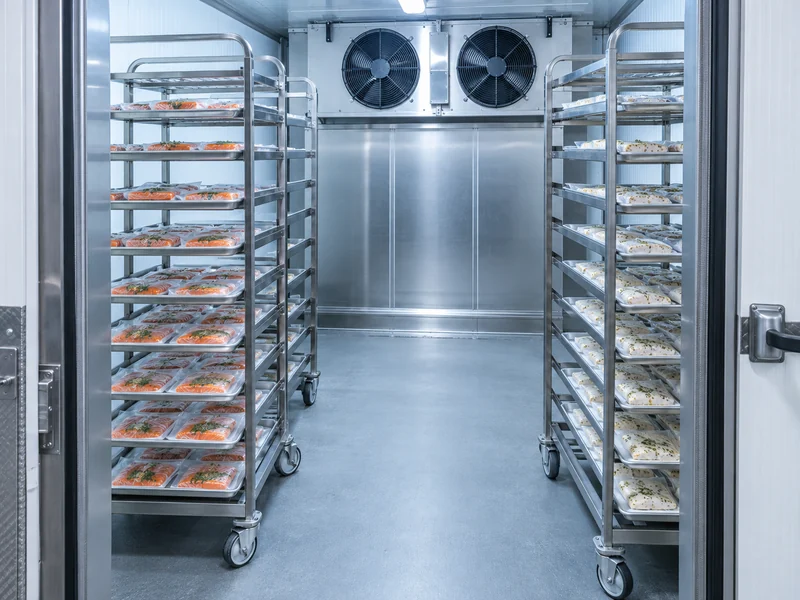
FAO’s guidance on specifying an air blast freezer emphasizes knowing the freezing time and required output before selecting the installation. Product trials or closely applicable measured experience are more informative than a single generic time table.
The evaporator and air-delivery arrangement should be selected with the loading plan. If trolley dimensions or packaging change after purchase, review the effect before continuing to use the original cycle.
How Should a Representative Freezing Trial Be Organized?
Build the trial around the commercial conditions that the proposed cycle must support. The most useful result is a documented process another shift can reproduce.
- Identify the product, pack dimensions, batch mass, and allowed entry-temperature range.
- Record the trolley or pallet layout and all relevant air gaps.
- Use suitable calibrated probes and a documented placement method.
- Monitor representative products, including positions expected to cool slowly.
- Record air conditions, loading events, defrost events, and any interruptions.
- Compare every required measurement with the agreed endpoint before accepting the cycle.
- Repeat or extend the trial as needed to address variation and justify the operating instructions.
A probe accidentally resting against a tray, sitting too close to the surface, or moving during loading can misrepresent the product. Establish a placement procedure suitable for the product and confirm it before interpreting a convenient-looking trace.
Keep probe hygiene and the handling of tested product within the site’s approved procedures. The measurements are useful only when obtaining them does not introduce a separate process problem.
As an illustrative comparison, test the same product in its existing pack and a proposed thicker pack under otherwise comparable conditions. If the new pack reaches the endpoint later, either the cycle or the production plan needs review before the new packaging becomes routine.
How Do You Convert Cycle Time Into Usable Throughput?
Count the whole production cycle, including the activities that stop the next batch from starting. Freezing time alone can overstate the output available during a shift.
For a simple planning example, suppose a validated batch holds 600 kg and freezing takes four hours. If loading, unloading, and required turnaround add one hour, that example occupies five hours of the schedule rather than four.
This arithmetic is illustrative, not a LINBLE capacity claim. Cleaning, defrost, staffing, transfer equipment, and the ability to finish the last batch within the shift can further affect usable daily output.
Use the discussion in blast freezer size and capacity planning as a starting framework, then replace general assumptions with data for your product and process. Specify throughput together with the conditions under which it must be achieved.
When Should You Recheck an Established Cycle?
Recheck when a change can affect heat removal or measurement reliability. A successful original trial should become a reference condition, not an unlimited guarantee for later operating changes.
- Product thickness, recipe, pack size, or packaging material changes.
- Batch mass or loading pattern increases.
- Incoming temperatures move outside the validated range.
- Fans, refrigeration equipment, or controls are replaced or adjusted.
- Unexpected core-temperature results or uneven product quality appear.
If you are still deciding whether the product needs rapid freezing at all, review which products benefit from blast freezing. For production-line selection, the comparison of spiral freezers and blast freezer rooms addresses a separate equipment-layout decision.
For a project enquiry, send LINBLE the product, maximum thickness, packaging, entry temperature, required endpoint, and available batch schedule. Those details make a freezing-time discussion specific enough to support an equipment selection and an agreed acceptance trial.