
Before cold room equipment leaves the factory, confirm the actual site supply, the electrical load of every supplied component, and who will connect each circuit. A compressor rating alone is not enough: evaporator fans, defrost heaters, door-frame heaters and controls may require different supplies or operating sequences.
For a LINBLE order, this check belongs beside the approved room layout and equipment schedule. A modular enclosure can fit perfectly while an unconfirmed neutral, an undersized feeder or the wrong frequency holds up commissioning.

Which Supply Details Need Written Confirmation?
Send the equipment supplier a site supply declaration prepared or verified by the local electrical contractor. “Three phase available” leaves several questions unanswered, particularly on an export project where the building supply and the manufacturer’s usual configuration may differ.
- Nominal voltage, phase arrangement and frequency at the intended connection point.
- Whether a neutral is available where the selected equipment needs one.
- Earthing arrangement and the local requirements applying to the installation.
- Available feeder capacity, cable route length and the proposed distribution-board location.
- Whether mains power, generator power or both will serve the cold room.
Use measured site information where the contractor considers it necessary, rather than copying the voltage from an old building drawing. The value printed on a distribution board does not establish the voltage available at equipment terminals during starting or under other site loads.
LINBLE’s condensing unit configurations include different structures and mounting arrangements. Confirm the electrical data for the selected model and its approved options; a range-page description cannot replace the project-specific equipment schedule.
What Should the Electrical Load Schedule Include?
List each powered item, its supply and its mode of operation. Separate cooling operation from defrost, standby and restart conditions so the contractor can assess the combinations that actually occur.
| Equipment or Circuit | Information to Request | Point Easily Missed |
| Condensing unit | Model, supply, rated electrical data and starting requirements | Cooling capacity in kW is not electrical input |
| Evaporator fans | Motor quantity, supply and fan-control arrangement | Fan wiring may be separate from heater wiring |
| Electric defrost | Coil and tray heater ratings, circuits and control sequence | Defrost can determine the feeder requirement |
| Door and drain heating | Locations, electrical ratings and operating controls | Small continuous loads disappear from compressor-only budgets |
| Controls, lights and alarms | Supply, transformer provision and backup arrangements | Monitoring may need to survive a refrigeration shutdown |
Ask for nameplate data, wiring diagrams and the manufacturer’s installation instructions together. Where the selected equipment provides minimum circuit ampacity or maximum protective-device information, the electrician must use that information within the locally applicable design rules.
A purchaser should not select a breaker simply by dividing refrigeration capacity by voltage. Cable installation conditions, starting behavior, protection coordination and the approved equipment data all affect the final design.
Are All Loads Connected Through One Control Panel?
Only if the approved design says so. A central panel may control the refrigeration system without supplying the lights, alarm communicator or door heating circuit.
Request a simple connection diagram showing incoming supplies and outgoing circuits. Mark every field-installed connection and identify whether its cable, isolator and termination materials are included in LINBLE’s supply or purchased locally.
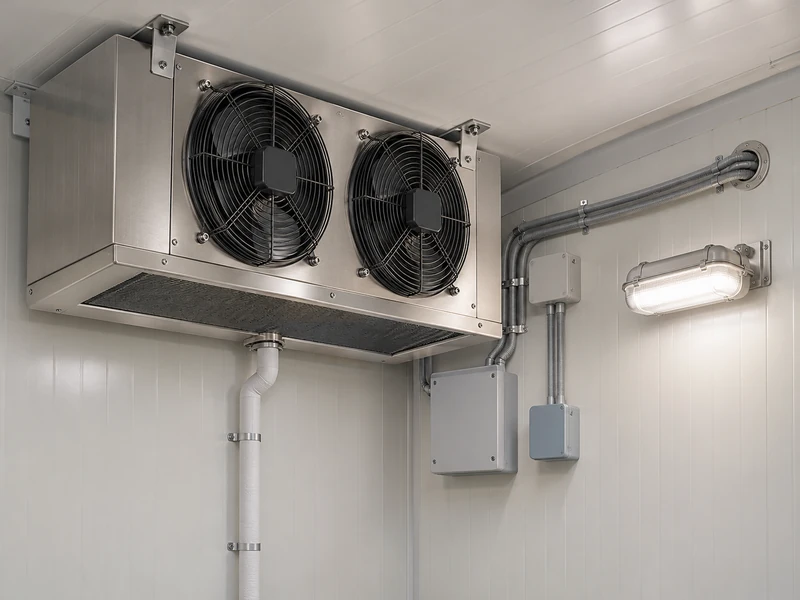
How Does the Defrost Choice Change Site Preparation?
Electric and water defrost create different site obligations. LINBLE offers both among its cold room evaporator options, so the order needs to state the selected method before the electrical contractor finalizes the installation.
For electric defrost, obtain the coil-heater and drain-pan-heater data separately, then confirm the intended interlocks with refrigeration and fans. The calculation should follow the actual control sequence, including whether several evaporators can defrost together.
For water defrost, do not assume electrical preparation disappears. Fans, controls, valves or associated pumps may still need power, while water supply, drainage and freeze protection need their own coordinated design.
Changing the defrost method after shipment can affect wiring, controller outputs and drainage work. Resolve that choice while the room and equipment drawings are still being coordinated, using the operating differences explained in LINBLE’s water and electric defrost comparison.
Who Owns the Connections Between the Package and the Building?
Give every connection an owner and an acceptance record. “Installation included” is too broad when a cold room package, the main building works and local electrical labor come from different contracts.
- The supplier confirms the selected equipment, diagrams and factory-installed wiring.
- The site electrical contractor designs and installs the building-side supply and required protective measures.
- The refrigeration installer coordinates control cables, sensors and field connections within the agreed scope.
- The owner arranges access, shutdown windows and approval from the relevant local authority where required.
These are suggested boundaries for a project discussion, not a statement that every LINBLE contract has the same inclusions. Put the agreed division into the order and site preparation documents, especially if remote technical guidance will support a local installation crew.
Position electrical enclosures where technicians can service them without moving stock or standing in a washdown stream. Cable entries through insulated panels need coordinated sealing details so the electrician’s work does not leave an air-leak path in the completed enclosure.
What Should Be Confirmed About Isolation and Backup Power?
Identify every source of power before handover. A stopped compressor does not establish that door heaters, control circuits or an independently supplied alarm are de-energized.
The American Society of Safety Professionals explains that hazardous-energy control addresses unexpected energization, starting and stored energy. Apply the site’s approved procedures and use qualified personnel for electrical verification; the purchasing checklist is a coordination document, not a live-work procedure.
If a generator is planned, have the electrical designer check the intended connected loads, starting sequence and transfer arrangement. State which functions must remain available during an outage and which may restart later, rather than asking only whether the generator can run the compressor.
Backup monitoring deserves its own decision: a refrigeration supply failure should be capable of reaching someone who can act. LINBLE’s article on backup systems in cold storage is a useful starting point for that conversation.
How Should Late Equipment Changes Be Controlled?
Review electrical requirements again when the equipment schedule changes. A different fan motor, an added heater or a revised controller can affect the connection arrangement even when the room dimensions remain identical.
Give the electrician the revised document rather than sending a photograph of one changed component. The diagram, load schedule and delivered equipment should carry compatible revision information so the crew knows which instructions apply.
Changes to the building can matter just as much. If the owner moves the condensing unit farther away, introduces another large electrical load or changes the generator arrangement, the contractor should assess the effect before the original supply design is treated as settled.
What Is a Sensible Stop Point?
Do not book the final connection on the assumption that an unresolved supply mismatch will be easy to fix on arrival. Ask the supplier and contractor to state the proposed resolution, required materials and schedule impact while the equipment is still accessible for any agreed factory changes.
Keep the purchasing record practical: one list of open electrical items with a responsible person for each. For a small room that list may be short, but it should still identify who confirms auxiliary supplies and who approves the field wiring.
Use the unloading inspection to reconcile the model labels on the delivered units with the final order list. Resolve any discrepancy with LINBLE and the site installer before those units are connected or put into service. A substituted model or an unexpected separate heater circuit is easier to resolve at this point than after the enclosure is loaded and the site is waiting for refrigeration.
What Should the Pre-Delivery Sign-Off Contain?
Close the review with one revision-controlled document set: approved layout, selected equipment list, electrical load schedule, connection diagram and site responsibility list. Record unresolved items with a named owner and completion date; silence is not confirmation.
As an illustrative example, a buyer may approve a freezer’s three-phase condensing unit while leaving the single-phase auxiliary circuits undecided. Discovering that gap before dispatch allows the supplier and local contractor to agree the arrangement before cables and controls arrive on site.
Reserve commissioning time for checking the installed supply, control sequence, alarms and equipment operation against the approved documents. Use LINBLE’s cold room commissioning checklist to connect this purchasing review with the final handover.
The useful question before delivery is precise: can the local contractor connect every item on this order to the available building supply using the agreed drawings? When the answer is documented, the equipment has a much clearer route from unloading to a working cold room.