
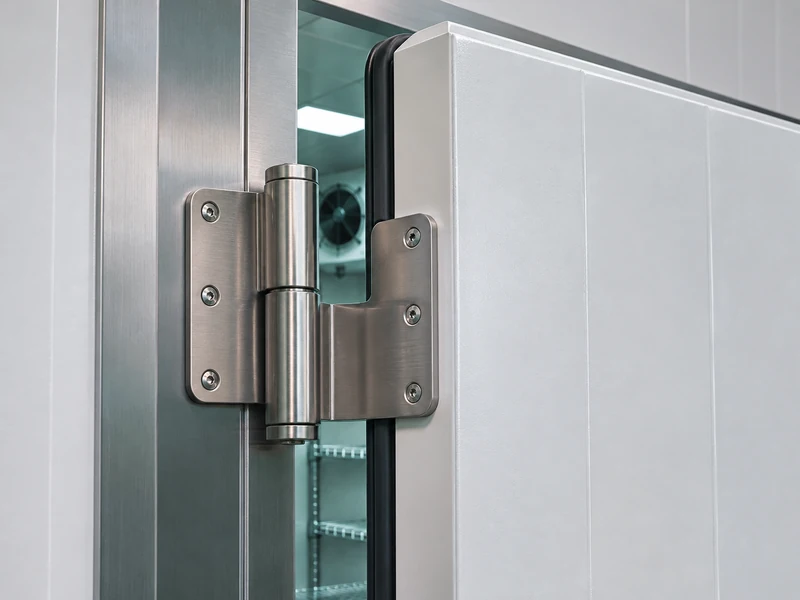
Choose cold room swing door hinges for the complete door leaf, its width and center of gravity, the frame construction and the expected opening duty. Door weight is essential, but it is not the only selection condition: a wide leaf and frequent trolley traffic can impose demands that a simple kilogram rating does not describe.
LINBLE offers customized hinged-door fittings alongside different frame forms. Ask for a matched door-and-hinge assembly instead of choosing a replacement hinge from its appearance or hole spacing alone.
Why Is Leaf Weight Only Part of the Selection?
The hinges support the leaf while resisting the turning effect created by its mass acting away from the hinge line. Increasing the width can increase that effect even when two leaves weigh the same.
A wider door may also be pushed, stopped or struck differently during use. Add the effects of closer settings, opening angle and trolley contact to the enquiry so the supplier can assess the actual assembly.
LINBLE’s hinged cold room doors include different thicknesses and frame configurations. Obtain the finished leaf weight for the selected size, cladding and options rather than estimating it from insulation thickness.
- Finished leaf dimensions and mass, including fitted accessories.
- Hinge model, quantity, position and compatible frame detail.
- Opening direction and required usable opening angle.
- The temperatures the hinge will experience, plus the washdown routine and exact cleaning products used nearby.
- Closer, latch and gasket arrangement.
- Typical and peak opening duty, plus likely impact exposure.
What Does an Opening-Cycle Requirement Need to Say?
Describe the work pattern, not just the daily total. Several hundred gentle hand openings differ from concentrated trolley movements, repeated hold-open periods or staff pulling a loaded leaf against a poorly set closer.
Ask the supplier whether the proposed assembly has relevant cycle-test information, and request the test conditions. A cycle figure is useful only when the tested leaf size, mass, installation and operating conditions are understood.
Do not turn an unspecified cycle-test figure into a promised number of service years. Site installation, adjustment, cleaning and impact exposure can change the outcome materially.
| Operating Pattern | Information to Give LINBLE | Selection or Layout Question |
| Occasional hand access | Leaf size, stock-handling route and closing needs | Can staff close and latch it comfortably? |
| Frequent kitchen trolley access | Peak movements, trolley width and approach angle | Is the opening sufficient without striking the leaf? |
| Wide heavy leaf | Finished mass, cladding and accessories | Is the hinge and frame combination approved for this geometry? |
| Humid or washdown area | Cleaning method and chemical exposure | Are materials and maintenance provisions compatible? |
Is a Bigger Hinge Always the Better Answer?
No. The hinge must fit the leaf reinforcement, frame fixing and movement geometry, not merely look stronger.
A different hinge may move the pivot line, alter gasket compression or change how the latch meets its keeper. That is why a visually similar part can create a new sealing problem after an apparently straightforward repair.
How Do Hinges, Gaskets and Latches Work Together?
The hinge positions the leaf so the gasket and latch can operate within their intended adjustment range. If the leaf sags, the gasket may drag along one edge while losing contact at another.
Inspect the whole perimeter before assuming the gasket itself is defective. Uneven contact can originate at the hinges, frame, threshold or fixing points.
The ASHRAE refrigerated-facility design chapter includes doorway considerations within the enclosure design. For purchasing purposes, that reinforces a practical point: hardware adjustment affects how the thermal boundary performs.
Frame and sill conditions deserve particular attention after installation on an existing slab. LINBLE’s article on common cold-room installation mistakes provides related checks before repeated hardware adjustment is attempted.
What Site Conditions Shorten Hinge Service Life?
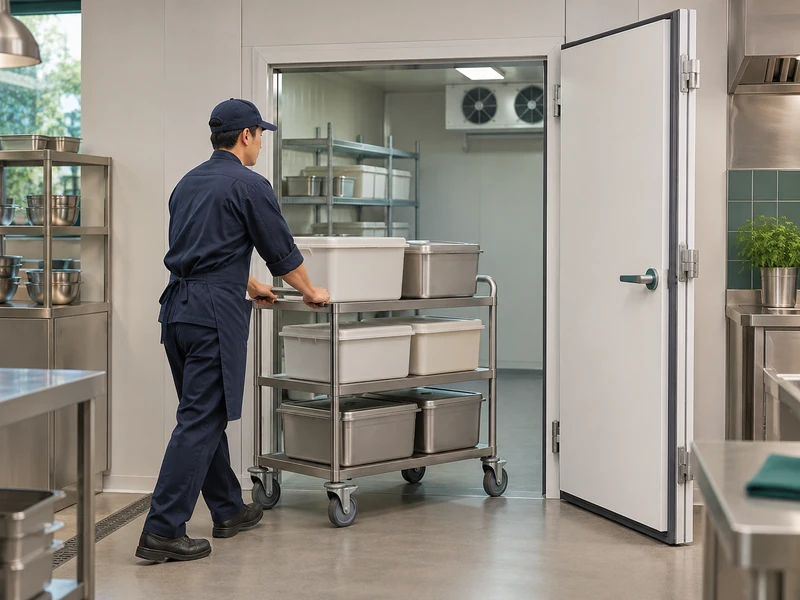
Repeated impact, unsuitable cleaning and poor alignment can overwhelm an otherwise appropriate hinge selection. Start by watching a busy loading period; the staff’s route may reveal more than a quiet inspection of the closed door.
If every trolley clips the leaf, review the approach width, opening clearance and door protection. Replacing the hinge repeatedly leaves the operational cause in place.
Cleaning also needs an agreed method. Ask which chemicals, lubrication products and inspection practices are compatible with the actual hinge, particularly where moisture can remain around joints and fasteners.
For a high-throughput route, reconsider the opening format as well as the hardware. LINBLE’s sliding-door and hinged-door comparison helps evaluate whether the swing space still suits the work.
What Information Is Needed for a Replacement Hinge?
Provide the door identification, finished dimensions, photographs of the hinge and frame, and the symptoms that prompted replacement. Include close views of the fixing area, gasket contact and latch alignment.
Record whether the leaf drops while moving, rubs the threshold, fails to latch or shows play at a particular fixing. A loose or damaged mounting area requires a different repair from wear within the hinge mechanism.
Have the door safely supported and serviced according to the manufacturer’s instructions. A heavy insulated leaf should not be released from its hardware by an unsupported, improvised procedure.
- Confirm handing and the exact compatible hinge model.
- Verify the approved fixing and reinforcement arrangement.
- Check whether other hardware or damaged mounting parts also need attention.
- Adjust and test the complete door assembly after repair.
- Record the part used and the condition of the remaining hinges.
When Does Traffic Justify a Different Door Brief?
When the opening repeatedly constrains normal movement or staff leave the leaf open to avoid operating it. A hardware upgrade may help, but it cannot create swing clearance that the building does not have.
Compare the clear opening and surrounding route against the actual trolley, not its nominal width alone. Staff need room to approach, turn and pass without pushing the leaf sideways with a load.
Use LINBLE’s broader cold room door range to discuss alternatives where appropriate. Any change should account for sealing, safety, floor detail and available service support as well as opening convenience.
What Should a Door-Hardware Enquiry Look Like?
A short operating description is more useful than a request for “heavy-duty hinges.” State the finished door dimensions, expected movements during the busiest hour and the equipment that passes through the opening.
Add the conditions around the frame: whether the doorway is in a washdown area, whether the leaf can open freely and whether a stop prevents it from contacting nearby equipment. These details help distinguish a component issue from a layout problem.
For an illustrative comparison, a narrow service-room door opened by one person and a wide kitchen door used by loaded trolleys may have similar daily opening totals. Their leaf geometry and impact exposure can nevertheless lead to different hardware and protection requirements.
Can Site Crews Add Another Hinge to an Existing Door?
Have the supplier approve the revised hinge layout and fixing design before this kind of site alteration. Additional hardware needs suitable reinforcement and aligned pivot geometry; another hinge does not automatically share the load as intended.
Ask the door supplier to assess the full assembly, including the existing fixing areas. If the frame or leaf has already been damaged, adding hardware around the damage may leave the underlying weakness unresolved.
After any approved modification, repeat the movement, latching, gasket-contact and escape checks. Keep the revised hardware arrangement with the door record so a later service technician does not restore an obsolete configuration.
These records need not be elaborate. A clear door identification, approved parts list and a few useful inspection photographs give the maintenance team a far better starting point than an unmarked spare hinge on a shelf.
What Should Be Recorded at Handover?
Record the approved leaf specification, hinge arrangement and adjustment instructions, then demonstrate smooth movement, consistent gasket contact, reliable latching and the required internal escape function. Check the door under the intended operating conditions using the project procedure.
Set an inspection frequency appropriate to the traffic and environment, with a route for reporting sagging, loose fixings or changed closing behavior. Early adjustment is easier to manage than a leaf that begins striking the frame during every delivery.
LINBLE’s article on door traffic and energy consumption covers the operating consequences of frequent access. Selecting the hinge correctly is part of making that access repeatable without sacrificing the seal.