
Limit grape stem browning by shortening the warm period after harvest, cooling through the actual pack, and maintaining stable cold storage with enough humidity to restrain water loss. The room also needs a holding airflow that reaches the pallets without continually drying the fruit; colder air or faster fans alone will not recover a dehydrated rachis.
For LINBLE, this is a combined packaging, cooling and room-layout question. A specification that lists only room volume and a temperature setpoint misses the carton openings, liners, intake peaks and fan operation that determine what the stems experience.
Why Can Stems Look Tired Before the Berries Do?
The cluster’s appearance does not change uniformly. Stems can lose their fresh green appearance while the berries still look sufficiently firm to pass a casual inspection.
The UC Davis grape fact sheet identifies stem browning and shrivelling among quality defects and describes stems as much more metabolically active than berries. It recommends cold storage near the commodity’s freezing boundary with high relative humidity, while also warning about decay.
For reference, that guidance lists berry storage at -1 to 0°C and 90–95% RH. A project should confirm its operating programme for the cultivar, packing method and expected duration, with enough control accuracy to avoid freezing sensitive parts of the cluster.
Photograph a sample of stems at receiving and again at release. If the fruit arrives with brown, brittle stems, the storage team needs to distinguish inherited damage from deterioration that develops inside the room.
Where Is the First Preventable Water Loss?
Look between harvest and effective cooling, including time spent waiting for packing or an available cooling position. The cold room may be blamed for damage that began while pallets stood warm beside it.
Build a simple batch record with harvest, packing, cooling-start and cooling-end times. Add product temperatures at meaningful points; the room controller’s reading cannot show how long the centre of a recently loaded pallet remains warm.
LINBLE’s precooling versus cold storage explanation is useful here because these stages require different duties. A holding room cannot be assumed to provide the same cooling performance as a purpose-designed precooling arrangement.
Can the Package Actually Pass Cooling Air?
Check the complete pack, including its liner and stacked orientation. A carton with generous visible vents can still cool poorly if the liner covers them or neighbouring cartons do not align.
- Use the intended carton, liner and packing density during cooling trials.
- Locate the slow-cooling positions inside the pallet rather than only at its edge.
- Keep vent alignment consistent during stacking.
- Control bypass air around a forced-air arrangement.
- Agree the product endpoint that releases the pallet to holding storage.
A liner change made to reduce moisture loss can alter cooling resistance. Treat packaging revisions as changes to the cooling process, with a trial before the next commercial intake peak.
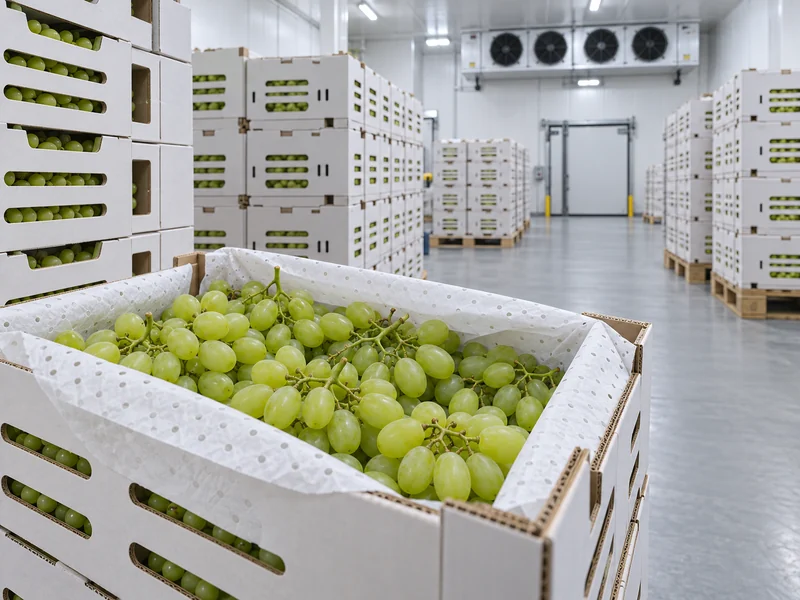
How Should Holding Airflow Differ From Precooling Airflow?
Once grapes reach their intended holding condition, the task changes from removing field heat quickly to maintaining an even environment with limited quality loss. Review fan staging and distribution for that second task.
A strong discharge aimed straight at the nearest exposed cartons may over-serve those pallets while air returns through a convenient empty aisle. The furthest stock can remain warmer even though the room seems windy.
When selecting a cold room evaporator, give LINBLE the pallet drawing and package information. Ask how coil duty, air throw, fan control and the chosen operating temperature work together under loaded conditions.
A larger coil surface or a different operating temperature difference may be considered where moisture loss is a concern, but selection must still meet the load and control requirements. “Low air speed” is not a satisfactory specification if it leaves an uncooled corner.
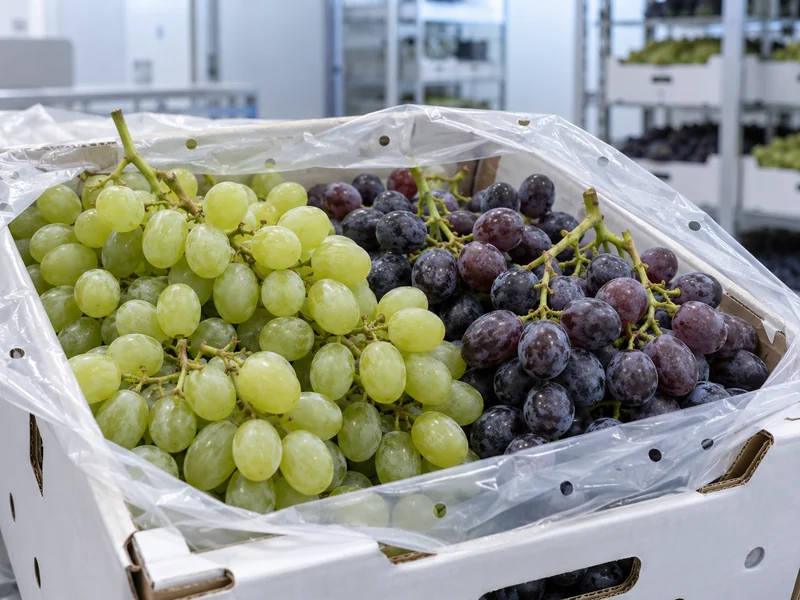
How Can High Humidity Be Maintained Without Wet Fruit?
Manage water loss and condensation as separate observations. High humidity can help limit dehydration, while water accumulating on cold fruit, liners or cartons introduces a different set of risks.
Begin by reducing avoidable moisture removal and infiltration. Check door use, coil operation and warm-air entry before adding a humidifier to compensate for a poorly controlled room.
LINBLE’s discussion of factors affecting cold room humidity provides a useful framework for that review. The practical design decision is how the room behaves during its loading and defrost cycles, not just its RH reading during a quiet hour.
If humidification is proposed, define water quality, sanitation, control accuracy and where moisture is introduced. Spraying grapes or making liners visibly wet should not be used as a shortcut to a high humidity reading.
| Observed Pattern | First Checks |
| Brown stems mainly beside the evaporator | Direct discharge, package exposure and fan operation during holding. |
| Warm pallet centres after intake | Cooling duration, liner resistance, vent alignment and air bypass. |
| Wet liners after door activity | Warm humid air entry and product movement between different conditions. |
| Decline spread across a whole received lot | Harvest-to-cooling history, initial condition and lot-specific handling. |
Does Decay Control Change the Room Specification?
It can, especially when the pack programme uses a treatment that affects materials, staff procedures or product release conditions. Confirm those interfaces before equipment and liners are ordered.
The UC Davis guidance identifies grey mould as a major grape-storage problem even at low temperatures. Cooling and humidity management therefore need to sit alongside the approved decay-control programme, rather than be treated as a complete replacement for it.
Where sulfur dioxide pads or another authorised treatment are used, follow the applicable product instructions and market requirements. Have the responsible specialist confirm compatibility, exposure controls and handling procedures; this article does not prescribe a fumigation dose.
Evaluate grape atmosphere control from evidence for the grape cultivar and pack under consideration; an apple storage recipe provides no validation for that combination. The value and suitability of atmosphere modification are commodity- and package-specific, so evaluate them with a grape postharvest specialist before adding gas-control equipment.
What Should Be Measured During a Loaded Trial?
Measure temperature distribution together with quality, not either one in isolation. A room that holds a stable average can still have an exposed pallet losing excessive moisture.
Use a repeatable sample plan covering pallets near the discharge, near the door and in the least accessible part of the load. Record the same stem-quality criteria and handling history for each sample.
- Product temperature at the end of cooling and during holding.
- Room temperature and RH through door and defrost events.
- Stem appearance, berry condition and evidence of decay.
- Carton and liner condition, including trapped moisture.
- Consistently measured sample mass where weight loss is being evaluated.
A temperature-mapping exercise can identify where to investigate further. It becomes more useful when the recorded positions match a real pallet layout and the trial includes the busiest intake period.
What Can One Bad Pallet Position Reveal?
Take an illustrative room where the cartons nearest the coil show dry stems while a rear pallet cools slowly. Raising humidity may improve one symptom without correcting the uneven air route, and increasing fan speed can make the exposed position worse.
Mark both locations on the loaded drawing and review where air can return to the coil. A wide empty channel, an unplanned stack height or a missing pallet can change that route substantially.
Compare cartons from the same received lot before attributing the difference to the room. If different cultivars or harvest conditions occupy the two positions, the comparison needs that qualification.
Then change one manageable variable, such as the loading position or an approved fan stage, and repeat the observations under similar conditions. Agree a limited test allocation and a stopping rule with the quality team before altering the approved storage routine for any saleable grapes.
For LINBLE, the useful feedback is a position map with the package details, product temperatures and quality photographs. “Grapes are drying out” gives the equipment team much less to investigate than a record showing when and where the change begins.
Bring partial occupancy into the review as well. A room loaded tightly during harvest and sparsely near the end of sales may need different permitted loading patterns or control settings, established through trials rather than left to operators to improvise around the remaining pallets.
What Makes a Grape Cold Room Brief Useful to LINBLE?
Specify the actual harvest flow, cultivars, carton and liner construction, daily intake curve and target market window. Include whether precooling happens elsewhere and how many pallets are moved through the holding room each day.
Within LINBLE’s fruit and vegetable cold room range, ask for a grape-specific arrangement with separate intake and holding assumptions. The right comparison is the quality of grapes leaving the system, supported by cooling and storage records, rather than an impressive fan rating on an otherwise incomplete quotation.