
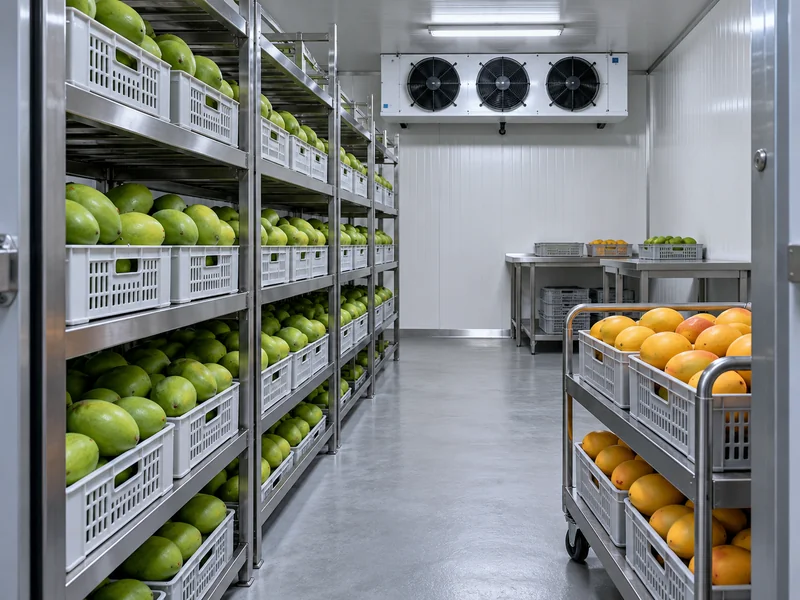
Choose mango storage temperature from ripeness, cultivar, intended holding time and the condition of the fruit at receipt. Mature-green mangoes generally need a warmer storage programme than many temperate fruits, while partially ripe and ripe lots may be handled differently. For LINBLE, the useful design brief is a set of defined mango programmes, rather than one setting marked “fruit.”
1. What Ripeness Stage Is Actually in the Crate?
Classify the lot with more than skin colour. Cultivar, cheek fullness, flesh colour, firmness and the grower’s maturity assessment can all affect the decision. A red blush is not a dependable measure of eating ripeness across mango varieties.
UC Davis’s mango fact sheet gives 13°C for mature-green mangoes and 10°C for partially ripe and ripe mangoes as reference storage temperatures. Treat those figures as starting points for a cultivar- and market-specific programme. They do not establish the correct condition for immature fruit, every treatment history or an unlimited holding period.
Keep the distinction between maturity and ripeness clear at receiving. Fruit harvested too immature will not become a good commercial lot merely because the cold room delays visible change. Record the supplied maturity specification and investigate inconsistent lots before changing the room programme to accommodate them.
What Happens When One Delivery Contains Several Stages?
Split the delivery into manageable lots where the operation allows it. Record the stage, arrival temperature and intended dispatch date for each group. If staff cannot identify which crates belong to which programme, having several controller settings will add little value.
A useful illustrative receiving decision is to place firm mature-green fruit intended for later sale in its defined holding programme, while routing softer fruit toward earlier dispatch or the approved ripening and sales plan. The exact limits must come from the business’s fruit specification. This avoids pretending that every crate has the same remaining life.
2. How Sensitive Is This Cultivar and Lot to Chilling?
Mangoes can develop chilling injury when exposed to unsuitable low temperatures, with the response affected by maturity, cultivar and exposure duration. Symptoms may become clearer after the fruit returns to warmer conditions. A lot that looks acceptable inside the store may therefore still disappoint at ripening or sale.
Ask the supplier for handling guidance for the named cultivar and the route it has already travelled. Include harvest region, transport history and any required treatment. A room specification cannot recover information that has been lost between the farm and the receiving dock.
UC Davis’s postharvest mango handling resource discusses maturity assessment, bruising, temperature and ripening. Its conservative handling context is a reminder to review the particular supply chain before applying a generic lower temperature. Where guidance differs, resolve the programme with the responsible postharvest specialist and product specification.
3. How Long Will the Fruit Stay Cold, and What Happens Next?
Choose the programme against the complete route to the customer. A short buffer before local sale and a longer distribution hold do not create the same quality priorities. Include transport, ripening and retail time rather than spending the whole expected life inside the warehouse.
For mature-green fruit, define whether the objective is to delay ripening until a later stage of the route. For ripe fruit, define how soon it must be dispatched and what firmness is acceptable at delivery. The required exit condition should appear beside the storage temperature in the operating instruction.
| Lot Condition | Planning Question | Useful Control |
| Mature-Green Fruit | How much delay is needed before ripening? | Defined cultivar-specific holding programme |
| Partially Ripe Fruit | Can the lot reach the customer at the required stage? | Frequent firmness checks and dispatch priority |
| Ripe Fruit | How short is the remaining commercial route? | Protected handling and prompt sale or processing |
| Mixed or Uncertain Lot | Can the stages be identified and separated? | Receiving assessment and clear lot identity |
LINBLE’s fruit and vegetable cold room solutions cover chilled holding and ripening-related applications. Explain which of those jobs the project must perform. A storage room holding mangoes is not automatically a validated ripening chamber with the required gas management and safety provisions.
4. How Much Heat Arrives with Each Batch?
Measure the fruit’s incoming condition and the quantity arriving during the busiest period. Warm mangoes create a cooling duty that cannot be estimated from the room’s floor area. If several deliveries arrive together, the peak load may govern the refrigeration selection even when average inventory is modest.
Include fruit size, carton construction, vent openings and pallet pattern. Outer fruit can cool while the centre remains warm, particularly if ventilation openings are blocked by wrapping or misaligned cartons. The loading instruction needs to preserve the route air is expected to take.
LINBLE’s explanation of precooling and storage duties is useful when deciding whether warm receiving belongs in the same space as cold stock. Where the room serves both, account for the effect of new arrivals on fruit already at its target condition. A dedicated receiving or cooling stage may be justified by the delivery pattern.
5. Will the Air Pattern Protect Firmness and Limit Water Loss?
Air should reach the fruit through suitable package openings without leaving ripe mangoes in unnecessary direct discharge. Excessive exposure can contribute to moisture loss, while poor circulation delays cooling. The aim is an effective product route through cooling and holding, with operating conditions suited to each stage.
Discuss the evaporator configuration with the actual rack and pallet drawing. Identify likely cold spots near supply air and warm positions inside dense stacks. The controller setting should be chosen with those differences in mind.
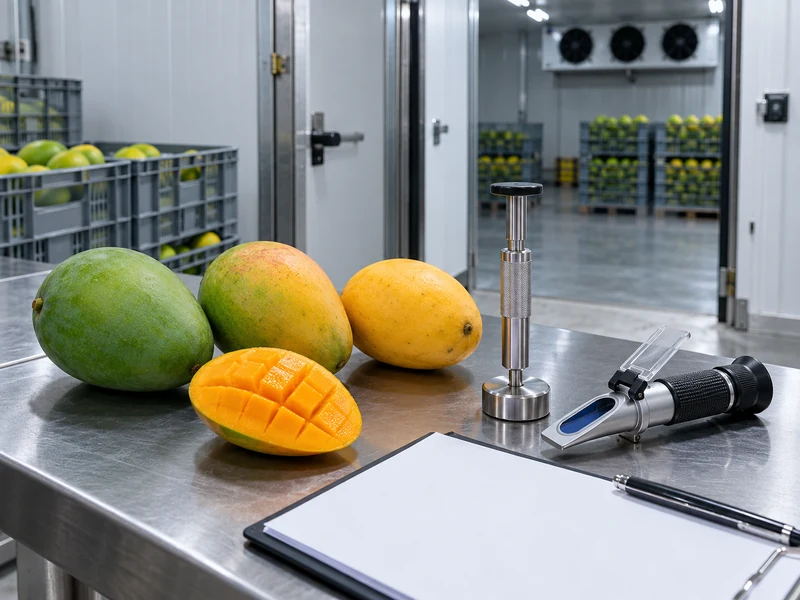
Use room temperature mapping to investigate the installed distribution. Combine it with fruit-temperature checks, because a sensor in free air does not describe the centre of a pallet. Where the acceptable programme is narrow, control accuracy and local variation become particularly important.
6. Can Ripening Fruit Be Kept Separate from Other Programmes?
Ripening mangoes release ethylene and continue to generate respiration heat. The room arrangement must account for the fruit mix and the intended ripening activity. Do not put sensitive greens or other incompatible produce into spare mango positions without reviewing their requirements.
LINBLE’s article on mixed-produce cold storage helps assess those combinations. For mangoes at different stages, the issue is also operational: teams need to know whether a lot is being held back, brought forward or prepared for immediate sale. Separate positions and records should make that intention visible.
Where several programmes are needed simultaneously, assess independently controlled rooms or a revised stock schedule. Alternating a single room between different settings can expose existing stock to conditions selected for a new lot. The saving in partition area should be weighed against the difficulty of maintaining the product plan.
How Could a Mixed Delivery Be Scheduled?
Suppose an illustrative delivery contains firm mature-green fruit and a smaller quantity already softening for near-term sale. Record the two groups separately and confirm their approved handling conditions. Do not lower the whole room setting solely because the softer fruit needs urgent attention.
Place the earlier-dispatch group where staff can remove it without disturbing the longer-hold stock. If the required programmes differ, assign a separate suitable space or revise the delivery and dispatch schedule. Distance from the evaporator is not a reliable substitute for an independently controlled environment.
During the hold, sample the groups separately using the business’s agreed assessment method. A combined average firmness can conceal a soft lot that should already have moved onward. Record any new bruising or decay so that it is not attributed automatically to the temperature programme.
At dispatch, confirm the destination and expected onward conditions before releasing each group. A programme chosen for a short local route may be unsuitable for another journey with a longer ripening stage. The schedule should connect fruit condition to the order being filled, with room capacity and handling access supporting that decision.
What Should the Final Mango Programme Record?
Record the cultivar, maturity and ripeness description, incoming temperature, intended duration, target product condition and dispatch destination. Add the approved loading pattern and the checks used to decide when a lot moves to the next stage. Keep a clear response for fruit with uncertain history or suspected chilling injury.
Send LINBLE those programmes with carton dimensions, daily arrival peaks and the available room layout. Include the split between holding, ripening and dispatch. That information gives the designer a much firmer basis than a request for the coldest room that mangoes can tolerate.