
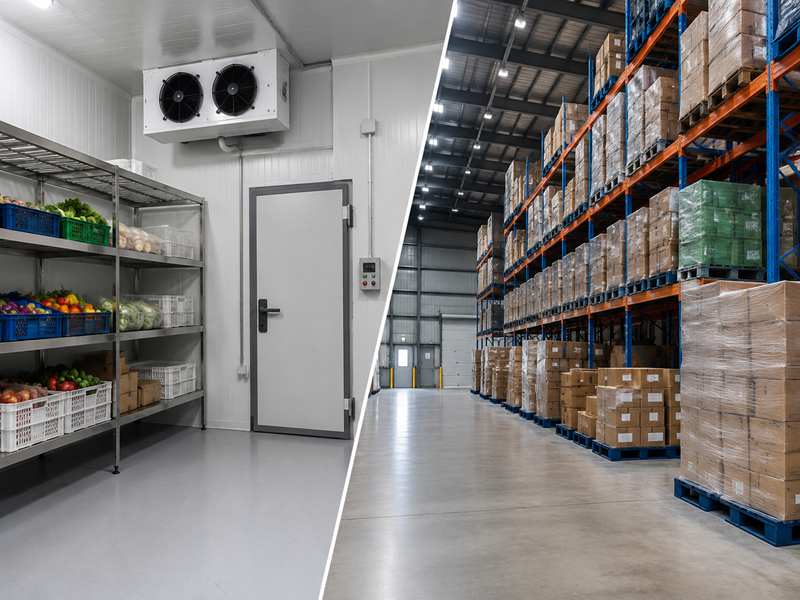
Chiller rooms and cold storage warehouses offer different solutions for temperature-controlled storage. Selecting the right option requires evaluating storage capacity, product types, access frequency, operating conditions, investment costs, and future expansion plans.
Definition of a Chiller Room
A chiller room refers to a small temperature-regulated storage area, which maintains goods under chilled environments and prevents product freezing. It usually consists of insulated panels, refrigeration equipment, doors, and temperature control systems to maintain a stable internal environment.
Chiller rooms are commonly used for products that require frequent access and short-to-medium-term storage. Such spaces find extensive use in catering outlets, supermarkets, food manufacturing plants and pharmaceutical storage scenarios.
Advantages of a Chiller Room
Chiller rooms provide flexible storage solutions for businesses that need convenient product access.
Key advantages include:
- Flexible Installation:
Chiller rooms can be customized according to available space, storage capacity, and specific temperature requirements. - Lower Initial Investment:
Compared with building a large cold storage facility, a chiller room requires less construction space and equipment investment. - Convenient Daily Operation:
Products can be stored close to the working area, making loading and unloading faster for restaurants, kitchens, and production lines. - Easy Expansion:
Modular chiller rooms can often be expanded when storage requirements increase.
Limitations of a Chiller Room
Although chiller rooms are suitable for many applications, they also have some limitations.
- Limited Storage Capacity:
A chiller room is usually designed for small to medium storage volumes and may not meet large inventory requirements. - Less Suitable for Distribution Operations:
Facilities handling large quantities of products may require more advanced storage and logistics management. - Higher Impact from Frequent Access:
Continuous door opening can cause temperature fluctuations if the room design does not match the operating conditions.
Definition of a Cold Storage Warehouse
A cold storage warehouse represents a large refrigeration facility built to stock massive quantities of temperature-sensitive goods. It usually includes larger refrigeration systems, storage racks, loading areas, and logistics management systems.
Cold storage warehouses are commonly used by food suppliers, agricultural companies, distributors, and manufacturers that need centralized storage and long-term inventory control.
Merits of Cold Storage Warehouses
Cold storage warehouses cater to businesses requiring large-volume inventory storage and product distribution capabilities.
Main advantages include:
- Large Storage Capacity:
Warehouses can accommodate high volumes of products and support bulk inventory management. - Efficient Distribution Support:
They are designed for pallet storage, forklift operation, and large-scale product movement. - Better Inventory Management:
Centralized storage allows businesses to manage seasonal products and supply chain operations more efficiently. - Suitable for Long-Term Growth:
A warehouse solution can support companies with increasing storage demand.
Limitations of a Cold Storage Warehouse
Despite their advantages, cold storage warehouses also require higher investment and more complex management.
Common limitations include:
- Higher Construction Cost:
Large facilities require more space, equipment, and infrastructure investment. - More Complex Operation:
Warehouse management usually involves inventory control, loading systems, and regular maintenance. - Higher Energy Requirements:
Maintaining a large refrigerated area requires continuous operation of powerful cooling systems.
Storage Capacity: Small-Scale Storage vs Large Inventory Management
Storage scale constitutes one of the core distinctions between chiller rooms and cold storage warehouses. The choice should be based on current storage demand and expected future growth.
| Comparison Factor | Chiller Room | Cold Storage Warehouse |
| Storage Volume | Small to medium quantities | Large-scale inventory |
| Space Requirement | Compact installation area | Dedicated facility space |
| Best Applications | Restaurants, supermarkets, small factories | Distribution centers and large suppliers |
| Product Handling | Manual handling or small carts | Pallets, forklifts, and logistics systems |
For businesses with daily product usage, a chiller room usually provides better convenience. For companies managing large inventories, a cold storage warehouse offers stronger storage capacity and operational efficiency.
Application Scenarios: Daily Storage vs Distribution Operations
The suitable solution depends greatly on how products are stored, accessed, and distributed.
| Application Scenario | Recommended Solution | Reason |
| Restaurant ingredient storage | Chiller Room | Easy access and flexible installation |
| Supermarket backroom storage | Chiller Room | Suitable for daily product turnover |
| Food processing plant | Both options | Depends on production volume |
| Regional distribution center | Cold Storage Warehouse | Supports bulk storage and logistics |
| Agricultural product storage | Cold Storage Warehouse | Suitable for seasonal inventory |
A chiller room is better for businesses that need products nearby and frequently accessed. If storage and product distribution rank as core business demands, a warehouse scheme will be a more viable option.
Installation Requirements: Flexible Setup vs Large Facility Planning
Installation conditions also influence the selection between these two solutions.
| Factor | Chiller Room | Cold Storage Warehouse |
| Installation Space | Small and adaptable areas | Large dedicated locations |
| Construction Process | Faster installation | Requires detailed planning |
| System Complexity | Simple refrigeration setup | Advanced cooling and management systems |
| Customization | High flexibility | Designed around large-scale operation |
Chiller rooms are easier to integrate into existing buildings, while cold storage warehouses usually require more planning for layout, loading areas, and equipment placement.
Operating Cost: Initial Investment and Long-Term Expenses
Cost evaluation should include both installation expenses and long-term operation.
| Cost Factor | Chiller Room | Cold Storage Warehouse |
| Initial Investment | Lower | Higher |
| Energy Consumption | Lower due to smaller space | Higher due to larger capacity |
| Maintenance Complexity | Easier maintenance | Requires professional management |
| Long-Term Efficiency | Suitable for smaller operations | Better for large-scale storage |
Choosing a larger system does not always mean better value. The optimal refrigeration scheme is the one that fits on-site actual storage demands.
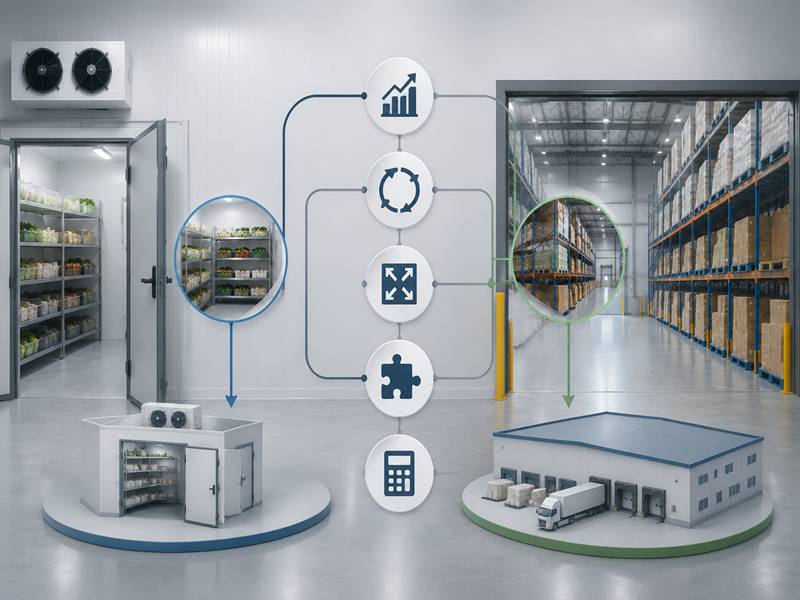
Tips for Choosing Appropriate Cold Storage Facilities
Multiple practical variables will determine the optimal selection:
1. Assess the required storage capacity
Businesses with limited inventory and frequent product usage usually benefit from a chiller room. Companies storing large quantities for longer periods should consider a cold storage warehouse.
2. Consider Product Turnover Rate
Products that move quickly through daily operations are easier to manage with a chiller room. Warehouses are more suitable for products requiring centralized storage.
3. Analyze Available Space
A chiller room can be installed in smaller areas, while a warehouse requires sufficient land and infrastructure planning.
4. Review Future Expansion Needs
Growing businesses should consider whether storage demand will increase. Modular chiller rooms provide flexibility, while warehouses support larger expansion plans.
5. Balance Investment and Operating Costs
The selected solution should provide a balance between initial budget, energy consumption, maintenance requirements, and long-term business needs.