
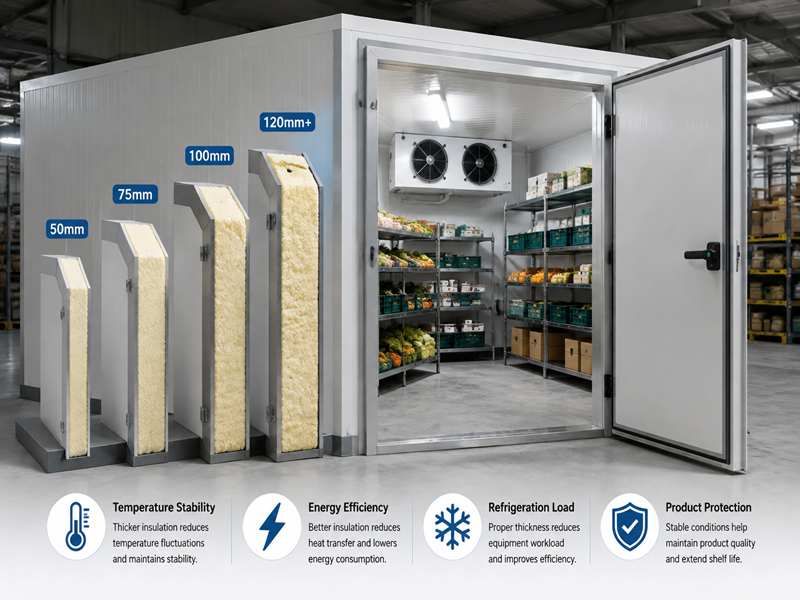
Insulation thickness directly affects chiller room performance by controlling heat transfer, maintaining temperature stability, reducing energy consumption, and improving refrigeration efficiency for reliable cold storage operations.
Insulation Thickness Options for Different Chiller Room Applications
Different chiller room applications require different insulation thicknesses based on storage conditions, operating frequency, and cooling requirements. The following table provides a general reference for selecting suitable insulation thickness.
| Application | Recommended Thickness Range | Main Purpose |
| Small Restaurant Chiller Room | 50–75 mm | Suitable for daily ingredient storage and basic cooling needs |
| Supermarket Storage Room | 75–100 mm | Provides balanced insulation performance and operating efficiency |
| Food Processing Facility | 100–120 mm | Supports stable temperatures for continuous operation |
| Large Commercial Storage | 120 mm+ | Handles higher cooling loads and demanding environments |
The suitable thickness depends on room size, product requirements, local climate, and refrigeration system design. A thicker insulation layer is not always the best choice because excessive investment may not provide proportional performance improvements.
The Influence of Insulation Thickness on Chiller Room Operating Performance
Insulation thickness determines how effectively a chiller room reduces heat transfer between the indoor cold environment and external surroundings. Proper insulation performance helps refrigeration equipment operate more efficiently and maintain stable storage conditions.
| Performance Area | Effect of Suitable Insulation Thickness |
| Temperature Stability | Reduces temperature fluctuations and improves recovery speed |
| Energy Consumption | Lowers cooling loss and reduces refrigeration workload |
| Equipment Performance | Helps maintain stable refrigeration operation |
| Product Protection | Supports consistent storage conditions |
1. Impact on Temperature Stability
Insulation thickness has a direct influence on how well a chiller room maintains its target temperature. When insulation is insufficient, external heat can enter the room more quickly, causing larger temperature variations.
| Insulation Condition | Temperature Performance |
| Thin Insulation Layer | Faster heat transfer and unstable temperature control |
| Suitable Thickness | Stable temperature and better recovery after door opening |
| Excessive Thickness | Higher investment with limited additional improvement |
For restaurants, supermarkets, and food facilities with frequent loading and unloading activities, proper insulation thickness helps the chiller room recover temperature faster after warm air enters.
Stable temperature control is especially important for products such as fresh meat, dairy products, and vegetables, which are sensitive to temperature changes.
2. Impact on Energy Consumption
Insulation thickness directly affects the amount of cooling energy required during daily operation. When heat transfer is reduced, the refrigeration system does not need to operate as frequently to maintain the required temperature.
Better insulation performance helps:
- Reduce heat entering the chiller room
- Shorten compressor operating time
- Lower unnecessary energy consumption
Increasing insulation thickness or selecting higher-performance insulation materials may increase initial construction costs by approximately 5–15%. However, for chiller rooms operating continuously, better insulation can help reduce long-term cooling expenses.
For commercial applications, the most suitable choice is usually not the thickest insulation panel but the one that provides the best balance between investment and operating efficiency.
3. Impact on Refrigeration System Load
The insulation performance of a chiller room directly affects refrigeration system requirements. Inadequate insulation leads to higher heat infiltration, making compressors and cooling parts run under heavier loads.
| Insulation Performance | Effect on Refrigeration System |
| Poor Insulation | Higher cooling demand and longer equipment operation |
| Suitable Insulation | More stable cooling load and efficient operation |
| Improved Insulation | Reduced heat gain and better system performance |
A well-insulated chiller room enables the refrigeration unit to stabilize temperatures with lower energy consumption. This can also help businesses select a more suitable cooling capacity instead of installing oversized equipment.
For larger storage facilities, insulation design and refrigeration system selection should be considered together during project planning.
4. Impact on Product Storage Quality
Maintaining stable temperatures is essential for protecting stored products. Insufficient insulation may create temperature fluctuations that affect freshness, shelf life, and storage reliability.
Proper insulation thickness helps:
- Maintain consistent internal conditions
- Reduce temperature changes caused by external environments
- Protect temperature-sensitive products
- Improve storage reliability
For example, food processing facilities handling dairy products, seafood, or fresh meat usually require stronger temperature control than small commercial storage rooms.
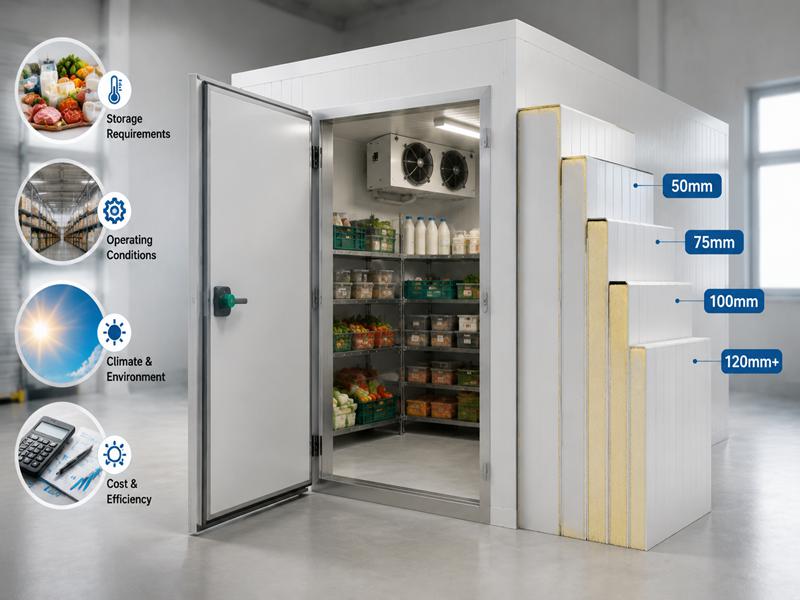
How to Select the Suitable Insulation Thickness for a Chiller Room?
Selecting insulation thickness requires evaluating storage requirements, operating conditions, and long-term costs. The optimal insulation choice depends on practical working conditions instead of blindly picking the thickest material.
1. Match Thickness with Storage Requirements
Different products have different temperature control requirements. A restaurant storing daily ingredients may need a different insulation specification compared with a food processing facility requiring continuous operation.
The stored product type, storage duration, and temperature sensitivity should all be considered before selecting insulation thickness.
2. Consider Room Size and Operating Conditions
Larger chiller rooms usually have more wall and ceiling areas exposed to external conditions. Higher-performance insulation might be needed to slow heat transfer and sustain steady internal temperatures.
Facilities with frequent door opening, high product movement, or large inventory volumes should pay more attention to insulation performance.
3. Evaluate Climate and Installation Environment
The surrounding environment affects insulation requirements. Chiller rooms installed in hot climates or areas with large temperature differences usually require better thermal protection.
Outdoor installations may also need stronger insulation designs because external heat exposure is generally higher than indoor environments.
4. Balance Initial Cost and Long-Term Efficiency
Thicker insulation panels usually require higher upfront investment. However, selecting suitable insulation performance can help reduce cooling loss and support lower operating costs over the service life of the chiller room.
The best solution should consider both installation budget and future energy consumption.
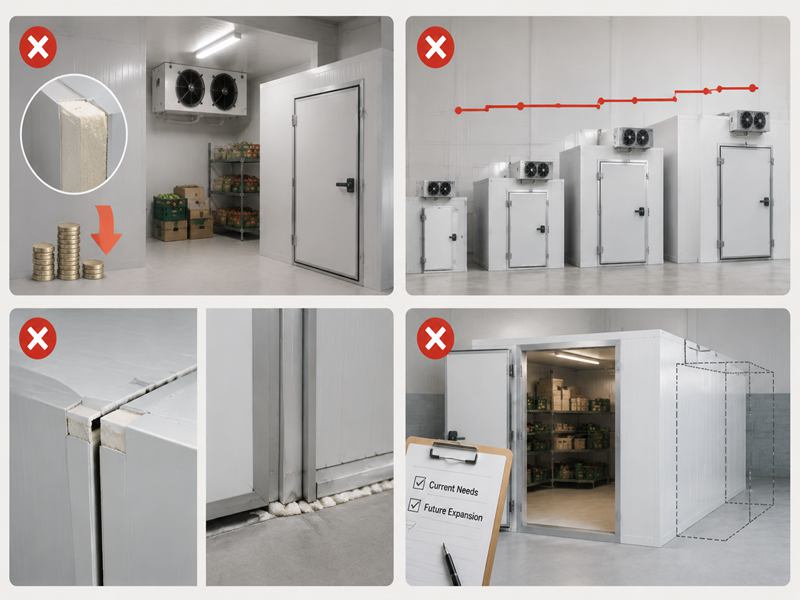
Typical Errors in Determining Insulation Thickness
1. Deciding Insulation Thickness Merely According to Cost
Choosing thinner insulation panels only to reduce initial costs may lead to higher refrigeration workload and increased energy expenses over time.
2. Applying Uniform Insulation Thickness to All Projects
Various usage scenarios come with distinct storage standards. A small restaurant and a large food storage facility usually require different insulation solutions.
3. Ignoring Installation Quality
Even high-quality insulation materials may not perform properly if installation details are overlooked. Proper sealing, panel connection, and construction accuracy are also important for maintaining insulation performance.
4. Ignoring Future Storage Requirements
Selecting insulation thickness only based on current needs may limit future expansion. Considering possible changes in storage demand helps maintain long-term chiller room performance.