
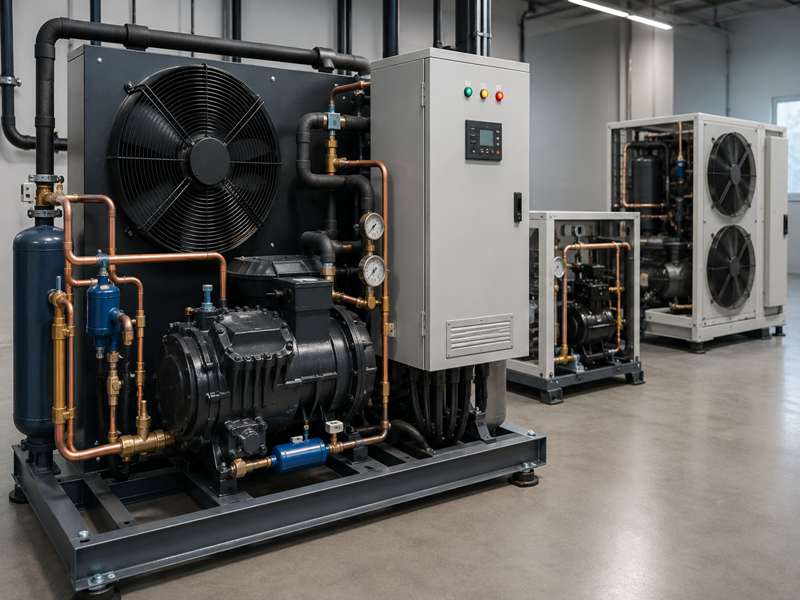
Selecting the right refrigeration unit is essential for maintaining stable freezer room temperatures and ensuring reliable long-term operation. The suitable system should match storage requirements, product conditions, installation environment, and future business needs.
What Is a Freezer Room Refrigeration Unit?
A freezer room refrigeration unit is the core system responsible for removing heat from the storage area and maintaining the required low-temperature environment.
The refrigeration unit absorbs heat from inside the freezer room and transfers it outside, allowing the internal temperature to remain within the required range. A properly selected system helps maintain product quality and supports stable daily operation.
Key Components of Refrigeration Systems
- Compressor:
The compressor serves as the main power driver for the refrigeration loop.It compresses refrigerant and helps maintain continuous cooling operation. - Condenser:
The condenser releases the heat collected from inside the freezer room. Its performance affects overall cooling efficiency. - Evaporator:
The evaporator extracts heat inside the storage chamber to sustain target low temperatures. - Control System:
The control system manages temperature settings and monitors operating conditions to support stable performance.
Understanding the function of each component helps businesses better evaluate whether a refrigeration unit is suitable for their freezer room application.
What to Consider When Selecting a Freezer Room Refrigeration Unit
The right refrigeration unit should be selected according to actual operating requirements rather than general specifications. Several factors directly affect cooling performance, energy consumption, and long-term reliability.
1. Match Cooling Capacity with Storage Requirements
Cooling output is a core criterion for refrigeration system selection. The system needs to provide enough cooling power to maintain the required temperature under normal operating conditions.
A common mistake is selecting a unit only according to freezer room size. In reality, storage volume, product quantity, loading frequency, and heat entering the room can also influence cooling demand.
Businesses should consider:
- Freezer room dimensions
- Storage capacity
- Product quantity
- Product loading frequency
- Door opening frequency
- Ambient temperature around the installation area
| Storage Condition | Cooling Requirement |
| Small freezer room with limited products | Standard cooling capacity may be sufficient |
| Medium storage with regular product access | Requires balanced cooling performance |
| Large storage with frequent loading | Requires stronger cooling capacity and faster temperature recovery |
For example, a supermarket freezer room with frequent product movement usually requires better temperature recovery ability than a small restaurant storing frozen ingredients. A properly sized refrigeration unit can maintain stable performance without excessive energy consumption.
2. Choose the Suitable Refrigeration System Type
Different freezer rooms may require different refrigeration system designs. The selection depends on storage scale, installation conditions, and operating requirements.
Common refrigeration options include:
| System Type | Suitable Application | Main Characteristics |
| Split-type Refrigeration System | Medium-to-large Freezer Cold Rooms | Features flexible field installation and reliable cooling performance |
| Monoblock Unit | Small freezer rooms | Compact structure and easier installation |
| Centralized Refrigeration System | Large facilities | Suitable for multiple storage areas |
Small businesses may prefer simpler systems with easier installation and lower complexity. Larger facilities usually require solutions with stronger control capability, higher reliability, and better flexibility for future expansion.
The refrigeration system type should also match maintenance conditions. Hard-to-access systems for inspection and maintenance will raise later-stage operational troubles.
3. Consider Temperature Control Requirements
Different products have different temperature requirements. The refrigeration unit should maintain stable conditions according to the stored products and daily operation patterns.
Important considerations include:
- Required storage temperature
- Temperature fluctuation tolerance
- Cooling recovery speed
- Product sensitivity
- Storage duration
| Storage Requirement | Selection Consideration |
| General frozen products | Stable temperature maintenance |
| Frequently accessed products | Faster temperature recovery |
| Temperature-sensitive products | More precise temperature control |
A refrigeration unit that only matches the room size may not provide reliable performance if product requirements are ignored. For businesses storing valuable or sensitive products, stable temperature control is especially important.
4. Evaluate Installation and Maintenance Conditions
The installation environment affects refrigeration efficiency and future maintenance. A suitable refrigeration unit should fit the available space and allow convenient inspection.
Businesses should evaluate:
- Installation location
- Ventilation conditions
- Maintenance accessibility
- Equipment service requirements
- Surrounding temperature conditions
A system installed in a hot or poorly ventilated area may experience higher operating pressure and reduced efficiency. Proper installation planning helps maintain stable performance and reduces future maintenance difficulties.
Maintenance convenience should also be considered before purchase. Easy access to important components can reduce service time and improve equipment availability.
5. Balance Energy Efficiency and Long-Term Cost
The initial purchase price is only one part of the total investment. Energy consumption, maintenance requirements, and equipment reliability also influence long-term operating costs.
| Selection Factor | Long-Term Impact |
| Proper Cooling Capacity | Prevents unnecessary energy consumption |
| Efficient Compressor System | Improves operating efficiency |
| Easy Maintenance Design | Reduces downtime and service costs |
For businesses using freezer rooms every day, selecting an efficient refrigeration unit can provide better long-term value than focusing only on initial investment.
A lower-cost system may appear attractive at the beginning, but higher energy consumption or frequent maintenance can increase operating expenses over time. A balanced choice should consider both current budget and future usage costs.
Additional Features to Improve Freezer Room Performance
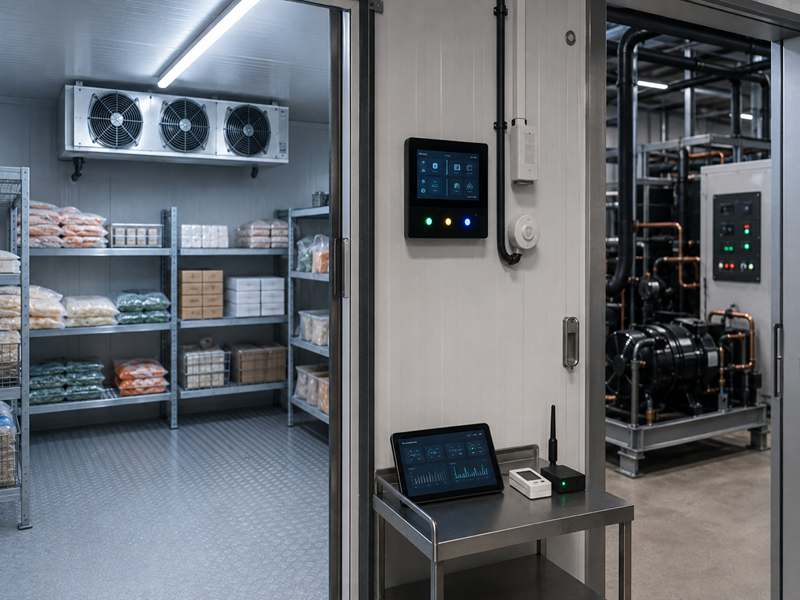
Besides basic cooling performance, additional features can improve freezer room management and make daily operation more convenient. Businesses should select useful functions based on actual needs instead of adding unnecessary options.
Important features may include:
- Temperature Monitoring System:
Real-time temperature tracking helps operators understand storage conditions and identify abnormal changes quickly. It is especially useful for businesses that need continuous temperature supervision. - Automatic Defrost Function:
Automatic defrosting helps reduce ice buildup on evaporators and maintain stable cooling performance. It can also reduce manual maintenance requirements. - Remote Control Capability:
Remote access allows operators to check equipment conditions and adjust settings without being physically present near the freezer room. - Energy-Saving Components:
Efficient compressors and control systems can reduce unnecessary energy consumption during long-term operation.
These features can improve operating efficiency, but the selection should still focus on whether they provide practical value for the specific freezer room application.
Matching the Refrigeration Unit with Your Business Needs
The suitable refrigeration unit should match the actual working conditions of the freezer room rather than only focusing on equipment specifications. Operators shall analyze storage needs, operating modes and long-term expansion plans before purchase.
Key considerations include:
- Storage Requirements:
Consider product quantity, storage duration, and required temperature conditions. - Daily Operation:
Evaluate product access frequency, loading activities, and temperature recovery needs. - Installation Conditions:
Check available space, ventilation conditions, and maintenance accessibility. - Future Development:
Anticipate possible storage growth and confirm system compatibility with future adjustments.
For instance, small restaurants need compact units for daily frozen supplies, whereas food processors require high‑power equipment for large‑scale continuous cold storage.
Choosing a refrigeration unit based on actual business conditions helps avoid unnecessary investment and provides more stable long-term performance.