
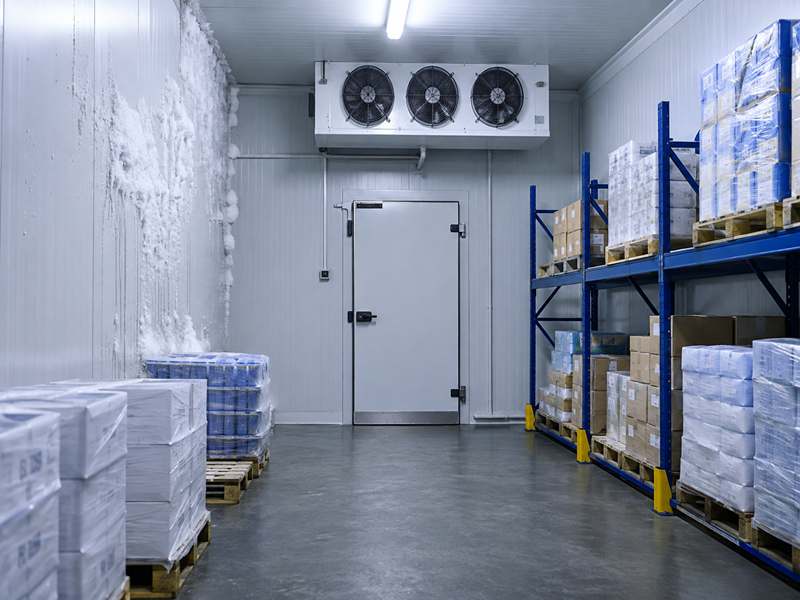
Ice accumulation on freezer room walls is a common issue that can affect storage efficiency, product access, and long-term equipment performance. Preventing ice buildup requires proper insulation, temperature control, airflow management, and suitable daily operation practices.
Why Does Ice Accumulation Occur on Freezer Room Walls?
Ice forms when moisture from outside air enters the freezer room and freezes on cold surfaces. The problem usually appears when warm air, high humidity, or temperature fluctuations affect the internal environment.
Identifying the root cause carries greater weight than merely clearing visible ice layers. Repeated ice buildup usually indicates problems related to insulation, air leakage, temperature control, or daily operation.
Common causes include:
- Poor Insulation Performance:
Weak insulation allows external heat to transfer through freezer room walls. When warm air contacts cold surfaces, condensation develops and eventually solidifies into ice. - Air Leakage ThroughOpen Gaps:
Damaged door seals, poor panel connections, or installation gaps can allow humid air to enter the room and increase ice formation. - Frequent Door Opening:
Each door opening introduces warmer air and moisture into the freezer room. Frequent access may increase condensation on cold surfaces. - Improper Temperature Control:
Temperature fluctuations caused by unsuitable cooling capacity or unstable operation can create conditions for repeated frost formation.
The actual cause of ice accumulation may involve several factors at the same time. For example, a freezer room with frequent access and weak door sealing may experience more serious icing than a system with only one issue.
Solution 1: Improve Insulation Performance to Reduce Wall Icing
Insulation stands as a major factor influencing internal ice accumulation. A well-designed insulation system helps separate the cold storage environment from external temperature and humidity.
When insulation performance is insufficient, heat can continuously enter through walls, ceilings, or panel connections. The refrigeration system then needs to work harder, while moisture may freeze on colder surfaces.
When selecting or evaluating insulation systems, businesses should consider:
- Panel Thickness:
Suitable thickness helps reduce heat transfer and maintain stable internal temperatures. - Material Performance:
High-quality insulation materials provide better thermal protection and long-term durability. - Sealing Quality:
Correctly assembled panel joints minimise air leakage and block moisture from penetrating concealed regions. - Installation Accuracy:
Even good insulation panels may lose performance if gaps appear during installation.
For example, a food processing facility operating in a warm and humid environment usually requires stronger insulation performance than a small restaurant freezer room used only for daily ingredient storage.
Solution 2: Maintain Proper Temperature Control
Stable temperature control plays an important role in preventing ice accumulation. A freezer room that frequently experiences temperature changes is more likely to create condensation and frost problems.
Temperature stability can be affected by several factors, including refrigeration capacity, product loading frequency, door opening habits, and equipment performance.
Businesses should pay attention to:
- Temperature changes during daily operation
- Cooling recovery after door opening
- Difference between target temperature and actual temperature
- Performance changes during heavy loading periods
| Temperature Condition | Possible Result |
| Stable low temperature | Lower risk of condensation and icing |
| Frequent temperature changes | Increased moisture freezing risk |
| Slow temperature recovery | Longer exposure to unstable conditions |
A suitable refrigeration system should match the actual freezer room requirements. Maintaining stable operating conditions helps reduce repeated ice formation on walls and other cold surfaces.
Solution 3: Reduce Moisture Entry Through Door Management
The freezer room door is one of the main areas where warm and humid air enters. Frequent door opening increases moisture exchange between the inside and outside environment.
Effective door management includes:
- Keeping doors closed when not in use
- Checking door seals regularly
- Selecting suitable door types based on access frequency
- Reducing unnecessary opening time
For supermarkets and food processing facilities, employees may need frequent access to frozen products throughout the day. In these situations, door sealing performance and operating habits have a direct impact on ice formation.
A well-designed door system reduces air leakage and helps the refrigeration system maintain a more stable environment.
Solution 4: Improve Airflow and Storage Arrangement
Air circulation affects how evenly temperature is distributed inside a freezer room. Poor airflow may create areas where cold air cannot move effectively, increasing the possibility of frost and ice formation.
Proper storage arrangement helps maintain better air movement throughout the room.
Businesses should consider:
- Keeping sufficient space between products and walls
- Avoiding blocking evaporator airflow
- Maintaining organized storage areas
- Checking locations where ice appears repeatedly
When products are placed too close to walls, airflow may become restricted. This can create temperature differences and make certain areas more likely to develop ice buildup.
Solution 5: Use Proper Defrost Management
Even with good insulation and temperature control, some frost may still form during normal freezer room operation. A suitable defrost method helps remove accumulated ice and maintain system efficiency.
Common defrost methods include:
- Automatic Defrost:
Suitable for businesses requiring continuous operation and reduced manual maintenance. - Manual Defrost:
Suitable for smaller freezer rooms with lower usage frequency. - Scheduled Defrost:
Allows businesses to arrange defrost cycles according to actual operating conditions.
The correct defrost method depends on freezer room size, usage frequency, and product storage requirements. Systematic defrost maintenance keeps slight ice accumulation from escalating into severe operational issues.
How Does Ice Accumulation Impact Freezer Room Operational Performance?
Ice accumulation on freezer room walls is not only a visual issue. When ice continues to build up, it may affect storage space, cooling efficiency, and daily operation.
The impact of excessive ice buildup includes:
- Reduced Storage Space:
Thick ice layers can occupy internal space and make product arrangement more difficult, especially in smaller freezer rooms. - Lower Cooling Efficiency:
Ice buildup on surfaces may affect heat exchange and increase the workload of the refrigeration system. - More Difficult Daily Management:
Heavy ice formation may make cleaning, product handling, and equipment inspection more complicated.
For businesses such as supermarkets and food processing facilities, ice accumulation can create additional operating challenges. Addressing the problem early helps maintain a cleaner storage environment and reduces unnecessary maintenance work.
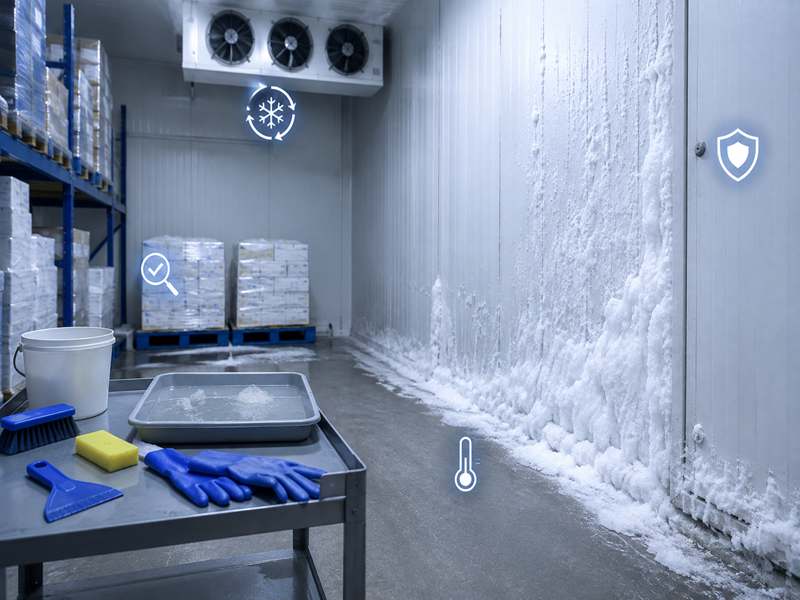
Safe Practices for Removing Existing Ice
Even with proper prevention measures, some ice may still appear during long-term operation. Removing ice correctly helps avoid damage to freezer room components and maintains normal storage conditions.
When removing ice buildup:
- Avoid using sharp tools that may damage insulation panels or refrigeration components.
- Use suitable defrost methods according to the thickness of ice accumulation.
- Check the possible cause after removal to prevent repeated problems.
- Ensure the freezer room returns to the required temperature before storing sensitive products.
Merely clearing ice without tracing its source can only resolve the issue for a short period. A long-term solution requires controlling moisture, temperature changes, and equipment operation.