
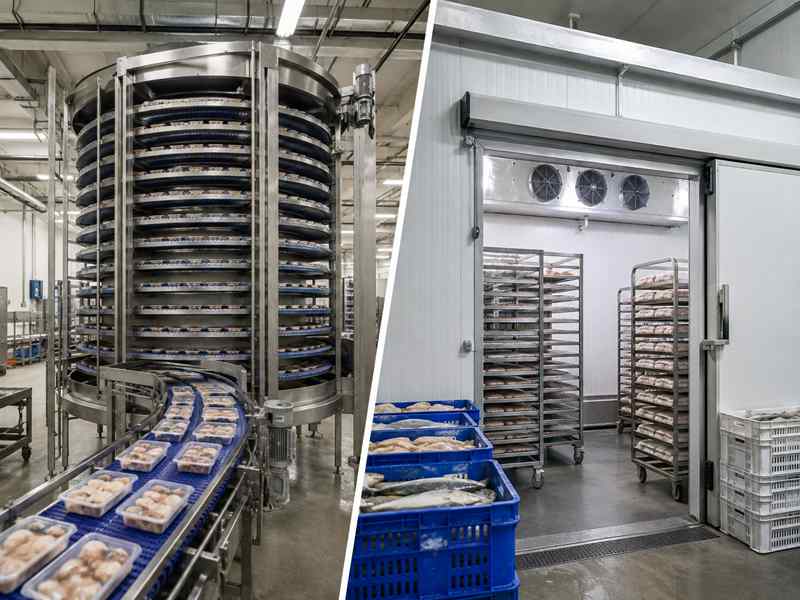
Choosing between a spiral freezer and a blast freezer room depends on production volume, product types, available space, and daily operation requirements. Though both systems deliver fast freezing capacity, they are engineered to fit distinct production modes.
What Are Spiral Freezer and Blast Freezer Room?
Spiral Freezer
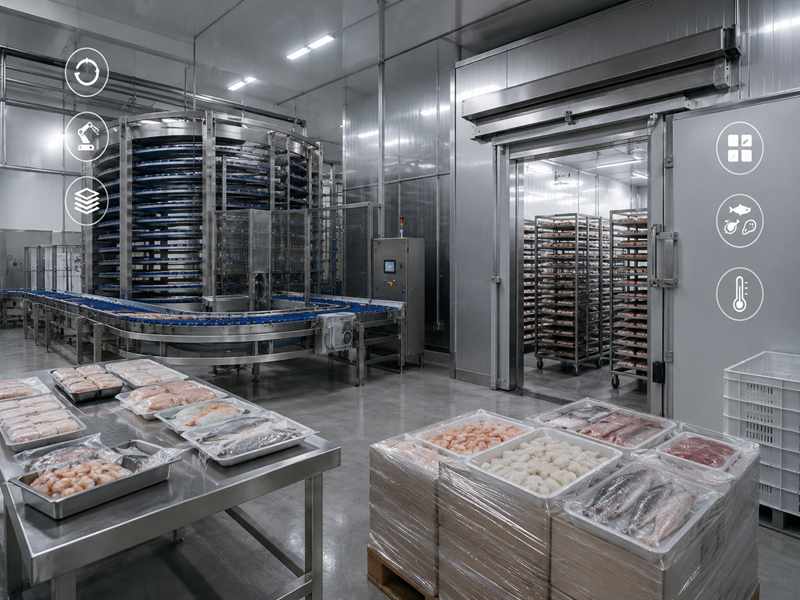
A spiral freezer represents a continuous freezing setup. It adopts conveyor structures to transport goods across several freezing tiers. Products enter and exit automatically, making it suitable for large-scale production lines.
Its main characteristics are:
- Continuous freezing operation
- Automated product movement
- High production capacity within limited floor space
Advantages:
- Supports continuous production with stable freezing output
- Reduces manual handling through automated operation
- Saves floor space with vertical spiral design
Disadvantages:
- Requires production line planning before installation
- Higher initial investment due to automation and conveyor systems
- Less flexible when frequently changing product types
Spiral freezers are commonly used in businesses with stable production output. For example, a frozen food factory producing packaged products every day may need a freezing system that works continuously with forming and packaging equipment.
Blast Freezer Room
A blast freezer room is a batch freezing system that uses high-speed cold air circulation to quickly reduce product temperature. Products are loaded into the room according to production schedules and freezing requirements.
Its main characteristics are:
- Flexible batch freezing
- Adjustable loading capacity
- Suitable for different product types
Advantages:
- Provides flexible freezing schedules for different products
- Easier to adjust according to changing production quantities
- Suitable for businesses requiring independent freezing areas
Disadvantages:
- Requires more manual loading and unloading operations
- Needs sufficient space for product arrangement and access
- Less suitable for continuous high-volume production lines
Blast freezer rooms are often selected by businesses that need more flexibility. A seafood processor handling different product quantities every day may prefer this solution because freezing demand changes with product availability.
Spiral Freezer vs Blast Freezer Room: Main Differences
Although both systems are designed for rapid freezing, their operating methods and application scenarios are different.
| Comparison Factor | Spiral Freezer | Blast Freezer Room |
| Freezing Method | Continuous conveyor freezing | Batch cold air freezing |
| Production Capacity | High-volume continuous production | Flexible batch production |
| Product Management | Suitable for standardized products | Suitable for different product types |
| Installation Requirements | Requires production line planning | Provides flexible installation options |
| Operation and Maintenance | Higher automation with more complex maintenance | Simpler operation with easier adjustment |
The comparison shows that spiral freezers focus more on continuous production efficiency, while blast freezer rooms provide greater flexibility for changing business needs.
1. Freezing Method Comparison
The freezing method affects how products move through the system and how businesses organize daily production.
Spiral Freezer
- Uses continuous conveyor-based freezing
- Products move automatically through different freezing stages
- Suitable for fixed production processes
Spiral freezers work well when products follow a consistent production route. They can connect with processing and packaging equipment to create a smoother production flow.
Blast Freezer Room
- Uses batch freezing with high-speed cold air circulation
- Products are loaded according to actual requirements
- Suitable for different freezing schedules
Blast freezer rooms provide more control over each freezing batch, making them practical for businesses that handle different products or changing production quantities.
2. Production Capacity Comparison
Production volume is one of the most important factors when selecting freezing equipment. Businesses should choose a system that matches their daily output rather than only focusing on freezing speed.
Spiral Freezer
- Designed for high-volume continuous production
- Matches automated processing and packaging lines
- Maintains stable freezing capacity during long operation periods
For example, a large frozen food manufacturer producing thousands of packaged products daily may benefit from a spiral freezer because the freezing process can keep pace with production speed.
Blast Freezer Room
- Suitable for batch-based production
- Handles changing product quantities more easily
- Allows businesses to adjust freezing schedules
A medium-sized food business with seasonal demand changes may find a blast freezer room more practical because it can operate according to actual production needs.
3. Product Management Comparison
Product type and storage management also influence the suitable freezing solution. Businesses handling standardized products usually require different equipment compared with those managing multiple product categories.
Spiral Freezer
- Better for standardized product lines
- Supports fixed product flow
- Reduces repeated manual movement
Spiral freezers are suitable when product size, packaging method, and production speed remain consistent.
Blast Freezer Room
- Suitable for multiple product categories
- Allows flexible loading arrangements
- Easier to adjust freezing plans
Blast freezer rooms provide more freedom when businesses need to freeze different products at different times.
4. Installation Requirements Comparison
Installation conditions can directly affect project feasibility. Businesses should consider available space, factory layout, and how the freezing system connects with existing operations.
Spiral Freezer
- Saves floor space through vertical design
- Requires production line planning
- Usually needs integration with conveyors and related equipment
Spiral freezers are suitable for factories with fixed layouts and clear production processes.
Blast Freezer Room
- Provides more installation flexibility
- Requires loading and unloading areas
- Easier to install as an independent freezing space
Blast freezer rooms are suitable for businesses that need flexible layouts or want to expand freezing capacity separately.
5. Operation and Maintenance Comparison
Long-term operation requirements should also be considered when selecting freezing equipment. Maintenance needs, labor requirements, and daily management methods can affect overall operating efficiency.
Spiral Freezer
- Provides higher automation
- Reduces manual product handling
- Requires professional maintenance for mechanical systems
For large production facilities, automation can improve efficiency and reduce labor requirements.
Blast Freezer Room
- Has simpler operating methods
- Easier for operators to adjust usage
- Requires more manual loading and unloading
For smaller businesses or companies with changing production requirements, simpler management may provide greater convenience.
Which Option Fits Your Business Requirements Better?
The right choice depends on how the freezing system fits into the business operation model.
Go for a Spiral Freezer Under These Circumstances:
A spiral freezer works best for companies with the following operational demands:
- Continuous production operation
- Large daily freezing capacity
- Automated processing lines
- Stable product output
Typical users include large frozen food factories, industrial bakeries, and businesses with standardized production processes.
Go for a Blast Freezer Room Under These Circumstances:
A blast freezer room is more suitable for businesses that need:
- Flexible freezing schedules
- Different product handling
- Batch production control
- Adjustable storage capacity
Typical users include seafood processors, restaurants, catering suppliers, and medium-sized food businesses.
Before making a decision, businesses should evaluate production volume, product types, installation conditions, and future expansion plans.