
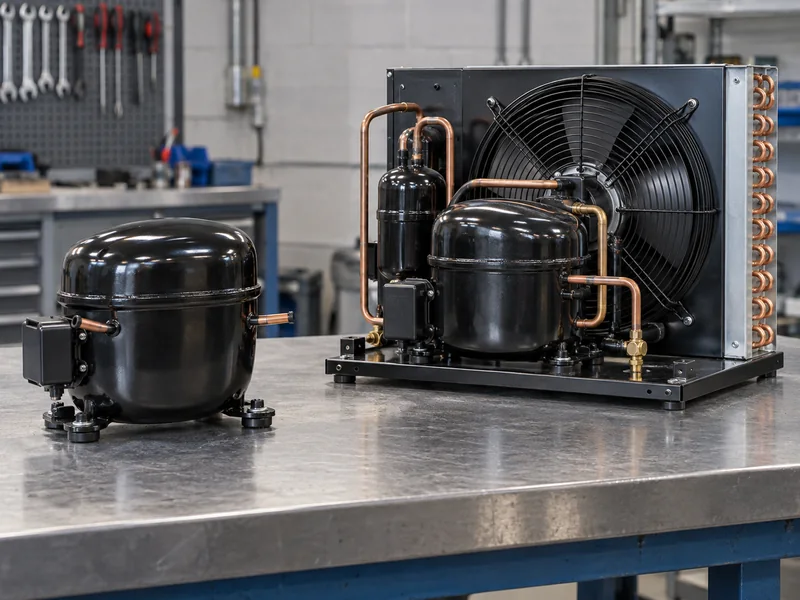
Replacing only the compressor can make sense when the failure has been diagnosed, the remaining equipment is in good condition and a suitable replacement is available. Replacing the entire condensing unit deserves consideration when several components need attention, compatibility is uncertain or the complete replacement offers a clearer service and warranty package. The decision should follow a system assessment, not a rule based only on equipment age.
For a cold-room owner, the immediate pressure is usually stock protection and downtime. Separate that urgent operating problem from the longer-term equipment decision. Arrange appropriate temporary storage first, then ask for written repair and replacement options that can be compared on the same basis.
Understand The Scope Of Each Option
A compressor replacement retains most of the existing installation. A condensing-unit replacement generally renews the outdoor or remote assembly containing the compressor and condenser, together with the components included in that particular package. It does not automatically replace the evaporator, field piping, room controls or enclosure.
That boundary matters. A new condensing unit connected to a faulty evaporator or unsuitable controls can leave important problems unresolved. Ask the contractor to mark every retained and replaced component on the quotation.
LINBLE’s cold room condensing unit page introduces the equipment category, but the final replacement must be selected against your existing system details. A matching physical size or similar compressor horsepower is not enough to establish suitability.
Get A Diagnosis Before Accepting A Parts List
Ask the technician to explain what failed and what evidence supports the diagnosis. The report should distinguish a failed compressor from a fault elsewhere that prevents normal operation. It should also describe any contributing problem that the proposed work will correct.
Copeland’s repair and replacement guidance emphasises identifying the root cause and checking system conditions to reduce repeat failures. For an owner, the practical implication is straightforward: the quotation should describe corrective work, not merely list the replacement compressor.
A useful report answers three questions. What happened? What needs to be corrected before the equipment returns to service? What will be checked at commissioning to show that the correction worked?
Clarify Whether Contamination Changes The Scope
Some failures require more than exchanging a component. Ask the contractor whether the condition of the refrigerant circuit requires cleaning, filter-drier work or further checks. Request the applicable manufacturer procedure and have the contractor identify which steps are included.
Copeland’s compressor-failure training material treats root-cause correction and system cleanup as part of preventing another failure. It should not be reduced to a universal do-it-yourself repair recipe. The work depends on the equipment and the diagnosed failure.
Replacing the complete condensing unit may remove some affected components, but it does not automatically resolve the condition of retained piping and evaporators. Ask how the contractor will assess those parts before choosing either option.
Assess The Components That Would Remain
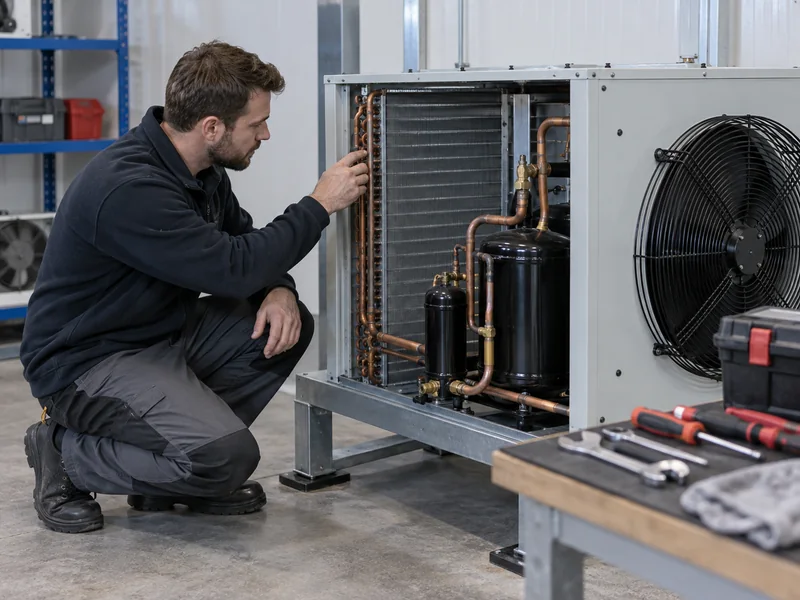
Request a condition review of the condenser, fans, electrical controls, frame and accessible connections. Note recurring leaks, previous repairs and evidence of damage. A compressor-only price is incomplete if other known defects will require a return visit soon afterwards.
Extend the review to the indoor cold room evaporator, drainage and controls. Document any existing performance problem that predates the compressor failure. Otherwise, the owner and contractor may have different expectations about what the replacement will solve.
Review service records for patterns rather than simply counting visits. Repeated attention to the same issue may point to an unresolved cause. Routine maintenance visits, by contrast, should not be treated as proof that the system is unreliable.
Confirm Replacement Compatibility In Writing
Give the contractor photographs of all relevant nameplates and any available original selection documents. Confirm the refrigerant, electrical supply, intended room temperature and operating environment. Ask for the exact proposed equipment identification before authorising the order.
For a compressor replacement, request a documented selection or manufacturer-supported cross-reference for the duty. For a complete condensing unit, ask how the retained evaporator, expansion device, piping and controls have been reviewed. A convenient in-stock unit is not necessarily the correct replacement.
Our guide to condensing-unit selection factors can help organise the discussion. The aim is a supported selection at the actual operating conditions, with any required changes listed as part of the job.
Compare Two Complete Quotations
| Question | Compressor replacement | Condensing-unit replacement |
| What is renewed? | Compressor and explicitly listed associated parts | Components included in the specified assembly |
| What remains? | Most existing equipment and field installation | Usually the evaporator, piping and parts of the control system |
| What must be verified? | Root cause, remaining condition and replacement compatibility | Root cause, retained-system condition and new-unit compatibility |
| What drives downtime? | Parts availability and the complete repair procedure | Unit delivery, installation changes and commissioning |
| What should the price include? | Corrective work, refrigerant handling and startup checks | Removal, adaptations, corrective work and startup checks |
Ask each contractor to distinguish included items, provisional allowances and exclusions. Include the same access arrangements and working hours in both options. If one price includes refrigerant, controls or lifting equipment and the other does not, resolve that difference before comparing totals.
Keep any proposed refrigerant change as a clearly identified part of the scope. It can affect technical selection and the applicable requirements. Do not accept a refrigerant substitution as an unexplained note on an otherwise like-for-like repair quote.
Calculate The Cost Difference Without Guessing Reliability
Start with the additional installed cost of the complete-unit option. Then identify any supported differences in maintenance, energy use and warranty coverage. Do not assign savings simply because a unit is new; request the evidence and operating assumptions behind the estimate.
For example, suppose a complete-unit proposal costs $2,400 more than a compressor-only repair. If documented operating and maintenance savings were $600 per year, the simple payback would be four years. This is a hypothetical calculation, not a price forecast or a claim about LINBLE equipment.
If savings cannot be substantiated, leave payback uncalculated and compare the other documented benefits. These may include a broader component renewal, a more useful warranty or a shorter delivery time. Our cold room investment guide provides further context for organising a project evaluation.
Put Downtime On The Quotation
Ask when the required parts can actually arrive, not just how long the hands-on replacement normally takes. Include diagnosis, procurement, site preparation, installation and commissioning in the timeline. A cheaper option with uncertain delivery may be unsuitable for a business without temporary storage.
Record the earliest realistic restart and any dependencies. Does the installer need an electrician, lifting access or a separate controls specialist? Will site work have to happen outside normal operating hours?
Then plan how products will be transferred back into the room. Restarting the machinery and immediately loading all displaced stock may create a different duty from the agreed commissioning test. Coordinate the return-to-service plan with the contractor and your operating procedures.
Read The Warranty At Component And System Level
Ask which supplied parts are covered and for how long. Clarify whether labour, refrigerant, transport and call-out charges are covered separately. A long component warranty may still leave the owner with substantial service costs.
For a compressor-only job, establish what happens if another existing component fails. For a new condensing unit, establish what happens if a fault is traced to retained equipment. Neither question is an argument against the option; both should be answered before the work begins.
Keep the warranty terms with the commissioning record and invoice. Note any maintenance or installation documentation required for a claim. It is easier to collect these documents at handover than during the next breakdown.
Use Three Decision Scenarios
The Rest Of The System Has A Documented Good Condition
If the failure cause is clear, a compatible compressor is available and the remaining equipment is sound, compare the complete repair cost against replacement. Compressor-only work may avoid renewing useful components. The quotation should still include the corrective action and verification needed for a dependable restart.
Several Condensing-Unit Components Need Work
If the compressor, condenser or controls all require significant attention, request a complete-unit option. Compare the accumulated repair scope with an appropriately selected replacement. Do not rely on the compressor price alone when assessing the repair total.
The Failure Exposes A Changed Operating Requirement
If production has grown or the product duty has changed, first reassess what the room now needs. A like-for-like replacement may simply restore a system that was already struggling with the new workload. Review the wider project before committing to either a compressor or a complete unit.
Agree On Commissioning Evidence
Ask for a startup record showing the installed equipment, relevant operating conditions, control settings and checks required by the manufacturer. The technician should document the correction of the original fault. Record any retained-system issue that remains outside the agreed work.
Check the room during representative use after commissioning, using the agreed observation period. Track temperatures, loading and any alarm events rather than relying only on the first stable display reading. Give the contractor useful records if further adjustment is needed.
Update the equipment list and service plan after the job. Our article on upgrading an existing cold room can help identify separate future improvements, without adding unrelated work to an urgent repair.
What To Send When Requesting A Replacement Proposal
Prepare the diagnosis, equipment photographs, nameplate information, service history, room dimensions and current duty. Include site climate, electrical supply, pipe-route information and the required restart date. State which components you intend to retain.
Request two clearly scoped options where both are technically suitable. Choose the one that resolves the diagnosed problem, fits the installation and offers an acceptable combination of cost, downtime and support. The best answer is the one you can justify from the actual condition of your system.