
Cold room temperature mapping uses several calibrated loggers to show how temperatures vary across the usable storage space over time. It identifies locations that are consistently warmer, colder or slower to recover than the room’s control probe suggests. A useful study combines a planned sensor layout, representative operating conditions and acceptance criteria defined before recording begins.
Mapping does not replace continuous monitoring, and a controller displaying the right setpoint does not prove every pallet position is suitable. The purpose is to turn an assumed storage environment into a documented one, with clear loading rules and monitoring locations.
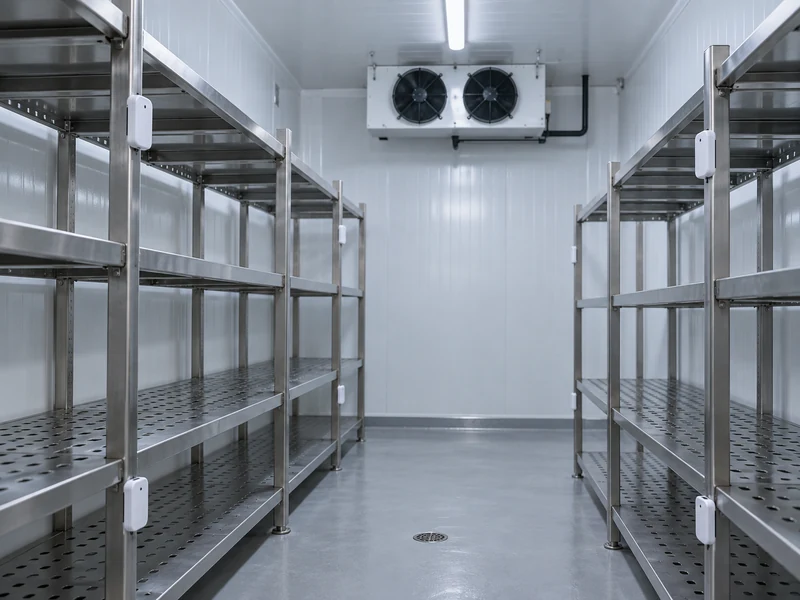
Why Does a Room Need Mapping as Well as Routine Monitoring?
Monitoring follows selected points during daily operation and raises alarms when configured conditions are exceeded. Mapping temporarily measures many locations to understand the wider temperature distribution. Its results help decide which locations should be monitored and which areas should not hold sensitive stock.
Calibration answers a third question: whether a measuring instrument reports temperature accurately enough for its intended use. A room can have a calibrated control probe and still contain poorly cooled corners. Conversely, a large set of unverified loggers can produce an impressive-looking map without reliable measurements.
The existing guide to real-time cold room monitoring explains routine tracking. Here, the focus is the study that establishes where and under what conditions that tracking is meaningful.
What Must Be Defined Before Installing Loggers?
Write a short protocol that identifies the room, products, permitted temperature range and intended storage volume. Define what counts as a failure and how brief events will be assessed. Do not decide after seeing the results that an inconvenient location or excursion should simply be ignored.
The relevant product requirements determine the criteria; there is no universal acceptable range for every cold room. A food holding room, a produce store and a pharmaceutical chamber may have different constraints. Where regulated products are involved, the responsible quality team should approve the protocol and interpretation.
- Record internal dimensions, rack levels, doors, evaporators and control-probe positions.
- Identify usable storage boundaries and areas already excluded from storage.
- Document planned loading conditions and representative operating activities.
- Specify logger identification, calibration status, accuracy and recording interval.
- Define study duration, event logging, acceptance criteria and report ownership.
ISPE’s controlled-temperature chamber mapping guidance provides a structured reference for sensor placement and risk-based planning. Its pharmaceutical context should be recognized rather than treating every recommendation as a mandatory rule for all food-storage rooms.
Where Should the Temperature Sensors Go?
Distribute sensors through the actual volume occupied by stored goods, including different heights and horizontal positions. A floor-plan grid alone can miss vertical differences between lower and upper rack levels. Include locations where the layout suggests unusual heating, cooling or restricted airflow.
Record each sensor’s coordinates and mounting position so another person can reconstruct the study. Photographs help distinguish a logger beside a pallet from one hidden behind it. Avoid contact with a wall, shelf or cooling coil when the intended measurement is air temperature.
| Location | Reason to Include It | Interpretation Caution |
| Upper, middle and lower storage levels | Detect vertical variation | Keep positions within the defined usable volume |
| Door-adjacent storage | Measure access-related warming and recovery | Record opening events rather than guessing their timing |
| Remote corners and restricted aisles | Find weak circulation | Document the load that creates the restriction |
| Near evaporator discharge | Assess localized overcooling | Separate diagnostic points from approved storage positions |
| Beside control and monitoring probes | Compare routine readings with independent measurements | Small placement differences can affect readings |
No fixed logger count is correct for every room. Size, geometry, rack density, multiple evaporators and distinct compartments can justify additional points. Explain the selection in the protocol rather than choosing a number because it is convenient or commonly advertised.
Should a Sensor Be Placed Inside the Product?
That depends on the question. Air mapping shows the environment, while a probe in a product or thermal surrogate shows a different response influenced by thermal mass and packaging. If both are measured, identify them separately and avoid combining them into one undifferentiated set of results.

Should You Test an Empty Room or a Loaded Room?
Both can be informative because loading changes airflow and thermal response. An empty-room study can reveal the basic behavior of the installed system, but it cannot prove that densely packed racks remain suitable. A representative loaded study should reflect actual packaging, clearances and stock distribution.
Do not use a convenient token load while claiming that maximum operational loading has been assessed. Record pallet locations, stack heights and clearances so the results have a defined boundary. Where several loading patterns are plausible, assess which presents the greatest relevant risk and document the rationale.
For practical layout changes, consult the guide to arranging products for better cooling. Mapping then provides evidence of whether the chosen arrangement actually works in the room being studied.
How Long Should the Study Run?
It should capture the operating cycles and conditions identified in the protocol, including representative access and defrost behavior. A short period of quiet overnight operation may miss the problem reported during loading. Conversely, an arbitrary long test is not useful if event records and loading conditions are missing.
Choose the interval between readings to resolve meaningful changes without mistaking every momentary air fluctuation for a product failure. The required duration and interval depend on room dynamics, product requirements and any applicable qualification procedure. Explain those choices rather than presenting one duration as universally compliant.
Which Events Should Be Recorded During the Test?
Synchronize logger clocks and maintain a separate event log. Record door openings, loading, defrost, unusual alarms and any authorized interruption to cooling. Without this context, a repeated warm peak can be wrongly attributed to inadequate equipment when it actually coincides with a scheduled event.
Challenge tests such as deliberate door opening or power interruption need a defined purpose and controlled conditions. Protect stock and obtain the necessary operational approval before performing them. A mapping exercise should not introduce avoidable product loss just to create a more dramatic temperature curve.
The article on cold room defrost controls can help operators understand which events to include in the log. Keep the mapping report focused on measured conditions rather than inferring a control fault from one isolated peak.
How Do You Identify a Real Hot or Cold Spot?
Compare each location’s time series, minimum, maximum, time outside limits and recovery behavior. A hot spot is a relatively warm location within the study, not necessarily a location above the permitted limit. Likewise, the coldest measured position may still comply with the required range.
Look for persistence and repeatability before drawing conclusions. One extreme point may reflect a displaced logger or an unrecorded door event, while repeated excursions at the same shelf position suggest a location-specific issue. Investigate questionable data transparently instead of silently deleting it.
Room averages can conceal unacceptable extremes. Present location results alongside the time plots, with loading conditions and event markers visible. A color map is useful for orientation, but it should not imply that unsampled positions were directly measured or that a smooth interpolation proves compliance.
What Should Happen After an Unsatisfactory Result?
Match the corrective action to the observed pattern. Blocked return air may call for revised loading, a persistent cold jet may require changing the approved storage boundary, and broad recovery problems may need refrigeration assessment. Replacing equipment is not automatically the first response.
After a relevant change, repeat the measurements needed to demonstrate that the issue has been resolved. Define the retest scope and preserve both the original and revised results. Do not label a modified room as qualified on the strength of data collected before the modification.
When a new layout or storage duty is planned, review the cold room configuration for the intended products and include mapping needs in the project discussion. Product compatibility and airflow should be settled before the room is filled.
What Makes the Final Report Useful to Operators?
The report should contain the approved protocol, sensor map, calibration records, raw data, event log and justified conclusions. State the tested conditions, storage limits and recommended routine monitoring positions. Include unresolved deviations and clear restrictions rather than issuing an unexplained pass.
Plan reassessment after changes that could alter distribution, such as rack rearrangement, capacity expansion or a different evaporator layout. Use the site’s risk assessment and applicable requirements to set the review schedule. Share the room layout and storage requirements with LINBLE when preparing a new project or investigating an existing distribution problem.