
Cold storage planning for beef, pork, lamb and poultry differs most in four places: the product’s entry condition, the way it occupies space, the cooling process it must complete and the handling route around it. Species matters, but a chilled carton of beef has more in common with other boxed chilled stock than with a warm beef side arriving directly from slaughter.
A useful LINBLE project brief therefore describes both the animal and the product form. Write “pork sides entering after dressing” or “sealed poultry cartons received already chilled,” then add quantities and timing; “a meat cold room for ten tonnes” leaves too much undecided.
1. How Does the Incoming Load Change Refrigeration Duty?
The first difference is how much heat the room must remove, and how quickly. Initial carcass chilling, final-product holding and freezing are separate duties, even when the rooms stand next to each other.
Beef sides arriving warm create a different load profile from chilled vacuum-packed beef received for distribution. Poultry moving continuously from a processing line creates another pattern: the equipment has to match the arrival rate, available cooling time and the production line’s stopping points.
For pork and lamb, record whether the room receives whole carcasses, sides, cuts or packaged stock. Include actual entry temperatures rather than infer them from the product name, and identify whether a previous process has already completed the required chilling step.
What Should the Load Schedule Show?
Show the largest arrival within a working period and the time available before dispatch or the next batch. Daily tonnage can conceal a short afternoon surge that dominates equipment selection.
- Mass entering each hour or batch, including any overlapping loads.
- Measured or specified entry condition and required exit condition.
- Product dimensions, package arrangement and expected cooling endpoint.
- Loading, unloading, cleaning and defrost periods.
- Any warm packaging, trolleys or handling equipment entering with the product.
LINBLE’s meat cold room solutions cover several storage duties. In an enquiry, select the process the room must perform before comparing its nominal refrigeration capacity.
2. What Changes When Meat Hangs Instead of Sitting on Pallets?
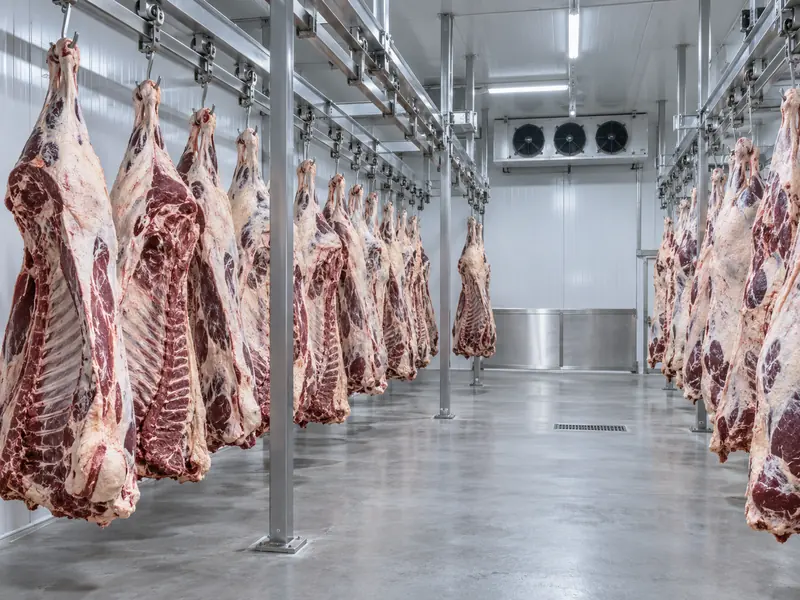
The second difference is the storage geometry and its structural consequences. Rail length, hanging clearance and switching points govern a carcass room, while pallet positions, rack levels and access govern a carton store.
Beef sides often make height and rail loading prominent design questions. Smaller lamb carcasses can change rail spacing and handling density, but those dimensions must come from the actual carcass range and rail design rather than a generic species table.
Pork may use overhead handling through several connected operations. Where that happens, a rail crossing at the doorway becomes a building and sealing detail as well as a material-flow decision.
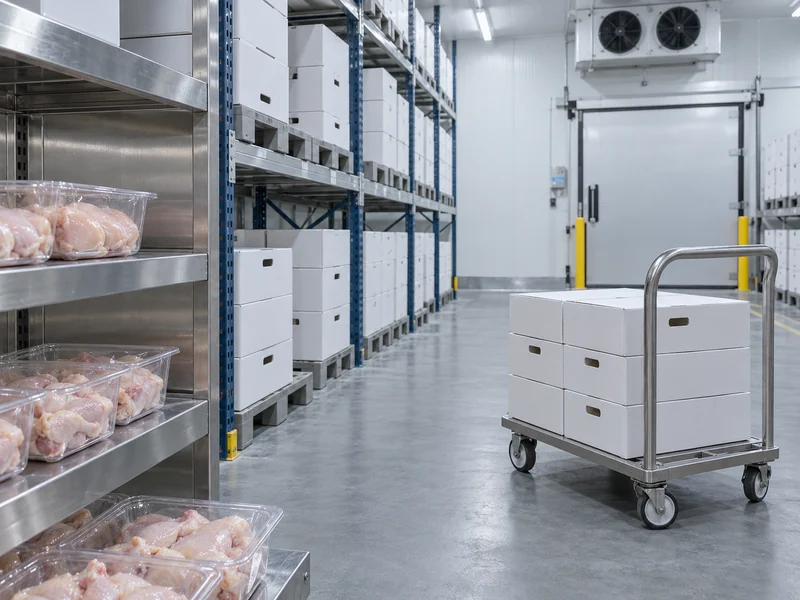
Packaged poultry often shifts attention toward crate or carton dimensions, rack capacity and frequent picking. That does not mean every poultry facility uses pallets: whole birds, trays and bulk containers can require very different layouts.
| Typical Product Form | First Layout Question |
| Hanging beef sides | Can the rail support, usable height and door opening accommodate the heaviest and longest loads? |
| Pork sides on an integrated rail route | Where do rails transfer between process areas, and how are those interfaces enclosed? |
| Lamb carcasses | What spacing and handling arrangement preserve access without crowding the cooling path? |
| Packaged poultry | How many usable pick and reserve positions remain after aisles and airflow clearances are included? |
Rails and racks need an approved structural load path. Insulated panel thickness alone does not establish that the ceiling can carry suspended meat or handling equipment.
For a rail-based project, develop the process layout together with the slaughterhouse equipment arrangement. Connecting drawings from separate suppliers after fabrication can expose avoidable differences in levels, openings and support positions.
3. Why Is the Cooling Programme Different From the Holding Temperature?
The third difference is the route by which the meat reaches storage condition. A room-air setpoint does not by itself define product cooling time, tenderness, surface condition or the temperature at the slowest point.
For newly slaughtered beef and lamb, the chilling programme must account for post-mortem muscle changes as well as microbiological control. The FAO discussion of meat production and quality describes cold shortening as a particular concern when susceptible meat is chilled too rapidly before rigor.
That does not justify delaying cooling by guesswork. The processing specialist should establish a validated programme for the product and market, then the refrigeration design should demonstrate that it can deliver that programme.
Pork and poultry require their own process definitions. Neither a beef ageing schedule nor a freezer’s nominal air temperature should be transferred to them as a complete operating instruction.
When Is a Separate Freezing Stage Needed?
Separate the freezing operation from frozen holding whenever the required throughput and product endpoint call for it. A store sized to receive already frozen cartons may struggle if it is also expected to freeze the day’s chilled production.
Specify the thickest product, pack arrangement and permitted batch duration when evaluating a freezing stage. LINBLE’s article on blast freezing time and core temperature explains why an air reading cannot replace a product endpoint.
The FAO manual’s treatment of meat chilling also distinguishes the requirements of different carcasses. Use that process perspective to frame questions for the meat technologist, rather than turn an illustrative temperature into a universal instruction.
4. How Do Packaging and Dispatch Change Hygiene and Airflow?
The fourth difference is the daily movement around the stock. Exposed carcasses, sealed cuts and ready-to-dispatch cartons create different cleaning, segregation, drip-control and access requirements.
A hanging room needs space to move product without contact between loads, walls or floor. A poultry carton store may need a larger active picking area because staff repeatedly open cases and build orders.
Packaging also changes moisture exposure. An unwrapped surface in a strong air stream faces a different drying risk from meat inside an intact moisture-resistant pack; treating both with the same fan arrangement can produce uneven quality.
Plan evaporator position around the full arrangement of rails or racks. A clear aisle can unintentionally become the easiest air-return route while densely occupied product positions receive less useful circulation.
Review cold room airflow dynamics with the storage drawing in hand. The relevant test is whether the chosen arrangement reaches the agreed product conditions in representative positions.
What If the Plant Changes Its Product Mix?
Suppose a plant initially dispatches most meat as chilled carcasses but later sells a larger proportion as boxed frozen cuts. Its daily slaughter count may remain unchanged while rail occupancy falls, cutting-room traffic grows and the freezing stage becomes the constraint.
A useful LINBLE layout review would follow that change through every room. Check whether cartons need a new accumulation area, whether the freezing batches can finish within the available shifts and whether frozen dispatch has enough accessible positions for the new SKU range.
Do not assume that spare floor area in the carcass room supplies the answer. Rail supports, drainage, door clearances and refrigeration duty may make conversion possible, costly or impractical depending on the original design.
Identify the future scenario in the initial proposal if it is credible, and distinguish reserved space from installed capacity. A provision for another evaporator is only useful if electrical supply, refrigerant arrangements, structure and controls can support it.
Review offal and other product streams separately rather than hide them within the main meat tonnage. Their containers, hygiene arrangements, timing and temperature requirements may create their own small but important storage demands.
Choose demonstration loads from the specified production mix, including the carcass sizes and pack formats that place the greatest demands on the proposed arrangement. If a mixed-load trial is planned, agree the representative sizes, loading pattern and measurement positions in advance so that an easy demonstration batch does not become the sole evidence for a demanding production promise.
How Can a Mixed-Meat Facility Avoid Buying Four Copies of the Same Room?
Group compatible duties where the validated process, hygiene plan and operating schedule allow it. Separation should follow a real incompatibility or workflow need, while shared services should be assessed against simultaneous demand.
For example, a processor might need a carcass chilling area, a boxed chilled store and a frozen dispatch store rather than one room labelled for each species. This is a planning example, not a proposed layout for every plant.
LINBLE’s published meat-project information includes an Angola pig-processing installation described with a blast freezer and wider processing scope. The useful lesson for a new enquiry is to state each room’s role and throughput clearly; another project’s daily tonnage is not a capacity guarantee for different products.
Finish the brief with a loading calendar and a drawing showing clean routes, handling clearances and future stages. The slaughterhouse cold room sizing discussion can help connect that process information to the space calculation.