
To manage defrost without warming ice cream stock excessively, control how the cycle starts, how heating ends, where meltwater goes and when airflow returns. Then verify the result at representative stock positions during real operating conditions. For a LINBLE ice cream room, the defrost plan belongs in the original evaporator-and-load review, alongside the product holding requirement and the receiving schedule.
A taller peak on the room-air graph does not automatically mean every tub has reached that temperature. Equally, a controller returning to its setpoint cannot establish that repeatedly exposed stock has retained its original texture.
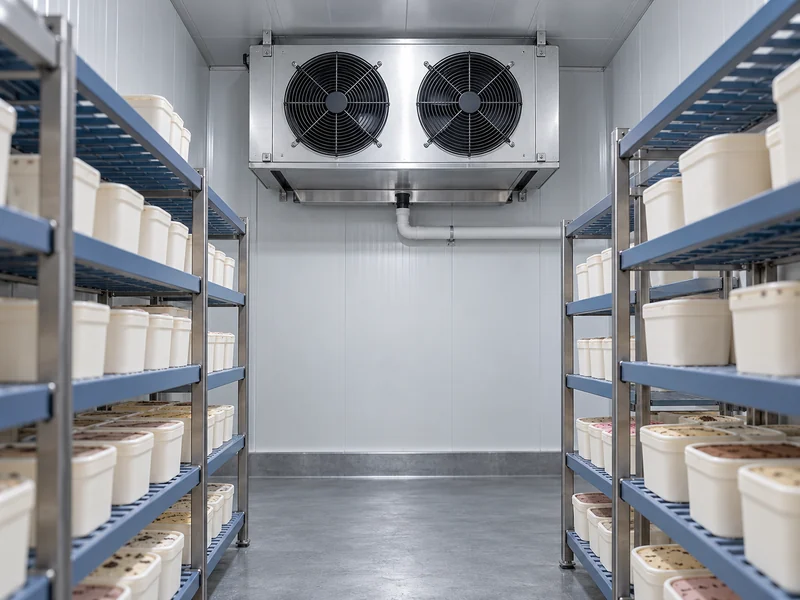
What Is the Defrost Cycle Supposed to Achieve?
It should remove the frost that interferes with evaporator performance and dispose of the water, using the installed equipment’s intended sequence. The useful question is whether the coil becomes ready for effective cooling again without unnecessary heat or retained water.
ASHRAE’s refrigerated-facility load guidance treats defrost as an equipment-related heat load and notes that short-term peaks can differ greatly from daily averages. This is why a small average allowance does not settle the operational effect of a particular cycle.
Ask the designer to explain where defrost heat enters the proposed system and how recovery has been allowed for. An equipment list that states only the room volume and nominal cooling capacity leaves that discussion unfinished.
Why Not Reduce Defrost Until the Air Graph Looks Flat?
Because an attractive graph can hide a deteriorating coil. Insufficient defrost may leave frost that restricts airflow, so the room cools unevenly or takes longer to recover after normal work.
Examine coil condition and recovery together. An adjustment is useful only if the complete refrigeration task improves while the agreed product conditions remain protected.
Which Parts of the Sequence Need Separate Checks?
Initiation, termination, drainage and fan restart answer different questions. Treat them separately in the commissioning record, even where the controller combines several functions under one menu.
LINBLE supplies cold room evaporators with configurations that need to be matched to the application. The selected model, heat source and controls determine the actual sequence; a timing copied from another freezer is not a commissioning method.
| Stage | Question for the Installer | Evidence to Keep |
| Initiation | What starts a cycle during normal use and after power returns? | Actual control logic and observed start event |
| Termination | What ends active defrost, and what limits an abnormal cycle? | Sensor position, termination event and protective limit |
| Drainage | Does the meltwater leave before the next stage? | Drain arrangement and observed clearance of water |
| Fan Restart | What allows air circulation to resume? | Release condition and observed restart |
The existing guide to defrost termination, drip time and fan delay provides the background to these checks. Use it to ask precise questions, then refer to the manual and approved settings for the installed equipment.
Can a Long Cycle Be Fixed by Changing One Timer?
Sometimes a setting is involved, but first establish what is actually prolonging the event. A misplaced or faulty sensor, a blocked drain and unusually heavy moisture entry are different problems.
Record whether the cycle ends by its intended condition or repeatedly reaches its maximum duration. That distinction gives the refrigeration specialist something more useful than “the freezer gets warm every afternoon.”
When Should Defrost Happen Around Receiving and Picking?
Choose a workable window based on the control design and the operating day. Where scheduling is supported, avoid deliberately combining defrost with the heaviest unloading period unless the complete arrangement has been assessed for it.
Consider an illustrative distributor receiving ice cream just before restaurant orders are picked. Moving the permitted defrost window may separate those demands, but only if the revised interval still clears the coil and meets the equipment requirements.
Discuss this pattern while planning a LINBLE ice cream cold room. Bring a shift timeline showing arrivals, dispatches, cleaning and long door-opening periods, rather than describing the store simply as “busy.”
Should Multiple Evaporators Defrost Together?
Do not assume simultaneous defrost is the best arrangement. Ask whether staging is supported and what cooling remains available while each unit completes its cycle.
The answer depends on the refrigeration circuits, control logic, coil coverage and required recovery. Staggering requires a coordinated design; it is not something to create by independently changing timers and hoping the remaining unit can carry the room.
What Can the Equipment Schedule Tell the Buyer?
LINBLE lists water and electric defrost options for its evaporators, together with different cooling configurations. Ask which configuration appears in the quotation and how its capacity has been selected at the proposed low-temperature operating condition.
A catalogue capacity without its rating conditions is difficult to compare with a room calculation. Have the supplier identify the selected unit, intended duty, defrost input and the assumptions behind available recovery capacity.
Keep the electrical and drainage interfaces on the same review sheet. This is especially useful where LINBLE supplies the room equipment and a local contractor completes installation: someone must own the connections between the component schedule and the building services.
Where Does Meltwater Become a Stock-Quality Problem?
Water that stays in the pan or drain can refreeze and disrupt the next cycle. It can also leave an operational mess that encourages staff to move cartons into unsuitable temporary positions.
Inspect the specified drain route, supports, insulation and freeze protection as an assembly. Check access for cleaning and service before shelving makes the connection difficult to reach.
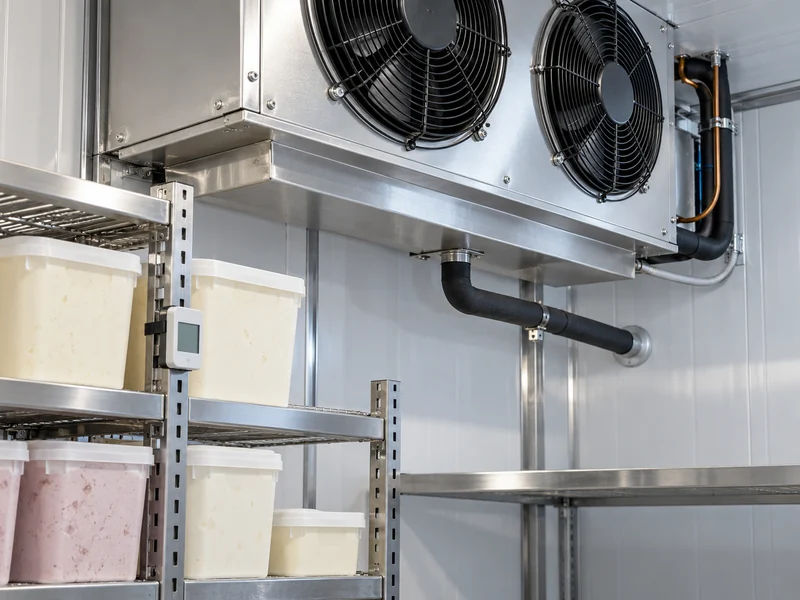
The ice cream store should retain a clear zone beneath equipment where the design calls for it. Keeping stock out of that space makes inspection possible and avoids treating a service area as bonus storage.
Does Water Defrost Automatically Mean Less Product Warming?
No single heat-source label proves the result in a particular room. Water supply conditions, drainage, controls and the installed refrigeration arrangement all affect whether the proposed method is practical.
For projects considering this option, review LINBLE’s article on water and drainage requirements for water defrost. Resolve the utility and drainage interfaces before selecting the unit, rather than discovering them during installation.
How Can Operators Tell Normal Recovery From a Developing Problem?
Build a reference record from satisfactory operation, with the room loading and door activity noted. Later events can then be compared with something meaningful instead of with an imagined universal recovery time.
Log the beginning and end of defrost, the drainage stage, fan return and the recovery of relevant monitoring positions. Identify air measurements separately from product or validated surrogate measurements.
- A peak beside the evaporator may describe the local cycle more than the condition of distant stock.
- Repeatedly slow recovery across several positions calls for a broader load-and-performance review.
- A single weak corner may point to stock placement or circulation.
- A changed pattern after heavy receiving should be reviewed with the delivery and door records.
Who Reviews the Ice Cream Batch After an Excursion?
Follow the site’s product hold and assessment procedure, preserving the batch identity and exposure record. Returning the air to normal does not answer the disposition question for affected stock.
Do not widen alarm limits merely to stop recurring notifications. Have the responsible team distinguish expected air-cycle behaviour from conditions requiring action, with any permitted delays justified and documented.
Which Trend Change Deserves Attention First?
Investigate a new departure from the established pattern, particularly when it appears without a corresponding change in receiving or door use. Compare like operating days before concluding that a longer cycle is seasonal or that an isolated peak proves inadequate capacity.
Give the service specialist the event log, sensor locations and photographs of the coil and drainage area taken safely from the normal access position. That short evidence pack can narrow the investigation far more than a photograph of the controller taken after the room has recovered.
What Should LINBLE and the Installer Hand Over?
Ask for a room-specific operating explanation that connects the equipment to the stock. It should identify the defrost method, settings, sensors, drain provisions and the loading conditions used to demonstrate recovery.
Use the cold room commissioning checklist to keep the handover review organized. Include a witnessed cycle and an explanation of what staff should report when its behaviour changes.
Keep room for maintenance in the final drawing and the daily loading plan. If a technician must unload an entire shelf to reach the drain or sensor, the operating arrangement will work against the maintenance plan.
The best defrost arrangement is one the team can understand and verify: a coil that clears, water that leaves, airflow that returns as intended and stock conditions supported by records. Specify those outcomes before debating a favourite timer setting.