
A water defrost evaporator needs a dependable water supply at the selected coil’s specified flow, pressure and temperature, plus a drain that can remove spray water, melted frost and occasional ice fragments without backing up. For a LINBLE cold room, those services should be agreed alongside the evaporator selection: a suitable coil cannot compensate for a weak supply line or a drain that freezes after the first cycle.
Before selecting this defrost method, trace the proposed water route from the building supply to the final receiving drain. Any unresolved restriction along that route belongs in the equipment discussion. Can this particular building deliver the water, contain it above the product and get it out again throughout the operating season?
What Water Duty Should the Site Actually Provide?
Ask for the duty of the selected evaporator, measured at its connection while defrost is running. A static pressure reading with every valve closed says little about the supply available when several services draw water together.
LINBLE’s cold room evaporator range includes water and electric defrost options. The published water-volume range spans different equipment sizes; it is a starting point for a model discussion, not a setting to copy into every project.
Send the supplier the proposed pipe length, elevation change, available source temperature and lowest expected supply pressure. Include filters, backflow protection and control valves in the pressure-loss calculation rather than treating them as negligible additions.
Should Evaporators Defrost Together?
Usually, the first option to examine is a sequence that avoids unnecessary simultaneous demand. Whether that sequence is acceptable depends on room temperature stability, frost accumulation and the refrigeration circuit arrangement.
For illustration, two coils each requiring an agreed flow of Q would demand roughly 2Q if they spray together, before other building uses are counted. Staggering them may reduce the water-service peak, but only if the controls and remaining cooling capacity support the resulting sequence.
Ask for a schedule showing which valves open together and how long the next coil must wait. That drawing is more useful to the plumbing contractor than a list of evaporator quantities.
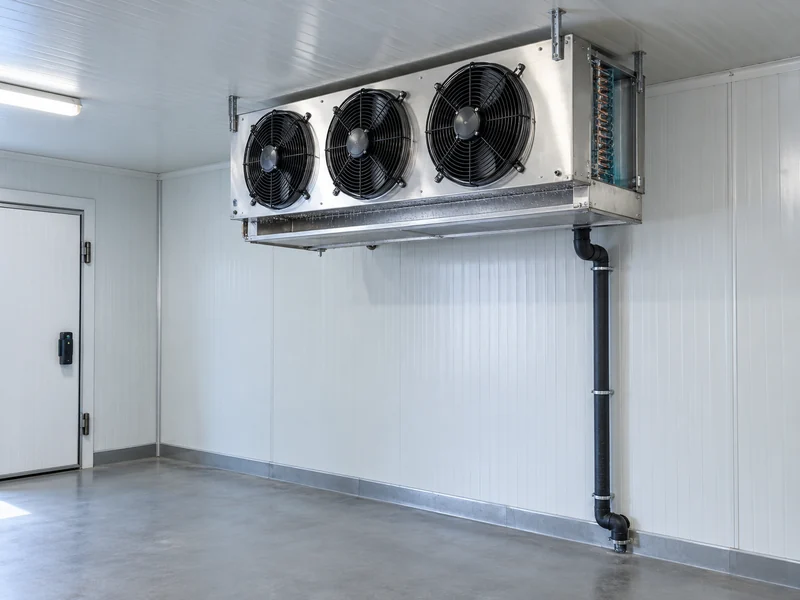
How Clean Does the Defrost Water Need to Be?
Water quality must suit the coil materials, spray openings and hygiene risk of the room. Sediment can restrict distribution, while scale and corrosive constituents create different maintenance problems; a filter selected for particles does not solve every water-quality issue.
For a food facility, use a documented water-quality assessment and obtain approval for the proposed source. Do not assume that defrost runoff, process water or an untreated borehole supply is acceptable simply because the water is not deliberately applied to food.
- Provide recent water analysis where hardness, sediment or corrosion is a concern.
- Confirm permitted inlet-water conditions with the evaporator supplier.
- Make strainers accessible for inspection without dismantling the cold room.
- Have the local plumbing designer specify backflow protection and the drain connection.
- Agree who cleans the spray distribution system and where that work can be performed hygienically.
Water defrost is also not a substitute for a sanitation procedure. Melting frost may expose dirt rather than remove it, and a visually clear tray does not establish microbiological cleanliness.
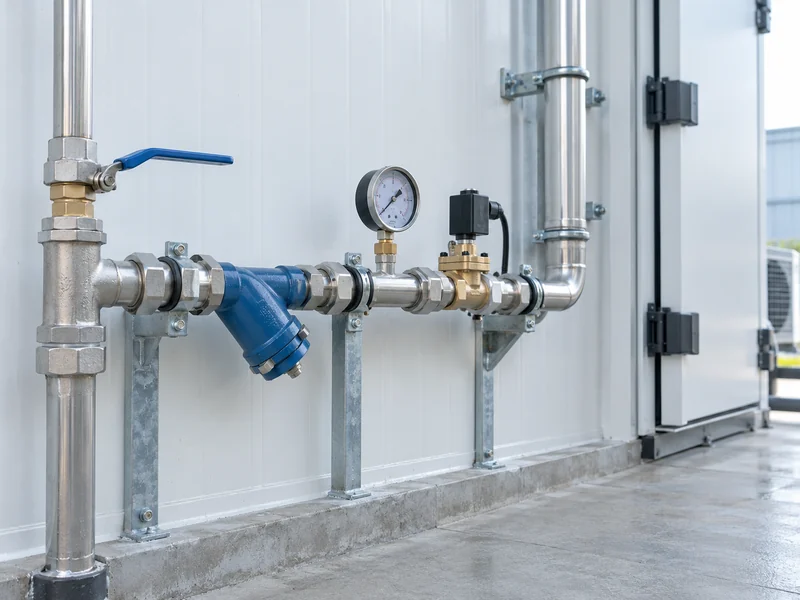
Can the Drain Handle the Peak Rather Than the Average?
Size and route the drain for the discharge during the actual cycle. That includes incoming spray water and melting frost, with enough allowance for the real pipe route, fittings and intermittent ice movement.
The FAO manual on meat cold-store operation specifically identifies falling ice fragments as a possible obstruction during water defrost. This is a practical reason to inspect the tray outlet and cleanout arrangement, rather than judge the installation only by the drain pipe’s nominal diameter.
Specify the elevation of each gravity-drain support so the installed pipe descends toward its receiving point without an unintended low pocket. A short reverse slope behind a wall panel can retain enough water to become the next cycle’s blockage, even when the exposed pipe appears neatly installed.
| Interface | What to Agree Before Installation |
| Tray and outlet | Peak discharge, access for cleaning and containment if the outlet becomes restricted. |
| Cold-side pipework | Fall, supports, insulation and any required freeze protection for the selected duty. |
| Building drainage | Approved indirect connection or other locally required arrangement, capacity and a serviceable receiving point. |
| Shared branch | Which evaporators may discharge together and how a downstream blockage will be detected. |
Avoid routing a discharge over exposed stock or through a doorway used by pallet trucks. The shortest route on a drawing may be the least convenient route to maintain once the room is full.
Where Does Freeze Protection Belong?
Review every part of the water path that can remain below freezing, including tray outlets, elbows, wall penetrations and sections outside the room in cold weather. A warm supply at the start of defrost does not guarantee that residual water will stay liquid afterward.
The selected arrangement may need drain heating, insulation, controlled emptying or a combination of measures. Heater type, power, thermostat arrangement and electrical protection should come from the approved design, with access left for inspection and replacement.
Bring these requirements into the cold room accessories specification early. A drain heater added at the last minute can leave awkward joints, unsealed panel penetrations and an unclear maintenance responsibility.
Is a Trap Needed Inside the Freezer?
Do not place a water-filled trap inside a freezing space by habit. Its location and configuration must address both the drainage rules and the actual freezing risk, which should be resolved by the local drainage designer.
The same applies to backflow and air-gap details. An illustrative refrigeration sketch cannot establish a compliant building connection in every destination country.
How Should Water Flow and Fan Restart Be Coordinated?
The control sequence needs to finish draining before normal airflow can throw residual droplets toward stock. Agree how refrigeration stops, water starts, defrost terminates and the coil returns to service.
A fixed timer may be part of that sequence, but it should not hide failed water delivery or an outlet that remains full. Discuss what the controller can actually detect, what generates an alarm and what the operator must inspect.
LINBLE’s explanation of termination, drip time and fan delay helps separate these functions. They should be coordinated around the selected coil rather than copied as one universal timetable.
Frost behavior also depends on air movement and coil geometry. If the coil repeatedly bridges with ice, review infiltration and evaporator fin spacing before simply increasing the amount of water.
What Changes When Two Rooms Share One Drain Route?
Consider a site with a produce chiller and a freezer discharging toward the same service corridor. Even if their evaporators defrost at different times, the shared downstream line still needs checking for the largest authorised discharge and the conditions between cycles.
A restriction beyond the wall may first appear as a freezer problem because that branch retains water and freezes. Replacing the evaporator would leave the cause in place, so the inspection route should extend to the building’s receiving drain.
For a LINBLE supply package, mark the physical handover points on the drawing: water connection, electrical connection, tray outlet and building drain. Assign pipe supports, insulation, heaters and wall sealing to specific parties rather than leave them under an undefined installation allowance.
Ask the installer to demonstrate how a strainer is removed, how the outlet is cleared and where water goes during maintenance. These are ordinary service tasks, but a high mounting position or a rack installed too close can turn them into disruptive work.
Finally, check the same route after a prolonged shutdown. The restart procedure may need an inspection for retained water, failed heating or a closed isolation valve before the first automatic cycle is allowed to run.
This interface review is especially useful on export projects, where refrigeration equipment and local plumbing are often purchased separately. Put the agreed duty and connection details into the approved documents so that a late change in pipe route triggers a review before commissioning.
What Should Be Demonstrated Before Handover?
Witness a complete cycle under representative conditions, then inspect the room after cooling resumes. An empty-room spray test can establish basic operation, but it does not show how a loaded aisle affects access or whether repeated cycles leave ice behind.
- Measure running water conditions with the agreed competing services operating.
- Watch distribution across the coil and confirm that water stays within the collection arrangement.
- Check the tray, downstream receiving point and vulnerable pipe sections.
- Verify drip time, fan restart and temperature recovery.
- Record valve settings, cleaning access and the response to a failed cycle.
Add those results to the cold room commissioning record. For a LINBLE quotation, provide the room duty together with the water analysis, supply conditions, drainage sketch and expected defrost schedule; those details establish whether water defrost is a sensible fit for the site.