
Reduce berry cooling delays by getting fruit out of the warm queue and making air pass through the packed load; reduce moisture loss by limiting unnecessary exposure after cooling. Those are connected but different tasks. In a LINBLE berry project, the receiving schedule, carton vents and transfer to holding deserve as much attention as the refrigeration unit.
Where Is the Delay Between Harvest and Active Cooling?
Start with a timeline for the busiest harvest period. Record picking, collection, shade, transport, weighing, packing and cooling start. A cold room may have spare refrigeration capacity while fruit waits outside for a trolley, a label or an available operator.
Measure the queue in batches and minutes, then identify its cause. If packing takes longer than harvest delivery, decide how fruit will be protected while waiting and how the flow will be balanced. Increasing the size of the holding room does not automatically increase cooling throughput.
UC Davis’s strawberry guidance identifies prompt cooling as an important part of controlling deterioration and gives near-0°C storage with 90–95% relative humidity as a reference for strawberries. Other berries and pack formats still need their own specifications. Do not turn one crop’s guidance into a universal storage-life promise.
Plan an arrival position before the harvest vehicle reaches the building. The unloading route should lead directly to the intended assessment, packing or cooling stage. Fruit should not have to wait in sun while staff clear a corridor that was counted as storage space.
Is This Room Cooling the Berries or Holding Them?
Define whether the room receives warm fruit, precooled fruit or both. Warm berries require heat removal through the whole packed load; cooled berries mainly need protection from further warming and drying. Those duties can require different airflow arrangements and schedules.
LINBLE’s fruit and vegetable cold room options provide the starting point for separating precooling and holding. Send the expected kilograms per hour during the busiest receiving period, not only the total stock at the end of the day. The cooling system must handle the rate at which heat arrives.
The distinction is developed in LINBLE’s precooling versus storage article. In a combined arrangement, specify where warm loads wait, where active cooling occurs and where completed batches are held. Otherwise, a new warm pallet can undo part of the benefit achieved for earlier fruit.
Can Air Pass Through the Clamshells and Cartons?
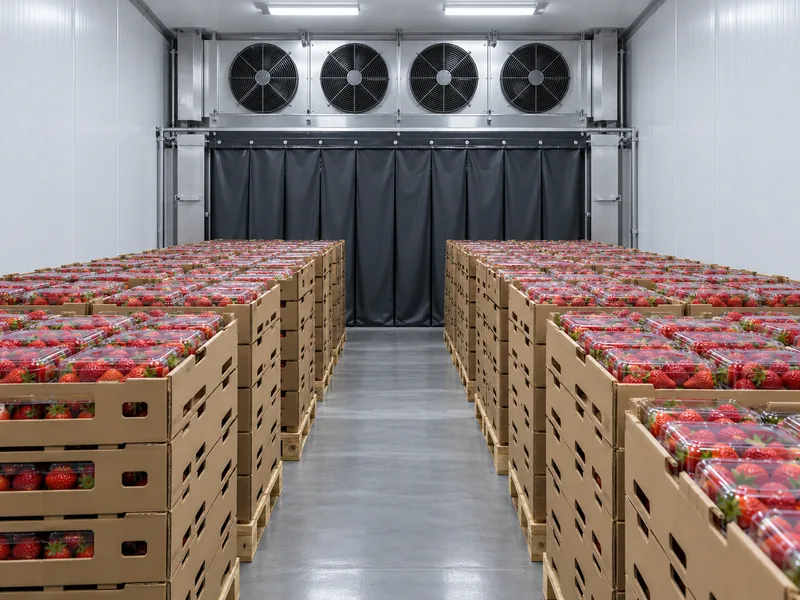
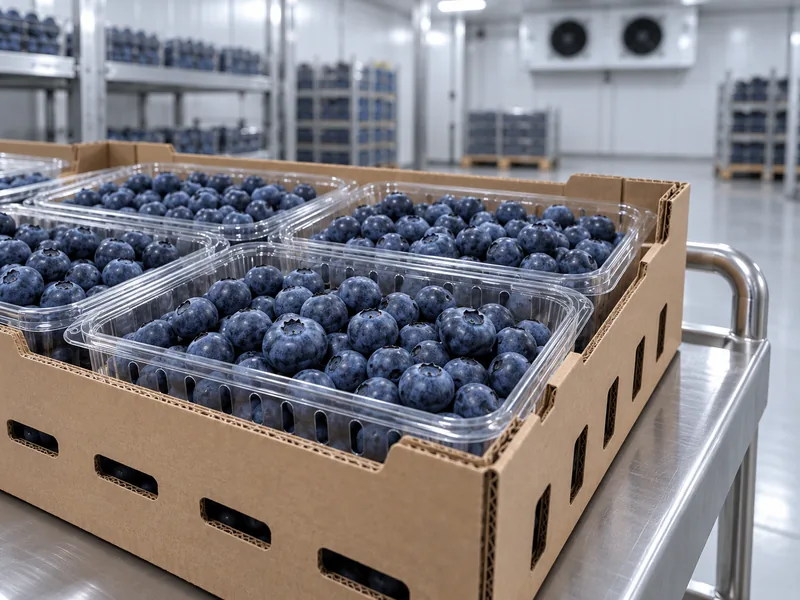
Review the package stack as a complete air passage. Openings in the outer carton must align with the route through the inner packs and fruit. A ventilated carton does little good if a label, liner or tight wrapping blocks the opening used by the cooling arrangement.
For a forced-air installation, the fan and plenum must create a useful pressure difference across the load. Air leaking through a broad uncovered opening can take an easier route than the packs. Curtains, seals or guide arrangements should be part of a cleanable, usable design rather than improvised after commissioning.
Do not prescribe one vent percentage without knowing the pack. Carton strength, fruit protection, moisture loss and cooling access must be considered together. Trial the normal packaging and keep a record of the stack pattern that performs acceptably.
| Observation | Likely Question | Useful Check |
| Outside Packs Cool First | Is air reaching the middle of the load? | Compare product temperatures across stack depth |
| Cooling Time Changes Between Shifts | Are vents, seals and stack patterns consistent? | Compare loaded photographs and batch records |
| Dry Fruit After a Long Hold | Is cooling airflow continuing unnecessarily? | Review exposure, humidity and packaging |
| Condensation at Dispatch | How long is cold fruit exposed to warm moist air? | Trace the transfer and loading sequence |
How Do You Know When Cooling Is Finished?
Use a defined product-temperature criterion and representative measurements. Room air can reach its setting well before fruit in the centre of a pallet. The point nearest the fan is rarely enough to characterise the whole batch.
Agree where samples will be measured, which instrument and hygiene procedure will be used, and how cooling completion is recorded. Include positions likely to cool slowly. A retained drawing makes comparisons useful when packaging or fan arrangements change.
A practical trial might compare otherwise similar loads with two approved stacking arrangements. Keep crop, incoming temperature and pack format as consistent as possible so that the result can be interpreted. This is a proposed test method, not a claim that a particular LINBLE installation has achieved a stated time saving.
How Can You Limit Water Loss After Precooling?
Move the completed batch into the agreed holding arrangement or change to the approved holding programme. Fruit should not remain in a high-exposure cooling position simply because no transfer rule was written. Once field heat is removed, unnecessary exposure can add drying without a useful cooling benefit.
Check the room’s humidity performance alongside packaging and storage duration. High relative humidity can reduce moisture loss, while free water and condensation create different concerns. Avoid treating a wet pack as evidence that humidity control is working well.
The University of Minnesota’s postharvest handling guidance distinguishes crop-specific cooling and washing needs. It is particularly useful when a shared packhouse proposes to wash every product in the same way. Berry handling should follow a suitable crop and food-safety procedure rather than an assumption that more water always improves freshness.
Choose the LINBLE evaporator arrangement around both cooling and holding duties. Discuss coil conditions, moisture removal and the locations of stored packs. A unit that can remove the heat load still needs a layout that protects fruit during the rest of its stay.
What Should Be Measured Besides Temperature?
Track a small set of repeatable quality observations: shrivel, visible decay, leakage, pack damage and fruit firmness where the business has a suitable method. Representative package weights can help investigate moisture loss. Compare like-for-like lots so that harvest maturity and injury do not get mistaken for refrigeration effects.
LINBLE’s article on grape dehydration and cold storage offers a related view of how packaging, cooling and holding conditions interact. Apply the reasoning with the berry crop’s own requirements. Grapes and berries should not inherit identical handling programmes merely because both arrive in small fruit packs.
Also inspect the warmest and coldest positions in the room. Use temperature mapping to identify where additional fruit checks are worthwhile. A good average reading can hide one regularly warm picking position or a cold spot that risks local freezing.
What Would a Useful Cooling Trial Compare?
Choose one question at a time. For example, compare the existing carton stack with an approved arrangement that better aligns the ventilation openings. Keep berry type, package fill, incoming temperature and the number of cartons as similar as the operation can reasonably achieve.
Record the time the batch actually begins cooling, rather than the time it arrives at the building. Measure the agreed product positions until the completion criterion is met, then follow the batch into holding. This separates queue reduction from a change in the active cooling process.
Inspect representative packs at dispatch as well as immediately after cooling. A faster initial result is less useful if it is followed by unnecessary drying, pack damage or a long warm transfer. Where weights are recorded, use consistent packs and account for sampling and damaged fruit.
Keep the winning arrangement as a photographed instruction, including the positions of any curtains or seals. If it depends on a particular stack height, state that limit. A repeatable loading method gives LINBLE a clearer basis for equipment selection and gives the packhouse a result it can reproduce on the next busy harvest day.
How Should the Dispatch Route Be Planned?
Prepare the vehicle and paperwork before moving cold fruit out of storage. Consolidate the intended load where the environment and product procedure allow it, then keep the transfer short. Repeated journeys through a warm doorway add handling and moisture exposure.
- Record the busiest harvest arrival rate and the actual cooling queue.
- Keep carton and clamshell ventilation consistent with the tested stack.
- Define when fruit leaves active cooling for holding.
- Protect completed batches from new warm arrivals.
- Check product condition after the transfer to dispatch.
For a LINBLE enquiry, include the berry species, pack photographs, carton dimensions, incoming temperatures and peak hourly flow. Add the maximum intended hold and the dispatch method. Those details make it possible to design the short, controlled route that berries need from harvest to a cooled, protected load.