
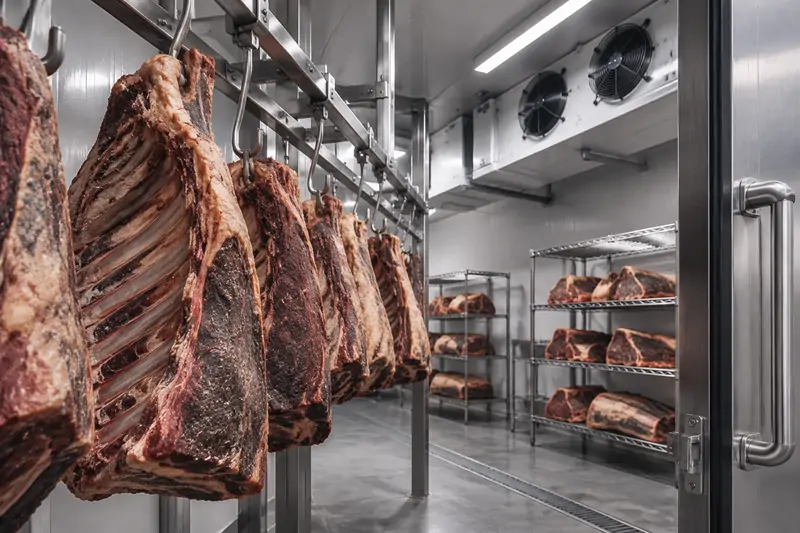
A walk-in cold room for dry-aging beef must maintain precise temperature, humidity, and airflow around unpackaged cuts. Poor control can cause uneven drying, excessive weight loss, and spoilage.
Unlike ordinary meat storage, a commercial dry-aging room requires coordinated refrigeration, moisture removal, air circulation, and hygienic handling throughout the aging cycle.
What Conditions Does a Dry-Aging Beef Cold Room Need?
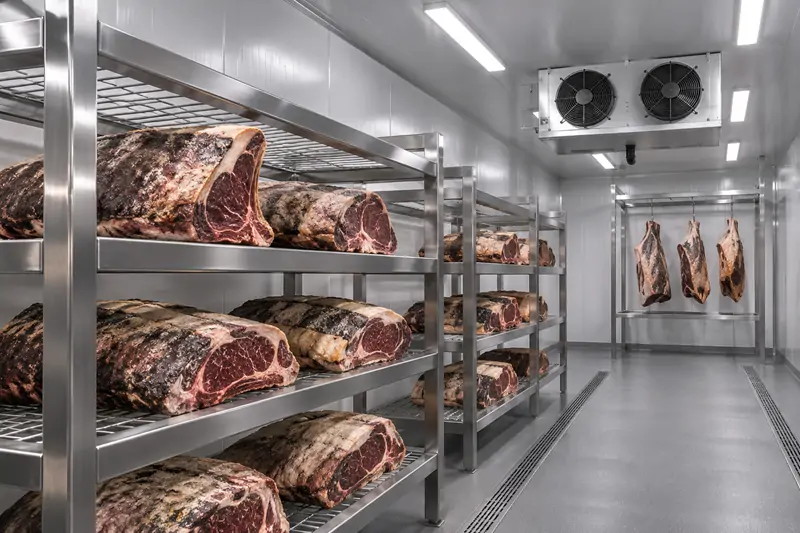
Before choosing refrigeration equipment, define the conditions the beef must experience.
A conventional walk-in chiller primarily slows deterioration. Dry aging also involves controlled moisture evaporation and enzymatic tenderization, making airflow and humidity equally important.
Reference Conditions for Dry-Aging Beef
| Parameter | Common Reference Range | Engineering Consideration |
| Air temperature | 0°C to 3°C | Maintain stable cooling without freezing the meat |
| Relative humidity | 75%–85% | Balance surface drying and excessive shrinkage |
| Air velocity | 0.2–0.5 m/s | An established approach for airflow around exposed beef |
| Aging duration | 21–35 days | Depends on cut characteristics and validated procedures |
These are reference conditions, not universally applicable operating limits. Published research reports wider variations in commercial practice.
The Dry-Aging of Beef technical review discusses how aging duration, temperature, humidity, and air movement affect meat quality and commercial yield.
The final operating limits should follow applicable food safety requirements and a validated aging process.
Calculate Storage Capacity Before Choosing Cold Room Dimensions
A common planning mistake is calculating room capacity from the total weight of meat without considering the aging period.
Dry-aged beef occupies refrigerated space for weeks. The finished quantity is also lower than the original loading weight because of moisture loss and subsequent trimming.
Consider this illustrative production example:
| Planning Item | Example Value |
| Required finished beef | 12 kg/day |
| Planned aging period | 28 days |
| Assumed combined saleable yield | 70% |
| Required average beef inventory | 480 kg |
The calculation is:
12 kg × 28 days ÷ 0.70 = 480 kg
The 70% yield is an illustrative planning assumption, not a guaranteed dry-aging yield. Actual results depend on cut selection, fat coverage, aging conditions, and trimming specifications.
South Dakota State University’s research on beef weight loss during aging demonstrates why processors should monitor shrinkage rather than assume a fixed percentage.
Translate Inventory into a Rack Layout
For commercial dry-aging room design, determine:
- Whether beef will hang from rails or rest on perforated shelves.
- The dimensions and weights of individual primal cuts.
- The space needed between cuts for unrestricted air movement.
- The aisle clearance required for loading, inspection, and cleaning.
- Whether aging batches enter together or on different dates.
Important: Do not fill every available shelf simply because the structure can support the weight. Overcrowding can create stagnant zones and compromise drying uniformity.
How Should Airflow Be Arranged Around Dry-Aging Beef?
Dry aging beef airflow should be assessed where the meat is positioned, not only at the evaporator outlet.
A powerful fan does not necessarily produce uniform drying.
Three layout decisions require particular attention.
1. Avoid Direct High-Velocity Discharge
Position evaporators so the strongest air stream does not continuously strike the nearest beef cuts.
Otherwise, the exposed surfaces may dry faster than cuts positioned farther away.
Consider adjustable fan operation or revised air distribution when the measured velocities vary significantly between racks.
2. Maintain a Complete Air Circulation Path
Cold air must reach the rear and lower portions of the loaded room before returning to the evaporator.
- Avoid placing tall racks directly across return-air openings.
- Prevent closely packed cuts from blocking air movement.
- Leave access for cleaning behind and beneath racks.
- Check air velocities at multiple heights and rack positions.
3. Select the Evaporator for the Actual Load
LINBLE offers cold room evaporators with single-side and double-side discharge arrangements.
Its published DL-series chiller evaporators cover:
- Operating temperature: −5°C to +5°C
- Cooling area: 10–800 m²
- Heat exchange capacity: 2.1–152 kW
These are product ranges, not automatically suitable specifications for every beef-aging room.
Final equipment selection should account for the required cooling duty, fan arrangement, room geometry, and loaded-rack airflow measurements.
Why Does Humidity Fluctuate Inside a Meat Aging Cold Room?
Even when a refrigeration controller maintains temperature, relative humidity can fluctuate substantially.
The problem often comes from interactions between the refrigeration cycle, door openings, meat moisture release, and the surrounding environment.
| Operating Condition | Possible Effect | Practical Response |
| Frequent door opening | Warm, humid air enters | Improve access scheduling and door sealing |
| Excessive dehumidification | Increased surface drying and weight loss | Review humidity setpoints and control response |
| Insufficient moisture removal | Damp surfaces and inconsistent crust development | Check refrigeration operation and RH control capacity |
| Uneven air circulation | Different humidity conditions around racks | Adjust air distribution and loading arrangement |
| Poor condensate drainage | Standing water and hygiene problems | Inspect drains, evaporator trays, and defrost operation |
Plan Humidity Control Separately from Refrigeration
A custom walk-in cold room may require dedicated humidification or dehumidification equipment, depending on operating conditions.
For better control:
- Position RH sensors away from direct evaporator discharge.
- Record both temperature and humidity continuously.
- Include alarms for prolonged deviations from validated limits.
- Review RH recovery following loading, cleaning, and door opening.
Refrigeration capacity alone does not establish humidity-control performance.
Which LINBLE Cold Room Components Fit Dry-Aging Applications?
A dry-aging room combines refrigeration equipment with an insulated, hygienic enclosure.
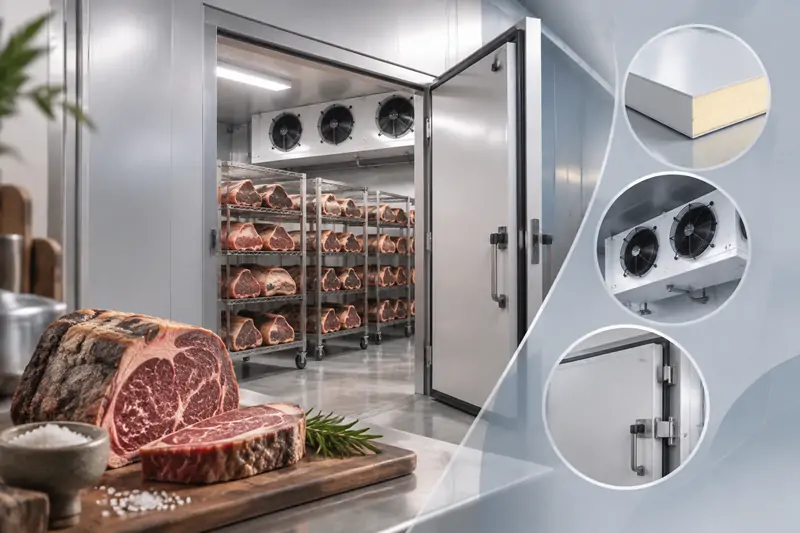
LINBLE provides custom cold room solutions with configurable dimensions, refrigeration systems, insulated panels, doors, and installation support.
The following published product options are relevant when preparing a project specification.
| Component | LINBLE Published Specifications | Application Consideration |
| PU/PIR insulated panels | 50–200 mm available thickness; thermal conductivity ≤0.024 W/m·K | Select insulation based on site temperature and energy requirements |
| Stainless steel panel cladding | 0.5–3.0 mm thickness | Consider cleanable finishes for hygienic areas |
| Insulated cold room doors | 100 mm or 150 mm hinged and sliding models | Match opening dimensions, movement, and sealing requirements |
| Chiller condensing units | Chiller configurations for −5°C to +5°C | Size for transmission, infiltration, product, and equipment loads |
Published product ranges are selection options rather than a complete dry-aging system specification.
For example, choosing thicker insulation does not compensate for poorly sealed panel joints or frequent door openings.
Likewise, specifying a larger condensing unit does not resolve an uneven airflow problem.
The correct configuration depends on the complete room design.
How Can a Dry-Aging Room Reduce Hygiene Risks?
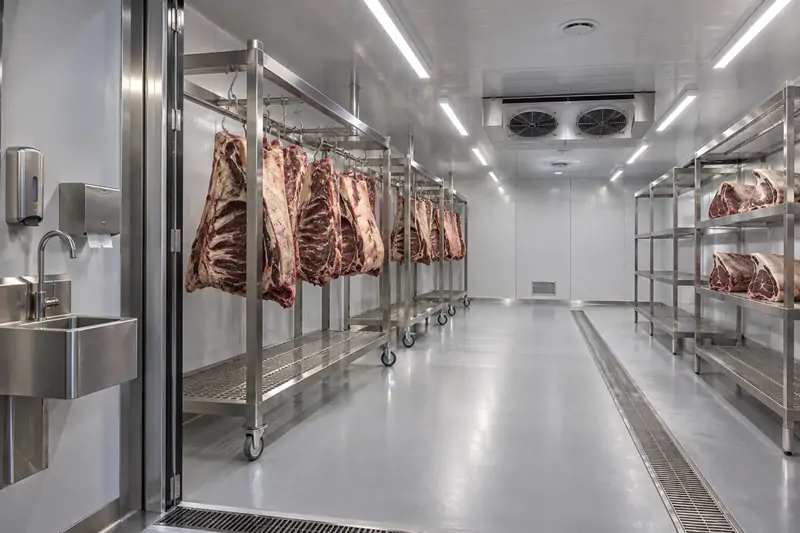
Dry aging involves leaving the beef’s outer surface exposed to the surrounding air for an extended length of time.This makes sanitation, product separation, and room accessibility particularly important.
The University of Missouri Extension’s beef aging guidance emphasizes room sanitation, proper air circulation, and preventing contamination from unrelated stored products.
Separate the Aging Process from Ordinary Storage
A dedicated aging area should support a clear operating sequence:
Receiving → Inspection → Loading → Aging → Unloading → Trimming
Apply the following precautions:
- Keep shipping cartons, unrelated food products, and unnecessary materials outside the aging room.
- Use removable, cleanable racks and appropriately designed food-contact surfaces.
- Prevent condensate from dripping onto exposed beef.
- Establish documented cleaning and sanitizing procedures.
- Separate trimming and packaging operations from exposed-meat storage.
Inspect incoming beef quality and maintain traceability throughout each aging batch.
Do Not Treat UV Equipment as a Substitute for Sanitation
Some dry-aging facilities consider air filtration or UV treatment as supplementary controls.
However, their effectiveness depends on equipment design and validated operating conditions.
Research published in the Italian Journal of Food Safety discusses microbial contamination on meat maturation chamber surfaces and the importance of appropriate sanitation methods.
Any supplementary treatment must be evaluated within the facility’s food safety program.
How Can Operators Identify Dry-Aging Cold Room Problems?
The appearance of the meat can reveal problems, but it should be interpreted alongside environmental records and food safety inspections.
| Observed Problem | Possible Cause | What to Check First |
| Uneven crust thickness | Unbalanced airflow | Measure air velocity at different rack positions |
| Excessive weight loss | Low RH, high airflow, or extended aging | Review weight trends and environmental logs |
| Repeated humidity spikes | Door infiltration or unstable moisture control | Examine RH records alongside door activity |
| Condensation near racks | Moisture ingress or local temperature differences | Inspect insulation joints, drains, and airflow |
| Unusual odors or suspicious surface growth | Contamination or inadequate process control | Hold affected products and initiate food safety assessment |
Suspected contamination should not be treated as an ordinary equipment-adjustment issue. A qualified food safety professional should determine product disposition.
What Should Be Tested Before Loading the First Beef Batch?
A completed cold room is not necessarily ready for dry-aging production.
Commissioning should demonstrate whether the room performs as intended, including under realistic loading conditions.
Temperature verification
- Record temperature at several locations, including areas near the door and farthest racks.
- Check recovery after representative door-opening events.
- Verify temperature alarms and data recording.
Humidity verification
- Compare RH readings from different room positions.
- Observe fluctuations during refrigeration and defrost cycles.
- Verify that the control system maintains the approved operating band.
Airflow verification
- Measure air velocity at representative beef positions.
- Repeat tests with racks arranged as they will be during production.
- Identify areas exposed to direct discharge or insufficient circulation.
Hygiene verification
- Inspect equipment surfaces, panel joints, and drainage.
- Confirm that racks and evaporator areas can be cleaned safely.
- Verify cleaning records and product-handling procedures.
These checks help identify mechanical problems before commissioning, but product safety still requires process validation and ongoing monitoring.
What Information Should Buyers Send to a Cold Room Manufacturer?
Before requesting a quotation, prepare an equipment specification that reflects the aging process rather than only the room dimensions.
Product and production requirements
- Beef cut types and individual dimensions
- Maximum simultaneous loading weight
- Target aging duration and finished daily output
- Hanging or shelf-based storage preference
Cold room operating requirements
- Intended temperature and RH control ranges
- Air velocity requirements at the meat surface
- Installation location and ambient conditions
- Available floor area, ceiling height, and utilities
- Monitoring, alarm, and sanitation requirements
Project delivery requirements
- Preferred insulation and interior finishes
- Rack layout and access arrangements
- Installation and commissioning responsibilities
- Required performance verification records
LINBLE’s meat cold room solutions support customized dimensions, layouts, shelving, temperature zones, and refrigeration configurations.
Plan a Dry-Aging Beef Cold Room Around Your Production Needs
The right dry-aging cold room is not simply the coldest or most powerful refrigeration system.
It is a coordinated environment where temperature, humidity, airflow, usable rack capacity, and hygienic access work together.
LINBLE combines customizable cold room structures, insulated panels, refrigeration components, and design-to-installation support for commercial cold storage projects.
Explore LINBLE’s custom cold room solutions or contact its engineering team to discuss your proposed dry-aging room, equipment requirements, and project layout.