
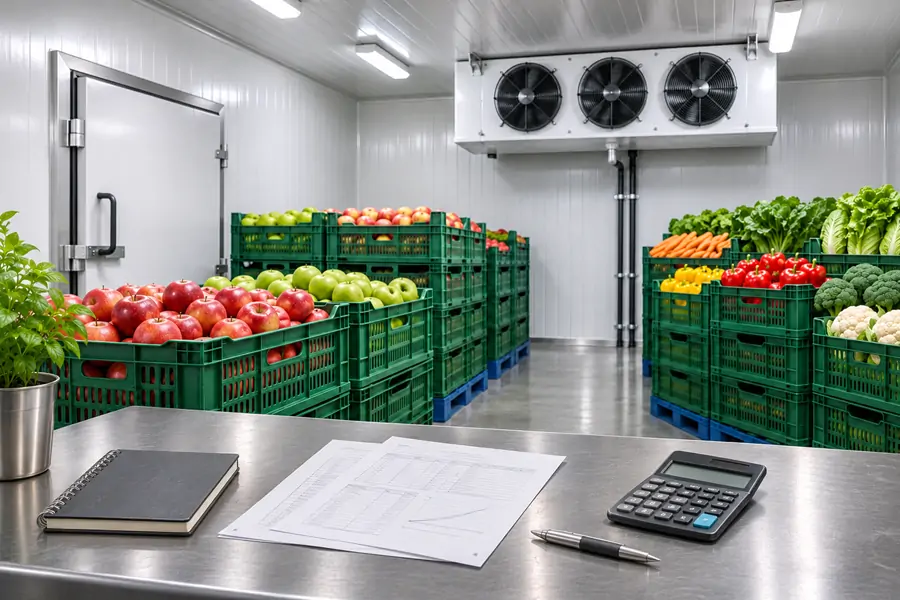
Calculating the cold room cooling load for fresh produce requires more than knowing storage volume. Incoming product temperature, respiration heat, packaging materials, and available cooling time directly influence refrigeration capacity.
For cold rooms for fruits and vegetables, the difference between receiving pre-cooled produce and freshly harvested crops can substantially change equipment requirements, electricity consumption, and achievable product cooling rates.
1. Separate Field Heat from Holding Duty
Fresh produce generates two distinct refrigeration demands: removing accumulated heat after harvesting and maintaining the required storage temperature afterward.
Field heat is the sensible heat that must be removed when harvested produce is warmer than its target storage temperature. The amount of heat to be removed is determined by the weight of the produce, its thermal properties, and the difference between incoming and target temperatures.
Holding duty continues after the produce reaches storage temperature. It includes respiration heat, heat transmission through insulated panels, air infiltration, lighting, and internal equipment.
| Cooling Load Component | Initial Pull-Down | Subsequent Storage |
| Product sensible heat | Significant for warm arrivals | Minimal without new arrivals |
| Respiration heat | Temperature-dependent | Continuous |
| Packaging heat | Depends on incoming temperature | Minimal after stabilization |
| Wall, ceiling and floor heat gain | Continuous | Continuous |
| Door infiltration | High during loading | Depends on operations |
| Fans and lighting | Operational | Operational |
A cold room sized only for holding duty may maintain already-cooled apples successfully but struggle to bring freshly harvested apples down to the same temperature within the required time.
Understanding the difference between produce precooling and cold storage helps determine whether a conventional storage room, a dedicated precooling system, or a combination of both is necessary.
2. Establish the Design Conditions for One Tonne of Produce
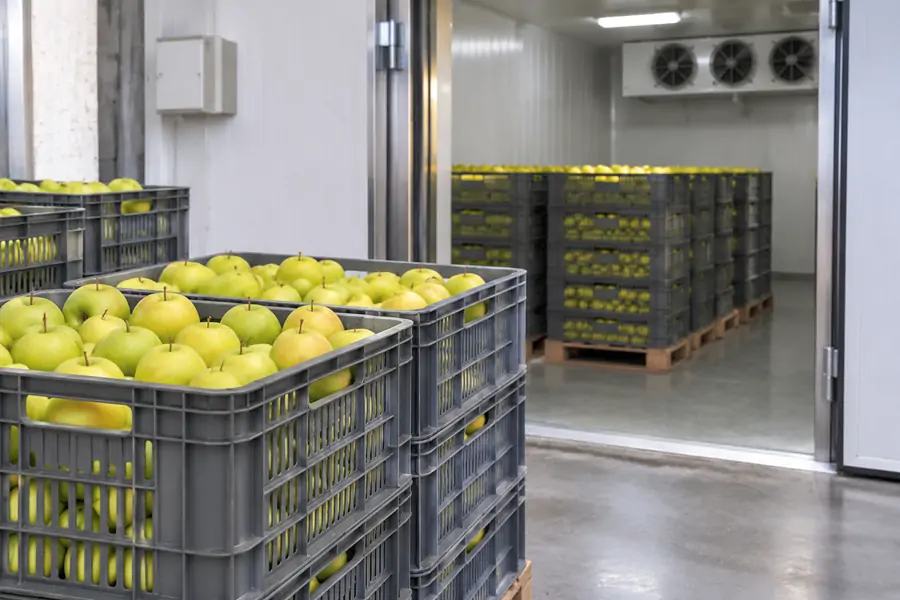
Consider a fruit cold room receiving 1,000 kg of Golden Delicious apples per batch. Two incoming temperature conditions are evaluated: freshly harvested apples arriving at 20°C and pre-cooled apples arriving at 5°C.
Both batches must reach a target product temperature of 1°C within 12 hours.
The following design conditions are illustrative rather than specifications for an installed project.
| Design Parameter | Assumed Value |
| Product weight | 1,000 kg |
| Uncooled arrival temperature | 20°C |
| Pre-cooled arrival temperature | 5°C |
| Target product temperature | 1°C |
| Product specific heat | 3.6 kJ/kg·K |
| Available pull-down period | 12 hours |
| Internal room dimensions | 4 × 3 × 2.5 m |
| Internal storage volume | 30 m³ |
| Room air setpoint | 0°C |
| Outdoor design temperature | 32°C |
| Plastic crate weight | 80 kg |
| Target relative humidity | 90–95% |
The UC Davis postharvest storage recommendations for Golden Delicious apples identify suitable storage temperatures around 0°C and relative humidity of 90–95%.
These conditions should not automatically be applied to other fruits or vegetables. Some commodities require higher storage temperatures to prevent chilling injury.
3. Calculate Product Sensible Cooling Load
The first step in a produce cooling load calculation is determining the thermal energy associated with the incoming crop.
The cold room calculation formula for sensible product heat is:
Eₚ = m × Cₚ × (Tᵢ − Tᶠ) ÷ 3,600
Where:
- Eₚ = product heat to remove (kWh thermal)
- m = net product mass (kg)
- Cₚ = specific heat (kJ/kg·K)
- Tᵢ = incoming product temperature (°C)
- Tᶠ = target product temperature (°C)
Scenario A: Freshly Harvested Apples at 20°C
Eₚ = 1,000 × 3.6 × (20 − 1) ÷ 3,600
Product sensible heat = 19.00 kWh thermal
Over a 12-hour cooling period:
Qₚ = 19.00 ÷ 12 = 1.58 kW
Scenario B: Pre-Cooled Apples at 5°C
Eₚ = 1,000 × 3.6 × (5 − 1) ÷ 3,600
Product sensible heat = 4.00 kWh thermal
Over the same cooling period:
Qₚ = 4.00 ÷ 12 = 0.33 kW
Precooling reduces the sensible product load imposed on the storage room by approximately 79%. This percentage applies to product heat, not the complete refrigeration load or total supply-chain electricity consumption.
The University of Vermont produce cooling load calculator provides a useful reference for estimating product pull-down, respiration, and enclosure loads.
4. Add Respiration Heat from Living Produce
Unlike most packaged industrial goods, fresh fruits and vegetables continue generating heat after entering refrigerated storage.
Respiration rates vary with commodity, maturity, temperature, and storage atmosphere. Warm produce generally produces more respiration heat than cooled produce.
Published respiration rates for Golden Delicious apples illustrate this temperature dependence.
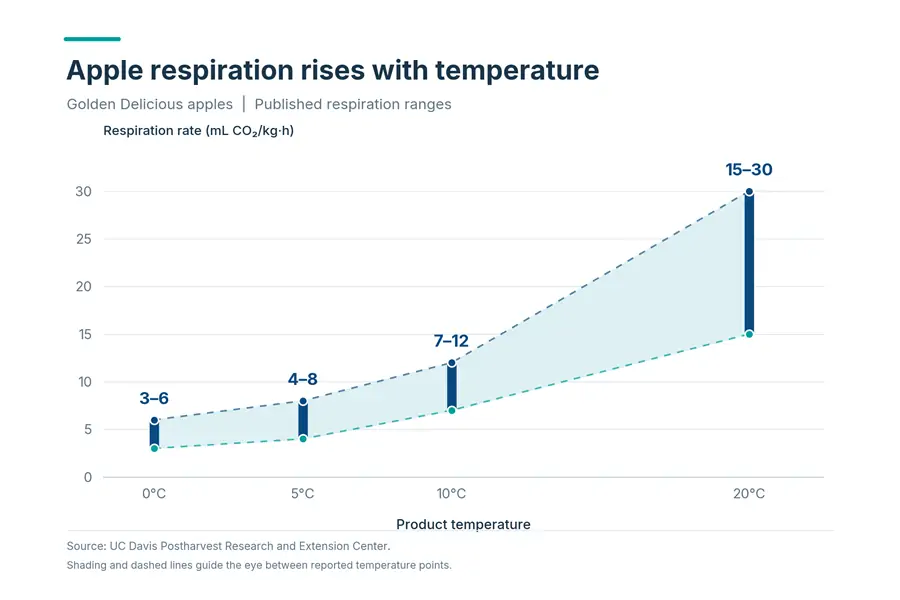
| Product Temperature | Respiration Rate (mL CO₂/kg·h) | Heat Generation per Tonne |
| 0°C | 3–6 | 17.7–35.5 W |
| 5°C | 4–8 | 23.6–47.3 W |
| 10°C | 7–12 | 41.4–70.9 W |
| 20°C | 15–30 | 88.7–177.3 W |
Data source: Postharvest Research and Extension Center, University of California, Davis.
UC Davis provides a conversion factor of 122 kcal per metric tonne per day for each unit of respiration rate expressed in mL CO₂/kg·h.
After conversion, the respiration heat formula becomes approximately:
Qᵣ = M × R × 5.91 ÷ 1,000
Where:
- Qᵣ = respiration heat (kW)
- M = product mass (metric tonnes)
- R = respiration rate (mL CO₂/kg·h)
| Parameter | Scenario A | Scenario B |
| Product mass | 1 tonne | 1 tonne |
| Assumed average respiration rate | 12 | 5.5 |
| Respiration load | 0.071 kW | 0.033 kW |
| Heat generated over 12 hours | 0.85 kWh | 0.39 kWh |
For preliminary calculations, assume the following average respiration rates during pull-down:
These averages are engineering assumptions, not measured cooling-cycle data. Detailed calculations should use the expected product temperature profile and corresponding respiration rates.
5. Include Crates, Cartons and Pallets
Packaging entering a cold room also carries sensible heat. Ignoring this component becomes increasingly problematic when large quantities of reusable plastic crates or wooden pallets circulate between harvesting and refrigerated storage.
Use the same sensible heat formula, replacing product mass and specific heat with packaging values.
For 80 kg of plastic crates with an assumed specific heat of 1.9 kJ/kg·K:
| Packaging Load | Scenario A | Scenario B |
| Crate arrival temperature | 20°C | 5°C |
| Final crate temperature | 1°C | 1°C |
| Thermal energy to remove | 0.80 kWh | 0.17 kWh |
| Average cooling load | 0.067 kW | 0.014 kW |
Calculate wooden pallets and other incoming packaging separately when applicable.
Packaging material properties, actual tare weights, and arrival temperatures should come from supplier specifications or representative measurements. Crates stored outdoors may arrive at a different temperature from the produce itself.
6. Calculate Heat Gain Through the Cold Room Enclosure
Field heat removal is only part of the total refrigeration duty. Heat continuously enters through the walls, ceiling, and floor, even when the cold room door remains closed.
The transmission load formula is:
Qₜ = U × A × ΔT ÷ 1,000
Where:
- Qₜ = transmission cooling load (kW)
- U = combined thermal transmittance of the enclosure (W/m²·K)
- A = surface area (m²)
- ΔT = temperature difference (K)
For the 30 m³ example, assume an overall heat transfer coefficient of 0.23 W/m²·K for the walls and ceiling, and 0.30 W/m²·K for the insulated floor.
| Surface | Area | Temperature Difference | Heat Gain |
| Walls | 35 m² | 32°C | 0.258 kW |
| Ceiling | 12 m² | 32°C | 0.088 kW |
| Floor | 12 m² | 20°C | 0.072 kW |
| Total | 59 m² | — | 0.418 kW |
Over 12 hours, enclosure transmission contributes approximately 5.02 kWh of thermal energy.
Actual calculations must account for panel thickness, insulation properties, thermal bridges, installation conditions, solar exposure, and the temperature beneath the floor.
For facilities operating throughout the year, use the relevant peak seasonal design conditions rather than average annual outdoor temperatures.
7. Account for Door Openings and Internal Equipment
During produce receiving, warm and humid outdoor air enters through the door.The cooling equipment must account for both the heat carried by incoming air and the energy released as airborne moisture condenses.
For this example, assume 150 kg of cumulative dry-air infiltration over the receiving and cooling period, with a moist-air enthalpy difference of 65 kJ/kg of dry air.
Eᵢ = 150 × 65 ÷ 3,600 = 2.71 kWh
Additional internal loads are estimated as follows:
| Heat Source | Operating Assumption | Heat Load |
| Air infiltration | 150 kg of dry air | 2.71 kWh |
| Evaporator fans | 150 W × 12 hours | 1.80 kWh |
| Lighting | 60 W × 2 hours | 0.12 kWh |
| Personnel | 2 people × 250 W × 1 hour | 0.50 kWh |
| Total | 5.13 kWh |
These assumptions must be adjusted for actual door dimensions, outdoor humidity, loading frequency, and equipment operation. Include defrost heat and dedicated precooling fans separately where applicable.
The postharvest refrigeration load guide from NC State University explains how product heat, respiration, enclosure transmission, and operational heat gains contribute to equipment sizing.
8. Compare Total Cooling Loads for Both Arrival Conditions
Combining all calculated components reveals how incoming product temperature affects fruit cold room cooling capacity.
| Cooling Load Component | Uncooled Apples (20°C) | Pre-Cooled Apples (5°C) |
| Product sensible heat | 19.00 kWh | 4.00 kWh |
| Respiration heat | 0.85 kWh | 0.39 kWh |
| Packaging heat | 0.80 kWh | 0.17 kWh |
| Enclosure transmission | 5.02 kWh | 5.02 kWh |
| Air infiltration | 2.71 kWh | 2.71 kWh |
| Fans, lighting and personnel | 2.42 kWh | 2.42 kWh |
| Total thermal load | 30.80 kWh | 14.71 kWh |
| Average cooling capacity | 2.57 kW | 1.23 kW |
| Capacity with 20% allowance | 3.08 kW | 1.47 kW |
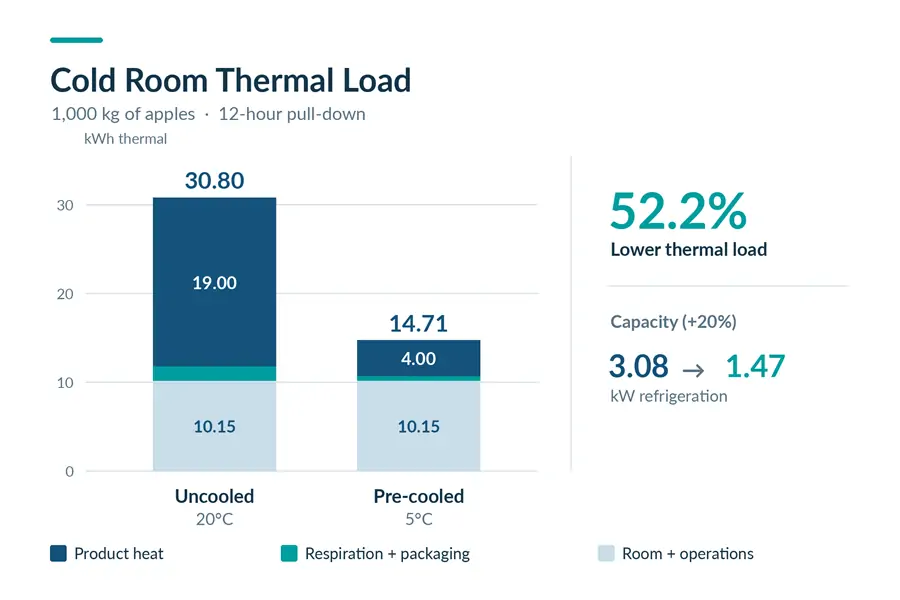
Under these assumptions, receiving pre-cooled apples reduces the total storage-room thermal load by approximately 52%.
For a business purchasing refrigeration equipment, the difference is substantial. Two cold rooms with identical dimensions and storage capacities may require very different refrigeration systems because of incoming product temperatures.
However, the remaining refrigeration demand does not disappear because enclosure transmission, infiltration, and internal equipment continue adding heat.
The calculated values represent refrigeration output, not electrical input power. The illustrative 20% allowance should also be adjusted according to project-specific uncertainties rather than treated as a universal requirement.
9. Convert Available Pull-Down Time into Required kW
Reducing the cooling period increases the required refrigeration capacity, even when product mass and temperature difference remain unchanged.
For the same tonne of apples arriving at 20°C, the sensible product heat remains 19 kWh.
| Available Pull-Down Time | Product Cooling Capacity Alone |
| 4 hours | 4.75 kW |
| 6 hours | 3.17 kW |
| 8 hours | 2.38 kW |
| 12 hours | 1.58 kW |
| 24 hours | 0.79 kW |
These figures exclude respiration, packaging, and room-related loads.
If defrost or operational interruptions reduce the available refrigeration time from 12 hours to 10 hours, the original 30.80 kWh thermal load requires an average refrigeration output of 3.08 kW during those operating hours, or approximately 3.70 kW with a 20% allowance.
This assumes the original total heat load remains unchanged. Any additional heat introduced by defrost must be included separately.
For additional equipment-sizing considerations, refer to LINBLE’s guide on calculating refrigeration capacity for a cold room.
10. Adjust the Calculation for Different Fruits and Vegetables
An apple cooling load calculation cannot be transferred directly to broccoli, strawberries, bananas, or other commodities.
Four crop-specific parameters require particular attention:
| Parameter | Effect on Refrigeration Design |
| Specific heat | Determines energy required for each degree of temperature reduction |
| Respiration rate | Determines ongoing biological heat generation |
| Safe storage temperature | Determines cooling temperature difference and operating conditions |
| Required cooling speed | Determines refrigeration capacity and airflow requirements |
Highly perishable crops may require shorter cooling cycles, while chilling-sensitive produce needs higher storage temperatures.
The UC Davis produce factsheets provide commodity-specific storage recommendations and respiration data for a wide range of fruits and vegetables.
For mixed-produce facilities, calculate each commodity separately before combining overlapping loads. Include the respiration heat of previously stored inventory when additional warm batches arrive.
Daily throughput and maximum stored inventory are separate design parameters. A facility receiving one tonne daily may eventually contain several tonnes of respiring produce.
11. Match Refrigeration Capacity with Actual Produce Cooling Performance
A refrigeration unit with sufficient rated capacity does not necessarily guarantee that the center of every crate reaches its target temperature on schedule.
Equipment selection must also consider:
- Airflow distribution:Ensure cooling air reaches the produce rather than bypassing densely stacked crates.
- Evaporator selection:Evaluate coil temperature difference, moisture removal, and fan performance.
- Condensing conditions:Confirm available refrigeration capacity at the site’s maximum design ambient temperature.
- Product temperature verification:Measure representative pulp temperatures at the slowest-cooling positions.
A room thermometer reaching its setpoint does not confirm that the produce has completed its cooling cycle. Product temperature measurements are necessary to verify actual pull-down performance.
LINBLE’s cold rooms for fruits and vegetables cover different produce preservation requirements, including precooling and refrigerated storage. Insulated panels, refrigeration equipment, and airflow arrangements can be configured according to the intended cooling duty rather than storage volume alone.
Size Your Fresh Produce Cold Room with LINBLE
Accurate fruit cold room sizing starts with incoming product temperature, daily throughput, and required pull-down time. Contact LINBLE with your crop specifications and operating conditions to develop a suitable refrigeration and storage configuration.