
Fresh and frozen meat need different storage conditions, so one undivided room at one temperature cannot properly serve both. Raw fresh meat and cooked ready-to-eat meat may sometimes share a chilled room under a suitable food-safety plan, but separate enclosed zones are preferable where handling, volume or exposure makes control difficult. For LINBLE planning, decide temperature compatibility and contamination control separately before deciding how many rooms to build.
What Does “Share the Same Cold Room” Mean?
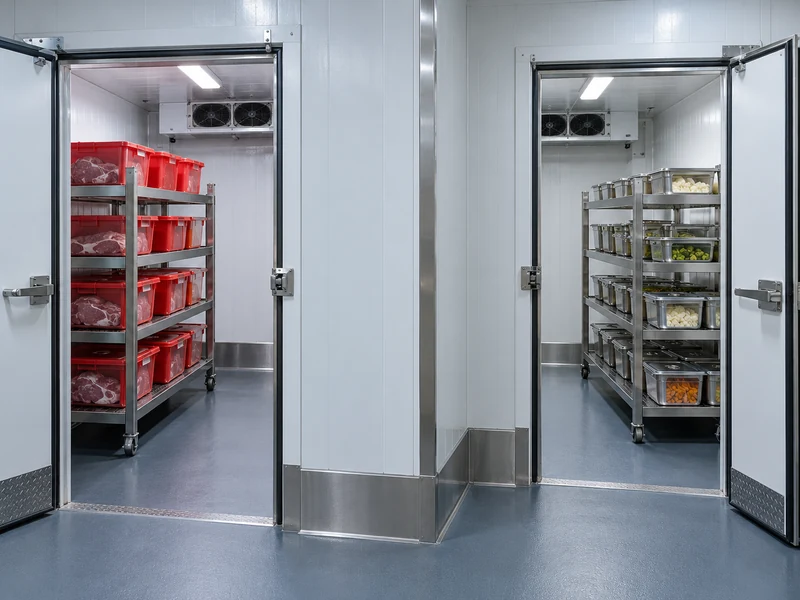
Sharing a building, sharing an insulated enclosure and sharing the same air are three different arrangements. A combined enclosure can contain independently controlled rooms behind solid insulated partitions. That does not make it a single mixed-temperature space.
A strip curtain or a painted floor line does not create an independently controlled freezer compartment. Nor does a shelf labelled “cooked” create a physical barrier against handling errors. Describe partitions, doors, refrigeration and access on the drawing so that everyone is discussing the same proposal.
LINBLE’s restaurant cold room solutions include different temperature zones and layout options. That provides a practical route for kitchens that need chilled raw ingredients, cooked components and frozen stock within a limited footprint. The operating procedure must still match the physical arrangement.
Why Can Fresh and Frozen Meat Not Use One Setpoint?
Fresh chilled meat must remain in its intended unfrozen condition, while frozen meat needs its specified frozen storage conditions. A temperature that keeps fresh meat suitable for its chilled use will not maintain frozen stock indefinitely. A freezer condition can freeze a product intended to remain fresh.
Placing frozen cartons near the evaporator and fresh meat near the door is not a reliable zoning method. Both locations change with loading, defrost and door use. The warmest position in a freezer is still not a controlled chilled room.
Temporary refrigerated thawing is a separate operation. Frozen meat being intentionally thawed under an approved procedure is becoming chilled material; it is not continuing in frozen storage. Provide containment, identification, time controls and sufficient refrigeration duty for that operation.
| Proposed Combination | Planning Decision | Condition to Resolve |
| Fresh Chilled and Frozen Stock | Provide separate temperature-controlled spaces | Product specifications and transfer route |
| Raw Chilled and Cooked Chilled Meat | Assess controlled sharing or separate rooms | Packaging, exposure and contamination risk |
| Raw Frozen and Cooked Frozen Packs | May be assessed for compatible packaged storage | Pack integrity, segregation and local requirements |
| Hot Cooked Meat and Chilled Stock | Provide a validated cooling process | Cooling time and effect on existing stock |
When Can Raw and Cooked Chilled Meat Share Storage?
Sharing can be assessed when both products have compatible storage requirements and the food-safety plan controls contamination during receiving, storage and picking. Fully enclosed, intact packaging is easier to manage than uncovered food. A small amount of wrapped raw meat is also different from frequent transfers of open raw containers.
At minimum, identify dedicated positions, suitable containment and handling rules. Raw products must not be able to drip onto cooked or other ready-to-eat food, and staff must maintain the required separation during replenishment. Follow the applicable authority’s requirements where they demand more separation.
University of Minnesota Extension’s safe storage guidance explains the basic principle of keeping raw meat below ready-to-eat food to prevent dripping contamination. In a commercial walk-in, that principle needs a complete procedure for shelves, trolleys, hands and containers. Shelf labels must be supported by a routine that staff can maintain while unloading and picking.
Do not assume that refrigeration or freezing makes raw meat microbiologically equivalent to cooked food. The University of Georgia’s freezing guidance states that freezing does not sterilize food. Separate storage and handling decisions must therefore remain part of the hygiene plan even when every pack is frozen.
When Is a Separate Cooked-Meat Room the Better Choice?
Separate space becomes more persuasive when ready-to-eat food is exposed, several staff pick simultaneously, or large raw deliveries arrive during cooked-food handling. Physical separation reduces the number of rules that must be followed perfectly in a crowded aisle. It also allows different cleaning and access routines.
Consider a kitchen receiving raw poultry while another team assembles cold sliced meat platters. If both teams must pass through one door and use the same trolley parking area, shelf separation solves only part of the problem. Distinct rooms or an altered receiving route may be a better use of the available area.
In a meat plant, discuss the product and hygiene requirements with LINBLE through the meat cold room planning process. State whether cooked food is sealed before storage and whether any pack opening, slicing or repacking occurs nearby. The room should support the site’s defined hygiene zoning.
Can Hot Cooked Meat Go Straight into the Shared Chiller?
Only if the approved cooling method and equipment capacity support that operation without compromising the food already stored. A holding room designed for chilled deliveries may not have the capacity or airflow to cool repeated hot batches. The risk is greater with deep pans and crowded shelves.
Determine the required cooling schedule from the applicable food-safety system and verify it in the product. Specify pan depth, batch mass, coverings and the available cooling equipment. A room-air sensor can recover quickly while a deep food container remains warm.
Keep the completed cooling stage visible in the workflow. For example, food awaiting a validated cooling cycle should not occupy positions designated for released chilled stock. Labels, records and defined transfer points make that distinction easier to maintain through a busy shift.
How Should the Room Be Laid Out If Sharing Is Accepted?
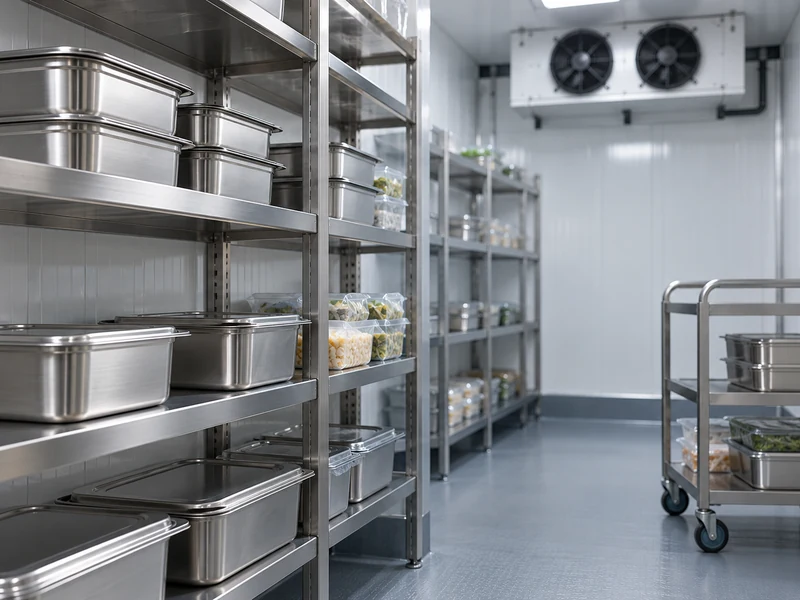
Design around the movements that could break separation. Put dedicated storage positions where staff can use them without lifting raw containers across cooked food or parking delivery boxes in the picking aisle. Keep cleaning access and the evaporator’s return-air route available.
- Allocate raw and ready-to-eat storage positions on the approved layout.
- Use suitable closed containers and drip containment for raw meat.
- Provide separate handling equipment where the hygiene plan requires it.
- Define receiving, replenishment and picking procedures.
- Keep allergen, date and batch controls visible in the stock system.
- Provide a clear response to damaged packaging and spills.
Airflow matters because overcrowding can create temperature differences even in an otherwise hygienic layout. LINBLE’s guide to arranging products for better cooling addresses useful spacing principles. Those principles complement segregation; they do not replace it.
How Could a Compact Kitchen Divide the Available Space?
Consider an illustrative kitchen receiving chilled raw meat, sealed cooked components and frozen ingredients. Start by allocating independent frozen storage, because its temperature duty cannot be combined with chilled holding. Then assess whether the remaining chilled products can share under the approved hygiene procedure.
If raw containers are frequently opened or cooked food arrives uncovered, a solid partition with separate access may be more practical than adding shelf labels. Show the reduction in usable positions caused by the partition and doors. Compare that arrangement with changing delivery frequency or moving a product group into another suitable appliance.
Do not sacrifice the working aisle to recover the positions lost to separation. Staff need room to remove a container without temporarily placing it on another product’s shelf. Include a defined destination for incoming cases before the delivery is accepted into the room.
Finally, agree an overflow rule for the busiest day. The rule might require an additional delivery slot or an identified suitable backup store. An unplanned instruction to “put it anywhere cold” would undermine the layout precisely when the kitchen is under the most pressure.
What Should Be Checked Before Accepting the Layout?
Check the warmest likely storage positions under realistic loading and door use. Record which products occupy them and whether those products meet their own storage requirements. Use cold room temperature mapping to investigate distribution rather than assuming every shelf follows the controller display.
Then run a practical receiving and picking exercise with the staff who will use the room. Include a raw delivery, a damaged container and a simultaneous request for cooked food. A layout that only works when nobody moves is not ready for operation.
Capacity should be assessed with all the required separation and handling space in place. LINBLE’s article on sizing from the menu and delivery schedule helps translate that into usable positions. If those positions do not fit, revise the room arrangement or stock schedule before relaxing the hygiene rules.