
Size an ice cream cold room from peak stock on hand, the real carton or pallet arrangement and the busiest loading-and-picking period, then calculate refrigeration duty separately. Seasonal sales volume alone is not enough: a freezer can have enough cubic metres for July’s inventory and still recover poorly during July’s afternoon dispatch peak.
For LINBLE, prepare an inventory curve and an operating-day schedule before requesting a room size. Also state whether the room receives fully hardened ice cream or must remove heat from newly produced product, because those duties lead to different equipment selections.
What Stock Accumulates Before the Sales Peak?
Calculate the inventory carried into the peak, then track receipts and dispatches through the build-up and drawdown. The highest daily sales figure is not necessarily the day with the largest stored quantity.
A distributor buying ahead of summer may reach maximum occupancy before demand peaks. A manufacturer producing steadily can face a different pattern, especially when promotions change the balance between bulk tubs, multipacks and individual retail products.
Start with stock by SKU and convert each to its actual case or pallet footprint. Retain enough detail to show slow-moving flavours and partially used positions, which may remain in the room while the fastest-selling products turn repeatedly.
How Can a Simple Inventory Example Help?
Consider an illustrative distributor starting a fortnight with 700 cartons, receiving 180 cartons per day and dispatching 150. After fourteen days, inventory reaches 1,120 cartons, assuming those quantities remain constant and ignoring returns.
If the approved stacking arrangement holds 40 cartons per pallet position, that stock requires 28 completely filled positions. The operating layout may need more because separate SKUs, partial pallets, quarantine and picking positions prevent every space from being perfectly full.
This hypothetical stock balance demonstrates the arithmetic only; the pallet count has not been checked against a particular room, handling arrangement or LINBLE equipment selection. Use actual carton dimensions and handling limits before converting the result into a room drawing.
How Does Stock Become Usable Room Capacity?
Lay out the storage and handling system, then calculate the internal dimensions around it. A volume allowance that ignores aisle width, door approach and evaporator clearance can overstate the capacity available to the business.
Include rack uprights, pallet overhang, protective barriers, access for maintenance and the space required to retrieve a product without reorganising the whole room. Confirm load ratings and handling equipment with the rack and building designers.
- Reserve positions for bulk stock and active picking.
- Allow the actual pallet truck or forklift to turn and approach racks.
- Keep the evaporator’s supply and return paths clear.
- Identify where incomplete orders wait without obstructing the door.
- Leave access to drains, controls and equipment service points.
LINBLE’s ice cream cold room solution should therefore be discussed with a stock-position drawing. The useful commercial capacity is the quantity that can be stored and retrieved while the room continues to operate as designed.
The layout issues in integrating racking into a cold room are particularly relevant when seasonal reserve stock uses upper levels above a busy picking aisle.
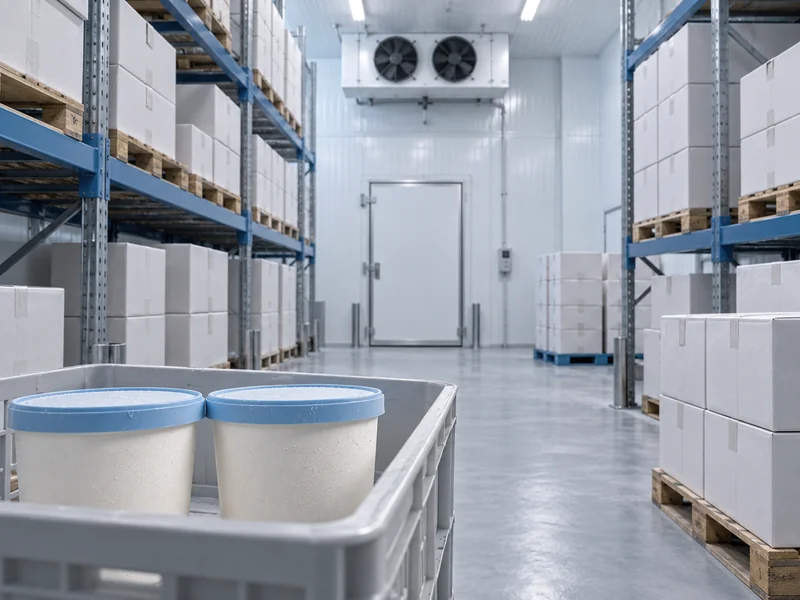
Is the Room Holding Ice Cream or Hardening It?
State this explicitly because hardening adds a process load that a storage-only calculation does not include. Receiving fully hardened products is different from loading freshly packed ice cream from production.
The Colorado State overview of ice cream production treats hardening as a distinct production step and notes the influence of product and freezer conditions. The room design should preserve that distinction.
For hardening, specify product entry condition, pack size, batch mass, required endpoint and permitted time. Validate the slowest product position rather than infer completion from the controller’s air reading.
For holding, obtain the finished product’s storage specification and use it to define the operating programme. A retail serving temperature or a general frozen-food limit is not automatically the right target for long-term texture protection.
What Makes the Refrigeration Peak Different From the Inventory Peak?
Refrigeration duty depends on heat entering during the operating period, not just the amount of stock already inside. Incoming products, warm packaging, infiltration, lights, people and handling equipment contribute differently over the day.
Ask for a load calculation based on the hottest relevant outdoor conditions and the intended room duty. Include defrost and the time available for useful cooling, with the selected unit’s performance stated at the actual design conditions.
| Seasonal Change | Design Consequence |
| More reserve cartons | Additional usable positions and a check of loaded air distribution. |
| More deliveries per shift | More product and infiltration load during receiving. |
| Longer picking periods | More door activity, people and working equipment inside the room. |
| New production entering before full hardening | A separate process-duty assessment rather than a storage allowance. |
When comparing a LINBLE condensing unit, use its duty under the specified ambient and refrigeration conditions. The compressor label or a capacity at a different operating point does not settle whether it can serve this room.

How Can Picking Be Kept From Damaging Product Quality?
Reduce avoidable exposure and repeated temperature variation along the picking route. The goal is a consistent product condition through reserve storage, order assembly and loading.
The University of Florida transport guidance explains that temperature fluctuations can enlarge ice crystals and damage ice cream quality. That makes dispatch behaviour part of the design brief, rather than a minor operating detail.
Arrange fast-moving lines where staff can retrieve them efficiently without blocking the return-air route. Consider a suitable protected staging arrangement when order assembly would otherwise hold the main door open for long periods.
LINBLE’s article on ice cream heat shock provides the quality context. A larger refrigeration unit cannot fully compensate for an order routinely left in unsuitable conditions after it leaves the room.
Should the Business Buy for the Biggest Possible Summer?
Compare a permanent room sized for the credible operating peak with a smaller base room supported by a defined seasonal overflow option. Both require a quality-controlled cold-chain plan.
A permanent extension may suit a recurring peak that is growing predictably. Short-lived promotions or uncertain expansion can justify a staged modular plan, provided the later equipment, access and utility requirements are considered from the beginning.
Include low-season operation in the comparison. Excess storage volume is not the only concern: equipment control and part-load behaviour should also be appropriate when the room holds less stock.
Use LINBLE’s discussion of expanding an existing freezer room when reserving space for a future stage. An intended extension needs more preparation than an empty strip of land beside the panels.
What If Summer Demand Shifts Toward More Flavours?
A wider range of flavours can increase the space required without increasing total cartons. Each slow-moving SKU may occupy a partly filled position, while popular lines need accessible pick faces and reserve stock behind them.
Use a peak-season SKU plan as well as a total-stock curve. Mark which products share positions safely within the inventory system and which require separate locations to preserve traceability and efficient picking.
Test one representative order against the drawing. Count the movements, door interactions and time spent building the order rather than assuming that the shortest aisle produces the quickest dispatch.
Then test a replenishment during picking. If a pallet truck delivering reserve stock blocks the only route to several fast sellers, the room may have sufficient storage positions but insufficient working space.
Include returns, damaged cartons and stock awaiting a quality decision in the operating plan. They need an agreed location and handling process rather than being placed wherever the summer load leaves a gap.
These details can change the most useful LINBLE proposal from one large chamber to a reserve-and-picking arrangement or a staged expansion. Compare the alternatives using the same stock, temperature and throughput assumptions, so the business can see whether it is buying more product capacity, faster handling or both.
What Should Be Sent With a Seasonal-Sizing Enquiry?
Send monthly stock peaks, the day-by-day build-up around the busiest period, carton dimensions, pallet patterns, SKU count and receiving temperatures. Add the busiest shift’s door schedule, dispatch method, local ambient conditions and any hardening duty.
Ask LINBLE to show usable storage positions and refrigeration assumptions separately, with the proposed expansion stage identified where applicable. That produces a room size the business can check against its summer stock and an equipment selection it can check against its summer workload.