
The choice between a rapid roll-up and a sliding freezer door depends on traffic during working hours, thermal isolation during inactive periods, and long-term operating reliability.
A Freezer Entrance Has Two Different Jobs
A busy freezer entrance must accommodate product movement without creating unnecessary exposure to warm, humid air. Once loading finishes, its priority changes from accessibility to thermal isolation.
These two operating states place different demands on the door assembly.
During active loading:
- Short opening and closing cycles.
- Unobstructed pallet movement.
- Reliable automatic activation.
- Limited exposure to surrounding air.
During inactive periods:
- Low heat transmission.
- Controlled air leakage.
- Reliable closed-door sealing.
- Protection against unauthorized access.
A rapid roll-up door primarily addresses frequent movement, while an insulated sliding door can provide a more substantial thermal barrier during extended closures.
However, neither function should be assumed from the door type alone. The selected assembly must demonstrate suitable performance under actual freezer conditions.
Some facilities may benefit from combining both door types rather than expecting a single door to perform every duty equally well.
Compare Door Performance Beyond Opening Speed
When evaluating rapid roll-up vs. sliding freezer door configurations, distinguish between published construction specifications and verified operating performance.
LINBLE’s rapid roll-up cold room doors use flexible polyester fabric curtains. Published specifications include:
- Width: 600–4,500 mm.
- Height: 900–5,000 mm.
- Curtain thickness: 0.8–1.2 mm.
- Listed temperature range: −40°C to +80°C.
- Integrated electrical controls.
LINBLE’s cold room sliding doors have a different construction:
- Insulated PU door core.
- Panel thickness: 100 or 150 mm.
- Customized opening dimensions.
- Listed temperature range: −45°C to +50°C.
- Manual or electric operation.
These specifications describe available product characteristics. They do not establish equivalent airtightness, whole-door thermal transmittance or operating speed.
Which Door Performs Each Duty?
| Operating Requirement | Rapid Roll-Up Door | Insulated Sliding Door |
| Frequent pallet transfers | Prioritizes rapid access | Depends on travel and closing time |
| Extended closure | Verify curtain thermal performance | Designed around an insulated leaf |
| Installation clearance | Requires overhead space | Requires lateral travel space |
| Main service components | Curtain, drive and sensors | Track, rollers and drive if powered |
| Primary selection concern | Actual cycle performance | Closed-door thermal performance |
The listed operating temperature range indicates the supplier’s stated application range. It does not establish suitability under every combination of humidity, pressure difference and opening frequency.
A high-speed freezer room door must therefore be evaluated as a complete operating assembly, not simply as a fast-moving curtain.
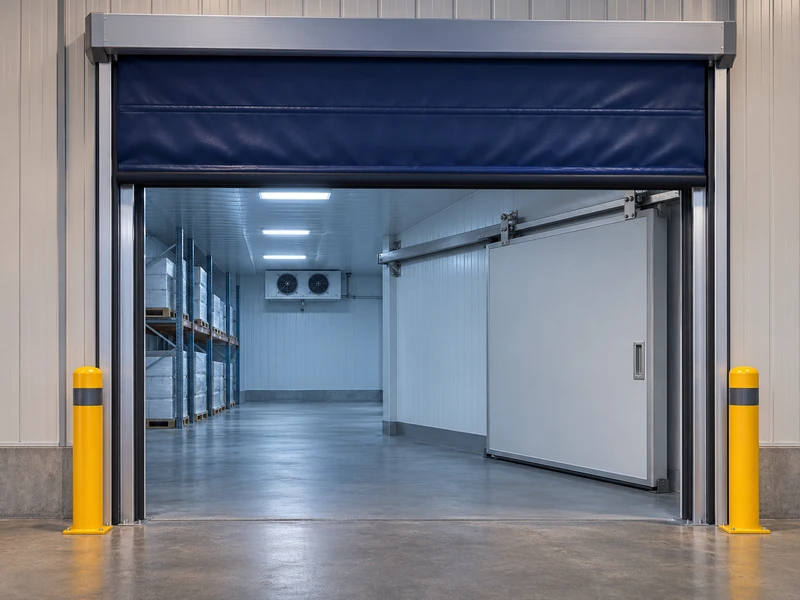
Follow the Entrance Through a 24-Hour Operating Schedule
Use the following hypothetical schedule for a frozen-food distribution facility. The same entrance serves eight hours of dispatch and pallet movement, from 08:00 to 16:00, then remains available for occasional access during the other sixteen hours.
Day Shift (08:00–16:00): Pallet Movements
During the dispatch shift, workers repeatedly move pallets between the freezer and an adjoining staging area.
The door must accommodate:
- Loaded pallet dimensions.
- Forklift approach distances.
- Closely spaced vehicle movements.
- Pedestrian safety requirements.
A rapid roll-up cold room door may reduce unnecessary exposure between transfers when its activation and closing behavior match the traffic pattern.
The greatest benefit may come from eliminating long idle openings rather than increasing maximum travel speed.
16:00–08:00: Extended Thermal Isolation
After dispatch finishes, the freezer remains operational, but product movement becomes infrequent.
During this period, closed-door performance becomes particularly important.
Compare the proposed assemblies using:
- Whole-door thermal transmittance.
- Air leakage at specified pressure differences.
- Perimeter and threshold construction.
- Electrical demand from any required heating.
An insulated sliding door may be better suited to extended thermal isolation, provided its actual assembly ratings satisfy the project requirements.
The operating schedule should also accommodate occasional overnight access, emergency escape and approved responses to power failure.
What Do 100 Opening Cycles Mean for Air Exposure?
A meaningful door comparison requires more than the opening speed stated in metres per second.
Measure the complete exposure period, starting when the closed barrier first opens and ending when it fully closes again.
This period includes:
- Opening travel.
- Vehicle or pedestrian passage.
- Programmed hold-open time.
- Closing travel.
- Any additional delay or reopening.
Illustrative Eight-Hour Shift
Assume that both door configurations complete 100 opening and closing cycles while handling equivalent traffic through the same opening.
The following durations are illustrative assumptions representing possible measured cycle averages. They are not LINBLE equipment test results.
| Measurement | Rapid Roll-Up Door | Insulated Sliding Door |
| Cycles per shift | 100 | 100 |
| Average exposure per cycle | 8 seconds | 20 seconds |
| Total exposure | 13 min 20 sec | 33 min 20 sec |
| Shift duration | 8 hours | 8 hours |
In this example, the rapid roll-up arrangement reduces cumulative doorway exposure by 20 minutes per shift.
That difference is useful for evaluating traffic performance, but it cannot be converted directly into an electricity-saving percentage.
ASHRAE’s discussion of refrigeration loads in cold storage facilities considers doorway opening duration, airflow behavior and the effectiveness of protective devices when estimating infiltration loads.
A project-specific calculation must also account for:
- Doorway dimensions.
- Temperature and humidity differences.
- Building pressure conditions.
- Actual opening area during travel.
- Nearby traffic and airflow disturbances.
A vertically moving curtain and a horizontally moving leaf expose the opening differently. Their total exposure times are therefore useful operational indicators, not direct measurements of infiltrated air volume.
Distinguish refrigeration heat load in kW from electrical input power in kW and electricity consumption in kWh.
Can Two Doors Perform Better Than One?
A dual-door freezer entrance separates frequent access from extended thermal isolation.
One possible engineering arrangement places a rapid roll-up door and an insulated sliding door along the same entrance route.
The rapid door handles routine traffic, while the insulated assembly provides the main closed thermal barrier during inactive periods.
Operating State A: Active Dispatch
- Insulated sliding door remains open in its approved parked position.
- Rapid door operates for routine transfers.
- Automatic controls manage normal access.
Operating State B: Overnight Storage
- Routine dispatch movements stop.
- Insulated sliding door closes fully.
- Rapid door follows the approved standby sequence.
Operating State C: Maintenance or Equipment Failure
- Affected equipment is taken out of normal service.
- The remaining door is used only if the approved operating procedure permits.
- Traffic is redirected or suspended when necessary.
This arrangement may be worth evaluating when a freezer combines intensive daytime logistics with long inactive periods.
It is not automatically equivalent to an airlock. A true vestibule arrangement requires sufficient separation, suitable control sequencing and coordinated traffic management.
Before approving a combined layout, request drawings showing:
- Door spacing and mounting positions.
- Overhead and lateral clearances.
- Forklift waiting and turning areas.
- Sensor coverage and control logic.
- Emergency access and escape routes.
Explore available cold room door configurations before finalizing the entrance geometry.
A combined installation requires project-specific engineering approval. Compatibility between the two assemblies and their controls must be confirmed rather than assumed.
Where Does Each Door Create Maintenance Demands?
Opening speed has little operational value if a door repeatedly interrupts dispatch activities.
The maintenance comparison should focus on component availability, inspection requirements and the consequences of a fault.
Rapid Roll-Up Door
Typical service considerations include:
- Curtain condition and guide assemblies.
- Motor and transmission components.
- Activation and safety sensors.
- Controller and electrical connections.
- Position detection and closing consistency.
Ask whether the proposed assembly has documented cycle-test information under relevant operating conditions.
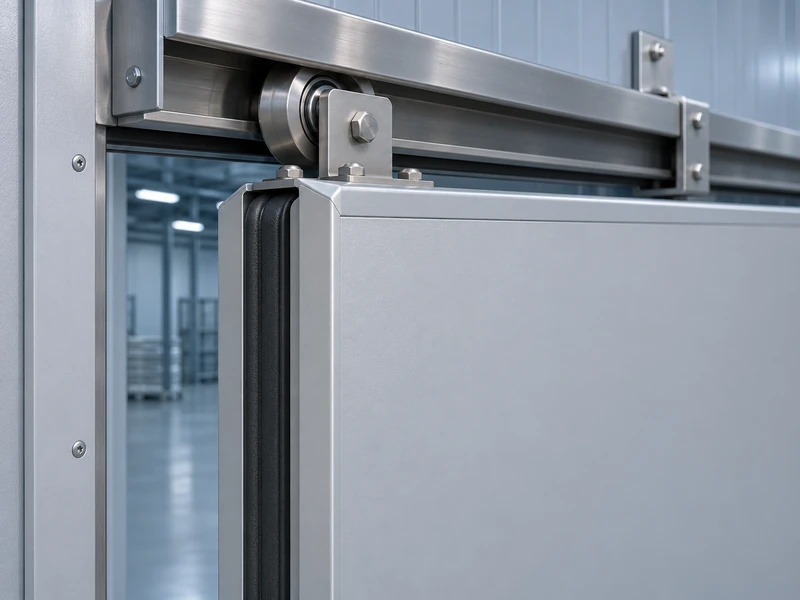
Insulated Sliding Door
Typical service considerations include:
- Upper track and roller assemblies.
- Door alignment and closing mechanism.
- Insulated leaf condition.
- Powered drive components, where fitted.
- Closure and thermal boundary integrity.
Maintenance requirements depend on the actual door model, installation and operating environment.
Combined Door Arrangement
Two assemblies introduce additional maintenance responsibilities, including coordinated control functions and separate service access requirements.
However, an approved combined layout may provide operational flexibility when one door requires maintenance.
Before purchase, establish who supplies replacement parts, how technicians access each assembly and whether a failure would require stopping freezer traffic entirely.
Compare lifecycle costs using realistic service intervals and downtime assumptions rather than initial equipment prices alone.
Test the Entrance During a Representative Busy Shift
A single unloaded demonstration cannot establish whether freezer room doors are suitable for intensive daily use.
Arrange a supervised commissioning trial with representative loads, authorized personnel and normal operating conditions. For the illustrative project, use a 100-cycle shift as the test basis.
Record the following observations:
| Test Item | Site Record |
| Completed cycles | ___ |
| Cumulative exposure | ___ minutes |
| Average exposure per cycle | ___ seconds |
| Unexpected reopenings | ___ |
| Extended hold-open events | ___ |
| Traffic interruptions | ___ minutes |
| Record temperature and humidity on both sides of the doorway throughout the test. Note unusual traffic queues, frost accumulation and changes in closing behavior. | Include extended openings in the total exposure record without counting overlapping events twice. |
The test should distinguish between normal vehicle passage and delays caused by unsuitable control settings, obstructed routes or equipment faults.
Check Performance After Dispatch Ends
Evaluate the entrance again during an extended closed period.
Confirm that:
- Both assemblies reach their intended standby positions.
- The designated thermal barrier closes consistently.
- No unexpected control commands reopen the entrance.
- Specified frost-protection functions remain operational.
Closed-door thermal performance and air leakage should be supported by applicable supplier ratings or agreed specialist testing. Visual inspection alone cannot establish either value.
Qualified door technicians, electricians and structural specialists must verify the installation, safety devices and emergency operating arrangements.
Never disable protective sensors or shorten safety-related delays simply to achieve a better cycle-time result.
Purchase the Entrance Around Its Busiest Hour
Different traffic patterns can justify different door arrangements.
Prioritize rapid roll-up operation when:
- Product transfers occur in concentrated batches.
- Repeated opening delays restrict throughput.
- The surrounding environment permits suitable thermal protection.
Prioritize insulated sliding operation when:
- Extended closed periods dominate the operating schedule.
- Verified thermal isolation is a primary requirement.
- Normal access can be accommodated without unacceptable delays.
Evaluate a combined entrance when:
- Both operating demands are commercially significant.
- The building can accommodate two assemblies.
- Safe controls and maintenance arrangements are feasible.
The final rapid roll-up vs. sliding freezer door decision should reflect measured traffic behavior and verified closed-door performance.
Give LINBLE Your Traffic Schedule, Not Just Your Door Size
Two freezers with identical doorway dimensions may need completely different entrance arrangements.
LINBLE offers customizable cold room doors, including rapid roll-up and insulated sliding configurations. To develop a project-specific proposal, prepare:
- Required clear opening dimensions.
- Busiest-hour traffic and daily cycle count.
- Loaded pallet or forklift dimensions.
- Freezer and adjacent-area conditions.
- Working hours and inactive periods.
- Available installation and maintenance space.
Use these details to discuss your cold room project with LINBLE and confirm the suitability of the proposed door assemblies.
The right freezer entrance should move goods efficiently during the busiest hour and protect the refrigerated space throughout the quietest night.