
Choose wet or dry storage for cut flowers by considering five factors together: species and harvest stage, time before sale, package and transport method, hydration capability, and the space and cooling route available. Wet storage keeps stem ends in a suitable solution; dry storage holds flowers out of water in a prepared pack, and its suitability must be established for the particular flowers and duration.
A LINBLE flower cold room can support either workflow, but the layout changes materially. Bucket trolleys, boxed stems and a mixed picking operation do not use the same floor area, air path or preparation space.
1. Which Flowers and Harvest Stages Are Being Stored?
Start with a species-and-cultivar list, including whether flowers arrive in bud, partly open or ready for immediate sale. An acceptable dry-storage routine for one product should not be assumed suitable for every mixed bouquet component.
Ask suppliers for the recommended handling method and verify it with a small commercial trial. Use the same harvest stage and route that the business intends to operate, rather than a convenient sample that arrives under different conditions.
The Oklahoma State cut-flower handling guide emphasises species, cultivar, harvest stage and periodic vase-life testing. Those distinctions are more useful for choosing a storage method than a general claim that one method always keeps flowers fresher.
Temperature compatibility comes first. Many temperate flowers use very cold storage programmes, while chilling-sensitive tropical flowers require a different environment; neither wet buckets nor protective cartons make an unsuitable temperature acceptable.
Within LINBLE’s flower cold room options, establish whether one room can meet the actual product mix or whether separate zones are justified. Specify the intended flowers rather than request a generic “floral temperature.”
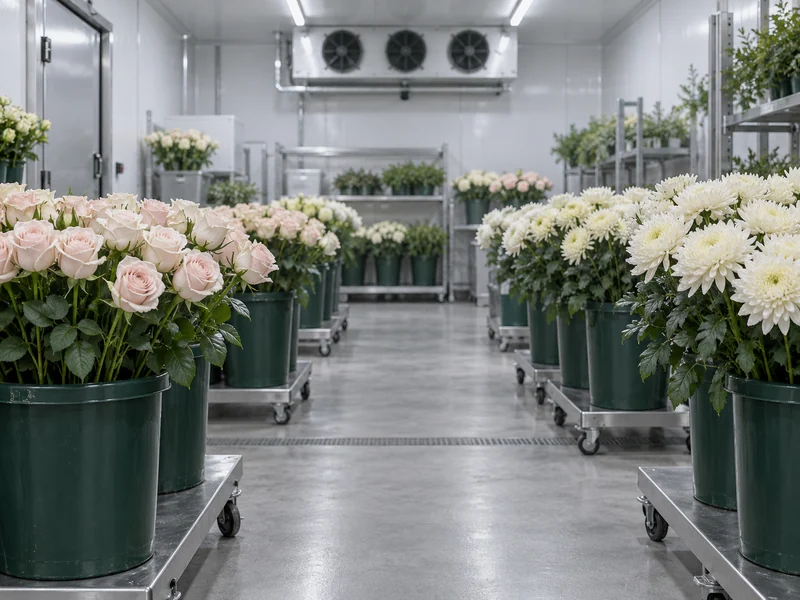
2. How Long Is the Complete Storage-and-Delivery Route?
Count the time until effective hydration and sale, including transport and waiting at the next site. The number of nights inside your own cold room is only part of the exposure.
Wet holding may be convenient for short-turn orders that need frequent inspection and selection. Dry packs may suit an established shipping programme where suitable flowers are cooled, packed and later rehydrated according to a tested routine.
Neither is automatically a long-storage solution. A route that looks acceptable at dispatch can still consume too much of the remaining vase life before the customer receives it.
How Should a Storage Trial Be Judged?
Judge it after the intended delivery and vase-life period, not only when the cold-room door opens. Compare stem posture, flower development, leaf condition and customer-use performance.
- Use matched lots with the same cultivar and harvest stage.
- Record cooling, packing, storage and rehydration times.
- Simulate the expected transport and receiving routine.
- Use consistent assessment criteria and photographs.
- Repeat when season, packaging or supply source changes materially.
For a fuller account of the related physiology, see LINBLE’s article on flower hydration and ethylene management. The wet-versus-dry decision should fit that handling programme rather than replace it.
3. Will Flowers Travel in Buckets or in Boxes?
Match storage to the next handling step where the product permits it. Repeatedly moving stems between buckets, benches and cartons adds labour and opportunities for damage.
For wet storage, calculate loaded trolley dimensions and the turning space needed for full buckets. Check shelf height against stem length and flower heads, with enough clearance to move them without crushing neighbouring blooms.
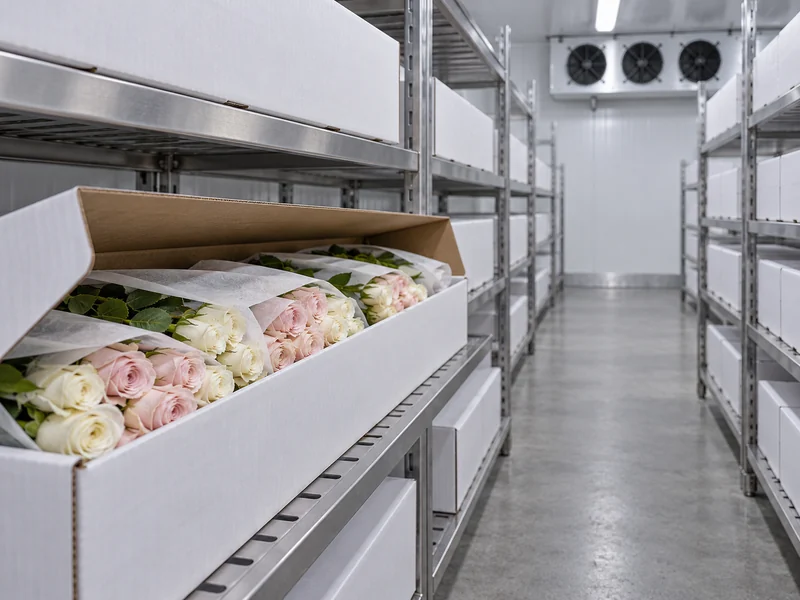
For dry storage, calculate usable carton positions and access to the required varieties. Long boxes can create awkward dead space in a room dimensioned around standard pallets.
| Workflow | Room-Planning Consequence |
| Wet buckets for daily order assembly | Allow stable trolley positions, selection access, solution handling and spill cleanup. |
| Dry cartons for a shipping programme | Allow the actual box length, cooling openings, stacking limits and dispatch sequence. |
| Mixed wet and dry inventory | Identify separate working positions so cartons are protected from bucket spills and congested aisles. |
| Flowers arriving warm | Provide a cooling route suited to the pack before counting the inventory as stable holding stock. |
Discuss these dimensions while the modular layout is still flexible. A room can contain enough nominal cubic metres yet provide too few accessible order-picking positions.
4. Can the Business Control Hydration Reliably?
Wet storage depends on a suitable solution and clean handling equipment. Dry storage depends on an appropriate preparation and rehydration routine, so it does not remove the need for water-quality and sanitation management.
Identify where buckets are washed, solutions prepared and stems recut where required. Keep that work from introducing dirty water or plant debris into the finished-stock area.
Oklahoma State’s guidance discusses water-quality effects and warns against chemically softened water for cut-flower handling. Obtain a water assessment and follow the instructions for the chosen floral treatment instead of improvising stronger concentrations.
North Carolina State’s postharvest resources for cut flowers provide further species-specific handling information. Use those resources and supplier instructions to build the routine for the actual crop mix.
Ask who will rehydrate a dry shipment at its destination and what facilities they have. An otherwise promising dry-storage method may fail commercially if the receiving business cannot perform the final step consistently.
5. Can the Cooling System Serve the Actual Load?
It must cool or hold the complete arrangement without drying exposed flowers or leaving warm pockets inside boxes. The evaporator rating alone cannot establish that result.
Wet buckets add water and handling mass; dry cartons can restrict air access to their contents. Give LINBLE intake temperatures and quantities for both, including any solution or containers entering warm.
Select the flower-room evaporator arrangement around the full layout and the required duty. Consider air distribution, coil operation and fan staging together rather than directing a strong jet at the nearest flowers.
Humidity management needs the same care. “Wet storage” describes stem-end hydration, while “dry storage” describes the absence of standing solution; neither term requires wet petals or an unusually dry room.
Review LINBLE’s cold room humidity-control factors when discussing condensation and moisture loss. Persistent droplets on foliage, cartons or the ceiling need investigation even if the controller displays the intended RH.
What Does the Storage Method Cost per Saleable Stem?
Compare labour, occupied positions, packaging and losses on a saleable-stem basis. Wet buckets can provide convenient selection, yet water handling and frequent solution work consume time; dry cartons may use space efficiently while requiring additional preparation and receiving care.
Use the flowers that survive the complete sales route as the denominator. A dense carton arrangement offers little commercial benefit if too many stems are downgraded during rehydration or customers receive a shorter usable vase life.
Include the busy order-assembly period in a layout trial. Staff should be able to select a variety without moving several unrelated buckets or repeatedly opening boxes that were intended to remain prepared for shipment.
Walk a loaded trolley through the actual doorway and turning space before the room dimensions are approved. Long stems and flower heads can require more clearance than the trolley chassis suggests.
Seasonal events can change the balance. A wholesaler may need more prepared wet stock for a concentrated local delivery period, while another part of the same business continues to move boxed flowers through a longer shipping route.
For LINBLE, describe those two operating patterns with quantities and timing. The room can then be reviewed against accessible positions, cooling load and labour movement, allowing the business to judge whether a mixed layout preserves more saleable stems than a room arranged around just one storage method.
Could a Mixed Arrangement Be More Useful?
Yes, when the product programme justifies it and the room can serve both flows without interference. Reserve specific positions for each method and write down when flowers move between them.
A wholesaler might hold shipping cartons in one defined area and hydrate selected flowers for the next day’s orders in another. That is an illustrative workflow, not a recommendation to combine flowers with incompatible temperature or ethylene requirements.
Use LINBLE’s broader discussion of cold rooms in the floral industry to relate the decision to receiving and order assembly. A useful proposal shows bucket or carton capacity, access and cooling assumptions separately.
Select the method after the trial flowers have completed the planned storage, delivery and customer-use period, with the results assessed against the business’s saleable-quality criteria. Room space, labour and shipping density matter, but a method only earns its place when the customer still receives the quality and vase life the business promises.