
Choose cold room panel finishes according to the cleaning routine, moisture and chemical exposure, risk of physical damage, and maintenance resources available at the site. Coated steel can be a practical choice for controlled storage environments, while an appropriately specified stainless steel facing can suit more demanding cleaning or corrosion conditions. Neither description alone guarantees that a panel will withstand every detergent, salt exposure, or operating practice.
The purchasing decision becomes clearer when the supplier receives an exposure description rather than only a request for “food-grade panels.” Specify what will touch the surface, how it will be cleaned, and where damage is most likely.
What Part of the Panel Are You Choosing?
The finish concerns the exposed facing of the sandwich panel, while the insulated core and complete assembly serve additional functions. Changing the facing does not by itself establish the panel’s thermal performance, fire classification, or structural suitability.
LINBLE’s cold room panel range lists PPGI or color steel and stainless steel cladding, alongside other surface options. Confirm the exact material and configuration proposed for your application rather than relying on a sample photograph.
For coated steel, ask for the substrate and coating system identification. For stainless steel, ask for the alloy grade, surface finish, and sheet thickness, together with suitable cleaning instructions.
A complete specification also addresses joints, trims, sealants, and fasteners. A durable wall sheet cannot compensate for incompatible detailing at the locations where water or residues collect.
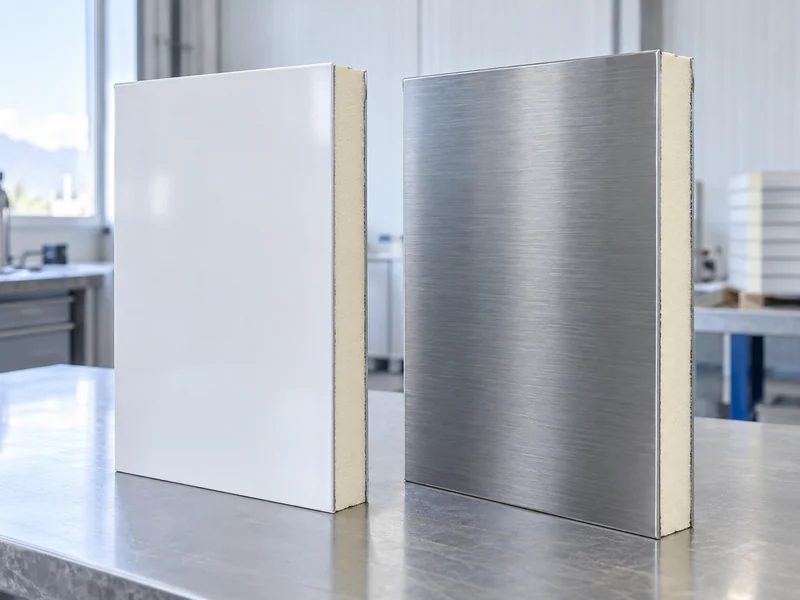
When Is Coated Steel a Practical Option?
Coated steel is worth considering where the specified coating is compatible with the environment and the site can keep it intact. It may be suitable for packaged-product storage with controlled cleaning and limited exposure to aggressive residues.
The important distinction is between a defined coating system and the general phrase “white panel.” Similar-looking surfaces can have different permitted cleaners, temperature limits, and repair methods.
Ask the supplier to confirm compatibility with the actual cleaning procedure, including chemical concentration, contact time, water temperature, and rinsing. A general statement that a panel is washable is too vague to settle those questions.
Inspect exposed edges, penetrations, and areas likely to be struck by trolleys. Where handling traffic is heavy, appropriate protection can be more useful than paying for a premium facing while leaving it exposed to repeated impact.
Coated steel is a less attractive choice when the maintenance plan assumes scratches will be ignored indefinitely. The repair process and acceptable condition of the surface should be clear before the room enters service.
When Does Stainless Steel Deserve Consideration?
Stainless steel deserves consideration where the cleaning demands or exposure justify the selected alloy and finish. It can provide a robust, cleanable surface, but the material still needs an appropriate specification and operating routine.
The industry association worldstainless discusses cleanability and corrosion resistance in its food and beverage material guidance. These are reasons to evaluate stainless steel for demanding environments, not reasons to omit cleaning or alloy selection.
Do not equate “stainless” with immunity to corrosion. Salts, deposits, unsuitable chemicals, and poorly designed crevices can create conditions that challenge an otherwise suitable material.
Should You Automatically Specify Grade 316 Instead of 304?
Choose the grade through an exposure review rather than treating a higher grade number as a complete design solution. Give the supplier the expected salt exposure and cleaning details, and request a written recommendation.
worldstainless’s corrosion guidance explains that stainless steels can suffer localized corrosion and other mechanisms under particular conditions. Its discussion reinforces the need to match the material to the environment.
Where brine, seafood residues, or aggressive washing are involved, ask whether the proposed alloy, finish, and detailing are appropriate together. A change in alloy cannot correct every trapped-water detail or incompatible cleaning practice.
How Should the Two Options Be Compared?
Compare the installed systems and their maintenance obligations under the same operating assumptions. The initial panel price is only one part of that comparison.
| Decision Area | Coated Steel | Stainless Steel |
| Specification | Identify substrate and coating system | Identify alloy grade and surface finish |
| Cleaning | Confirm compatibility with coating | Confirm compatibility with alloy and finish |
| Damage | Review coating repair and exposed edges | Review dents, scratches, and contamination |
| Corrosion Exposure | Check suitability of the complete coating system | Match grade and details to actual exposure |
| Ownership Cost | Include inspection and repair access | Include correct cleaning and surface care |
This table deliberately avoids a universal service life or price premium. Those figures would depend on the specific material, thickness, project quantity, local installation costs, and exposure.
For the wider assembly decision, consult our cold room panel selection guide. Keep the surface specification visible as its own line item so a substitution is not hidden within a general panel description.
Why Do Joints and Cleaning Details Matter So Much?
Surface selection works best when the room can actually be cleaned, inspected, and dried as intended. Difficult corners and damaged seals can undermine the practical benefit of a more durable wall sheet.
Review the floor-to-wall junction, panel joints, door frames, penetrations, and protective rails with the installer. Ask where water can collect and how the site will reach those locations during routine cleaning.

Use the panel supplier’s approved cleaning method and the chemical supplier’s instructions together. Do not assume that a cleaner suitable for one piece of stainless equipment is automatically suitable for every wall finish, sealant, and door component.
- Identify the cleaning agent and working concentration.
- Record contact time, application temperature, and any required rinse.
- Confirm permitted tools and whether pressure washing is allowed.
- Protect exposed electrical equipment and vulnerable joints as specified.
- Inspect surfaces afterward for residue, damage, or persistent moisture.
For the cold-room environment itself, persistent moisture may require a separate investigation. The guide to reducing chiller room condensation addresses causes that a facing change alone may not resolve.
Can Different Areas Use Different Finishes?
A zoned specification can be reasonable when exposure differs significantly across the facility. The interfaces and cleaning routine must still be designed as a coherent system.
For an illustrative example, a distributor might compare a dry packaged-stock room with an adjacent area where wet seafood containers are handled. Giving both spaces the same material specification without examining exposure could either overspend in one location or under-specify another.
Discuss whether different internal and external facings are available and appropriate for the particular panel assembly. Also identify trims, door frames, and exposed fasteners that need to match the local conditions.
In a complete cold room project, make those boundaries clear on the material schedule. Terms such as “stainless where necessary” leave too much room for different interpretations during manufacture and installation.
How Should Damage and Repairs Be Planned?
Define acceptable repair methods and inspection responsibilities before damage occurs. Waiting until the first dent or coating scratch can turn a small defect into an avoidable dispute.
Ask which repairs may be performed on site, which require specialist attention, and when a facing or panel should be replaced. Include the effect of repairs on cleanability and any relevant warranty conditions.
Keep a simple record of the location, cause, photograph, and repair date. Repeated damage at the same trolley corner usually calls for a handling or protection change as well as another surface repair.
Do not confuse cosmetic appearance with the condition of the complete panel. An apparently minor impact may also require inspection of the joint or seal, depending on its location and severity.
What Should a Clear Purchase Specification Include?
A useful enquiry describes the room’s exposure and asks for a named material system with documented care requirements. It should let you compare quotations without guessing what each supplier means by a broad marketing term.
- Product type, packaging, room temperature, and expected moisture conditions.
- Cleaning chemicals and the complete application procedure.
- Salt, brine, or other relevant chemical exposure.
- Internal and external facing materials, thicknesses, and finish descriptions.
- Joint, trim, sealant, and fastener requirements.
- Impact protection, approved repairs, and maintenance access.
For joint construction, the comparison of cam-lock and plug-in panel systems provides related background, subject to the details of the proposed assembly. Request separate supporting information for thermal, structural, and fire requirements rather than inferring them from the facing.
Share this exposure brief with LINBLE when requesting panel options. The aim is a finish that fits the actual room and can be maintained consistently throughout its use.