
Precooling removes the heat carried into the packing operation by freshly harvested produce; cold storage then maintains suitable conditions around the cooled crop. A room that holds chilled stock successfully may not remove a large incoming field-heat load fast enough. The distinction is the cooling task and its timing, not simply whether both activities take place behind an insulated door.
Following one batch from harvest to dispatch makes that difference easier to see. Each transfer can either preserve the cooling already achieved or add work for the next stage.
What Happens Between Harvest and the Cold Room?
The crop arrives with a temperature history that starts before the refrigeration plant becomes involved. Harvest conditions, waiting time, shade, and transport all influence what the cooling stage must handle.
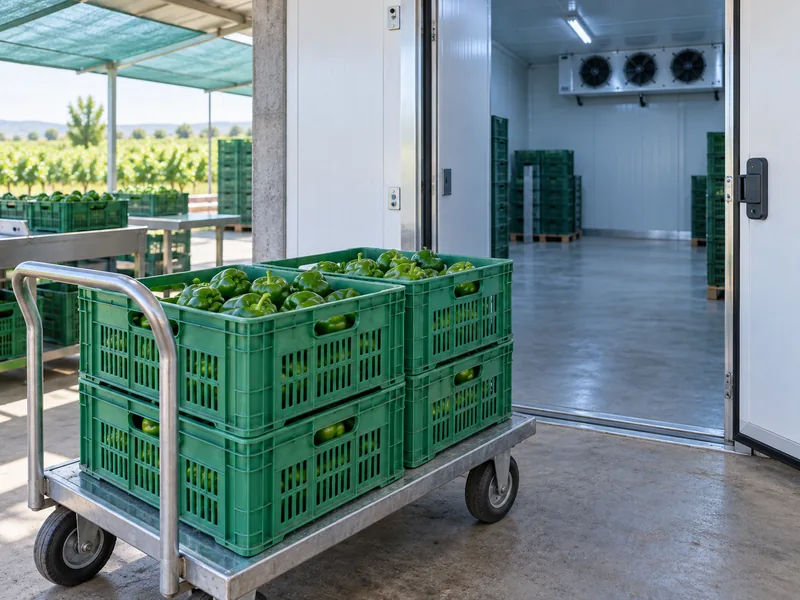
Consider an illustrative batch of peppers collected during a warm afternoon. Moving the crates into shade reduces further exposure to sunlight, but it does not instantly bring the peppers to their required storage temperature.
The next step is therefore not just to find an empty floor position. Staff need a defined destination for the incoming batch, a cooling method suitable for that crop, and a clear transition into holding storage once cooling is complete.
Why Is Field Heat Different From the Holding Load?
Field heat describes the initial heat that must be removed as the harvested product cools. Holding duty continues afterwards because heat still enters through the enclosure and door, while equipment and the living produce can add heat within the room.
Those loads can overlap during receiving. A busy afternoon may bring warm arrivals into a room that is already holding earlier batches, so the refrigeration system faces more than the needs of the stored stock alone.
Our discussion of factors affecting chiller room cooling speed provides broader context. For produce handling, the important extra detail is the temperature inside the incoming crop, rather than only the air surrounding its crates.
Why Can the Air Feel Cold While the Produce Remains Warm?
The air and the crop do not cool at the same rate. Heat must travel from inside the produce to its surface and then into the cooling medium, with packaging and stacking influencing that route.
A sensor near the cooler may reach the room setpoint well before the centre of a tightly arranged batch does. Neither touching the outside of a carton nor watching the controller establishes the temperature of the slowest-cooling produce inside it.
FAO’s produce handling manual distinguishes rapid removal of field heat from subsequent storage and describes cooling methods suited to different commodities. Its discussion supports organizing the process around the crop and package, rather than assuming that every refrigerated room performs the same task.
For a fruit and vegetable cold room, that means the daily receiving routine matters alongside the enclosure and refrigeration equipment. A holding room should not quietly become the batch precooler merely because it has spare floor space.
How Do the Main Cooling Routes Differ?
The routes differ in how they bring the cooling medium into contact with the product. The fastest suitable option depends on crop characteristics, packaging, hygiene requirements, and the operation’s handling sequence.
| Cooling Route | How Heat Leaves the Crop / Important Limitation |
| Room cooling | Cold air circulates around packages and exposed surfaces. Dense loads and restricted ventilation can cool slowly |
| Forced-air cooling | A pressure difference drives refrigerated air through package openings. Air bypass and blocked vents undermine the intended path |
| Hydrocooling | Chilled water carries heat away. The commodity and packaging must tolerate wetting; water hygiene matters |
| Vacuum cooling | Evaporation under reduced pressure removes heat. Crop suitability and moisture loss require attention |
This comparison is about process behaviour, not a ranking of equipment. Some crops tolerate a slower route within their handling requirements, while others need faster heat removal to preserve marketable quality.
What Makes Forced-Air Cooling More Than an Extra Fan?
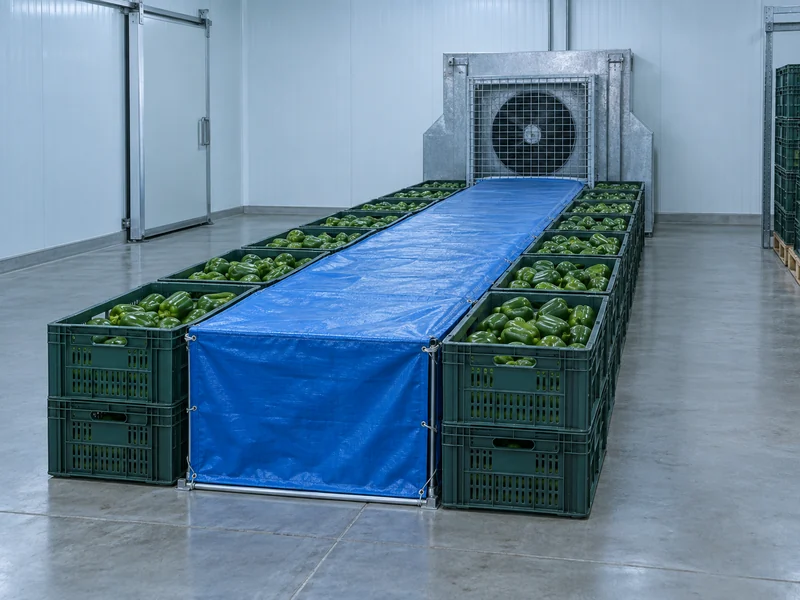
The defining feature is a controlled pressure difference through the load. A fan blowing across an open aisle may mainly move air around cartons instead of through their contents.
In a tunnel arrangement, a cover and a fan plenum can direct room air through vented packages toward a central channel. Gaps that offer an easier route allow air to bypass the product, even when the fan sounds powerful.
FAO’s guidance on room cooling and forced-air cooling explains the distinction between circulation around containers and airflow through them. It also illustrates why covers and package openings form part of the cooling arrangement.
What Changes When the Same Crop Arrives in a Different Box?
The package can change the cooling path even when the crop and batch weight remain the same. Treat a packaging change as a process change, not merely a warehouse convenience.
For an illustrative comparison, imagine peppers previously handled in vented reusable crates arriving in cartons with liners. The room may still reach its usual air temperature, but the openings, liner position, and stack contact points now create a different resistance to airflow.
Three practical questions help explain what has changed:
- Can air enter? Package openings must remain available in the assembled stack, rather than only on an empty carton.
- Can air pass through the contents? Liners and tightly packed produce can alter the intended route.
- Can air leave? The outlet side must connect to the pressure path rather than terminate against another solid surface.
More open packaging is not automatically the whole answer, because product protection and moisture management also matter. The appropriate arrangement balances cooling access with the requirements of the crop and its distribution journey.
The same principle underlies cold room airflow dynamics. A circulation path must remain usable after real stock, liners, pallets, and people enter the picture.
When Does the Batch Move From Cooling to Holding?
It moves when the product has reached the defined condition for that crop and handling process. An elapsed time alone is meaningful only when it has been established for the relevant product, pack, load, and operating conditions.
The transition needs a clear operating instruction so the next shift does not continue intensive cooling unnecessarily or move warm stock onward too early. Appropriate product-temperature measurements support that instruction; a single air display cannot replace them.
Why Should the Cooling Target Be Crop-Specific?
Some produce suffers chilling injury at temperatures that suit other crops. The goal is the appropriate product condition, not the lowest temperature the machine can deliver.
A mixed operation should keep crop identity and destination visible throughout the flow. Our article on fruits and vegetables that should not share a cold room explains why compatibility involves more than finding a common shelf.
What Happens to Airflow After Precooling?
The holding arrangement must continue to distribute cooling without unnecessarily exposing the crop to an intensive precooling regime. Any change in fans or controls should follow the designed operating sequence.
The room’s evaporator and a forced-air tunnel perform related but different roles. The evaporator cools the air; the tunnel arrangement directs that air through the batch.
How Can the Daily Flow Preserve the Cooling Already Achieved?
Plan the handoffs so cooled produce does not wait in a warm staging area while staff search for space or transport. The strongest cooling stage cannot prevent losses introduced by the next delay.
- Before arrival: allocate a suitable receiving and cooling position.
- During cooling: keep the agreed package arrangement and batch identity together.
- During transfer: have the destination ready before moving the load.
- During holding: separate incompatible crops and avoid obstructing circulation.
- At dispatch: coordinate loading so the prepared batch spends only necessary time outside controlled conditions.
A simple batch record linking arrival condition, cooling completion, and transfer time helps explain delays between stages. It also makes a repeated bottleneck visible without reducing every problem to a colder setpoint.
Precooling and storage work as consecutive responsibilities in the same cold chain. When the incoming heat load, package airflow, and handoff are treated deliberately, the storage room can focus on preserving the condition the cooling stage has achieved.