
Match a blast freezer evaporator to the loaded batch by checking refrigeration duty and the air path together. The fan must deliver useful airflow through the product gaps at the resistance created by trays, cartons and frost. For a LINBLE room, start with the loaded trolley or pallet drawing; an evaporator selected from room dimensions alone leaves too much unanswered.
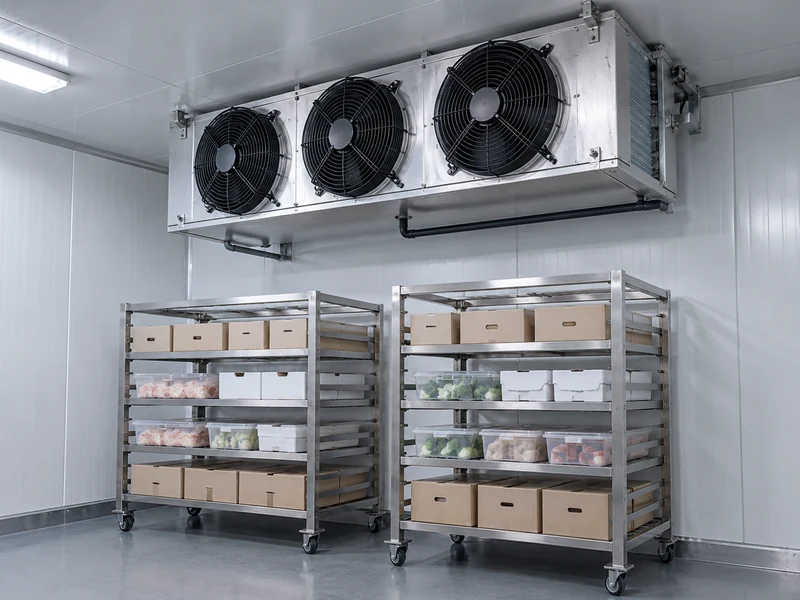
What Does the Batch Actually Look Like?
The same weight of food can present very different resistance to air. Shallow trays with aligned openings create one path; cartons wrapped tightly on a pallet create another. Before discussing fan size, establish which surfaces the air can reach and how heat must travel out of the product centre.
Prepare a load sheet with product thickness, package material, outer dimensions, weight per tray and the number of occupied positions. Draw the loaded height, including anything projecting above the rack. Note whether the wrapping and tray orientation remain consistent between shifts.
For mixed production, group batches by their real cooling difficulty rather than their sales category. A thick sealed meat block may govern the freezing time even when a lighter, loosely arranged batch occupies more room. A selection based on the easiest product can leave the busiest programme short of capacity.
Why Are Air Volume and Product Air Speed Different?
Air volume describes the quantity moved; air speed describes movement through a particular area. Dividing volume flow by an area can give a rough average, but only if that area and the flow crossing it are defined correctly. Dividing a fan catalogue figure by the whole room cross-section does not establish the velocity between trays.
As an illustrative calculation, 12,000 cubic metres per hour is about 3.33 cubic metres per second. If all of that air crossed an effective opening of 1.2 square metres, the average would be about 2.8 metres per second. Real leakage, uneven resistance and bypass flow would change the distribution, so this example is a bookkeeping check rather than a design recommendation.
The Oregon State guide to seafood freezing explains how unequal resistance allows air to take shortcuts around trolley loads. Its useful lesson for a batch room is to evaluate the complete circulation loop. The strongest jet beside the fan may coexist with a slow, warm position inside the batch.
Which Evaporator Details Should Be Compared?
Compare capacity at the proposed operating conditions, available fan pressure, coil arrangement, fin spacing, defrost method and access. A nominal kilowatt value without its rating conditions is incomplete. A large airflow figure without the resistance at which it is delivered is similarly difficult to use.
LINBLE’s evaporator range includes temperature-based series and different mounting and blowing arrangements. Those options give the designer choices, but a series label does not establish suitability for a particular carton stack. The quotation should identify the selected model and the assumptions used to match it to the batch.
| Detail to Confirm | Why It Matters | Evidence to Request |
| Cooling Capacity at Design Conditions | Catalogue ratings may use different temperatures | Selection conditions and calculated duty |
| Airflow Against Resistance | Product and coil resistance reduce useful flow | Fan operating point and circulation arrangement |
| Frost Allowance | Air passages change during production | Expected cycle and defrost assumptions |
| Service Clearance | Coils, fans and drains require access | Installation drawing with clearances |
The LINBLE blast freezer room should be considered as an assembled system: evaporator, condensing equipment, envelope and loading pattern. Specifying these independently can produce components that look adequate in isolation but do not deliver the required batch cycle together.
How Do You Stop Air from Bypassing the Product?
Use a planned supply route, reasonably consistent product passages and a defined return route. Baffles or plenums may be appropriate, provided they are designed for the room and remain accessible for cleaning. Blocking every visible gap without understanding the loop can restrict return air or overload a fan.
Look particularly at the space above the load, the gap beside the first trolley and empty rack positions. These can offer a much easier route than the tray passages. The solution may be a loading rule, a properly designed guide surface or a revised evaporator position.
Ask the designer to show the half-load arrangement as well as the full-load arrangement. If a small batch uses only one side of a room designed for two trolley rows, air distribution may change considerably. A fixed minimum loading pattern can be more repeatable than allowing operators to place racks wherever there is space.
When Does More Fan Speed Stop Helping?
More speed has diminishing value when the main resistance to cooling lies inside a thick product or an insulating pack. It also adds fan heat and may increase drying of exposed surfaces. Correct the limiting part of the process before asking for additional motor power.
FAO’s engineering discussion of fish freezing distinguishes surface heat transfer from heat movement through the product and packaging. The principles are useful beyond fish, although its numerical examples should not be copied into an unrelated batch specification. For a difficult load, changing carton depth or pack arrangement may deserve a trial before changing the evaporator.
Variable fan operation can be worth discussing when product duties differ, but it needs an approved operating range and a verified programme. Reducing fan speed simply to lower electricity use may lengthen freezing and reduce daily throughput. Judge the whole batch result, including product quality and recovery between cycles.
What Happens as Frost Builds Up?
Frost can narrow coil passages and alter the fan operating point. A room that performs well immediately after defrost may therefore perform differently late in the production run. Check the realistic sequence of moist loads, door openings and defrost opportunities.
Wider fin spacing can help manage frost tolerance, but it is one part of a selection involving coil size, temperature difference and cleaning access. LINBLE’s article on evaporator fin spacing and airflow develops that tradeoff. Avoid choosing a spacing from a generic temperature table without reviewing the moisture entering with the process.
Defrost must fit the production plan, including drainage and fan restart. The relevant operating details are covered in LINBLE’s explanation of defrost controls. If operators routinely postpone defrost to finish another load, the quoted daily capacity should account for that actual practice or the schedule should change.
What Should a Batch Change Trigger?
Review the selection when a packaging or loading change alters the air passage. Replacing shallow trays with deeper packs, adding a liner or rotating cartons can change the result without adding a kilogram to the batch. A larger fan is only one possible response, and may leave the underlying obstruction in place.
For example, suppose a processor changes from vented outer trays to closed cartons to simplify dispatch. The original arrangement exposed more of the pack surface to moving air. Before accepting the old cycle time, compare core-temperature curves for the new pack and ask whether carton depth, loading density or the available process time should change.
Keep the old and new load drawings with the trial record. Mark which clearances are fixed by the room and which depend on operators positioning a trolley correctly. If the arrangement requires a removable baffle, define where it is stored, how it is cleaned and how staff confirm it is fitted.
Also ask who may alter fan settings or product programmes. An undocumented adjustment can make the next batch behave differently even when the racks look unchanged. Simple access control and a recorded approved programme help preserve the performance established during the trial.
How Should You Prove That the Match Works?
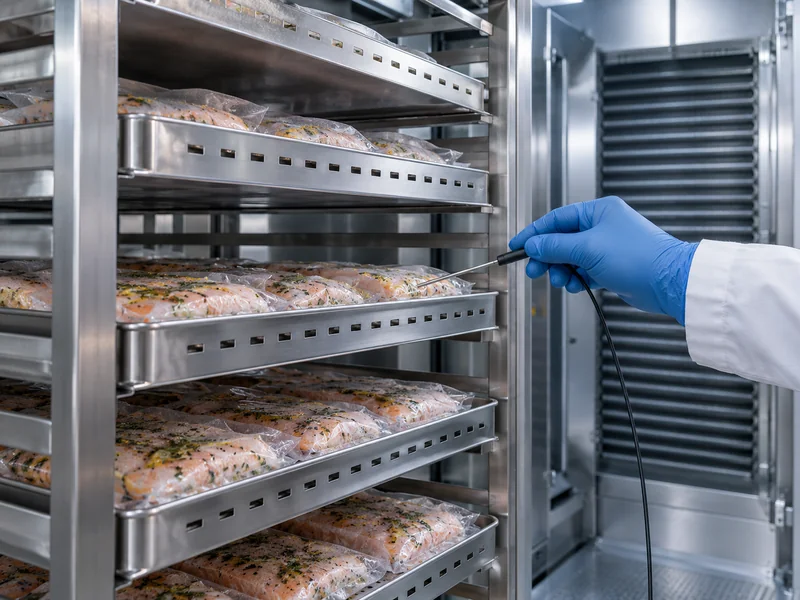
Run the difficult agreed batch, record representative core temperatures and examine differences across rack positions. Measure useful air movement with suitable instruments where practical, while respecting the facility’s hygiene procedures. Assign every instrument position a reference on the load sketch so subsequent trials can use the same locations.
- Use the normal packaging and the maximum agreed product thickness.
- Record entry temperature, batch mass and the loading arrangement.
- Check the slow positions, including the centre and the return end of the load.
- Review a realistic late-run condition as well as a clean-coil start.
- Document the loading pattern that operators must reproduce.
Release the batch using the agreed product criterion, not a brief dip in room air temperature. LINBLE’s guide to freezing time and product core temperature explains why that distinction matters. The final deliverable should include a workable loading instruction alongside the equipment schedule, so that the air path on the drawing survives the next production shift.