
In central kitchen blast chilling, pan depth directly influences how quickly cooked food loses heat. Two batches of identical weight can require different cooling times when distributed across different containers.
Reliable cooling validation must account for food consistency, actual filling depth, container material, trolley loading, and internal product temperatures. A low chamber temperature alone cannot establish safe batch completion.
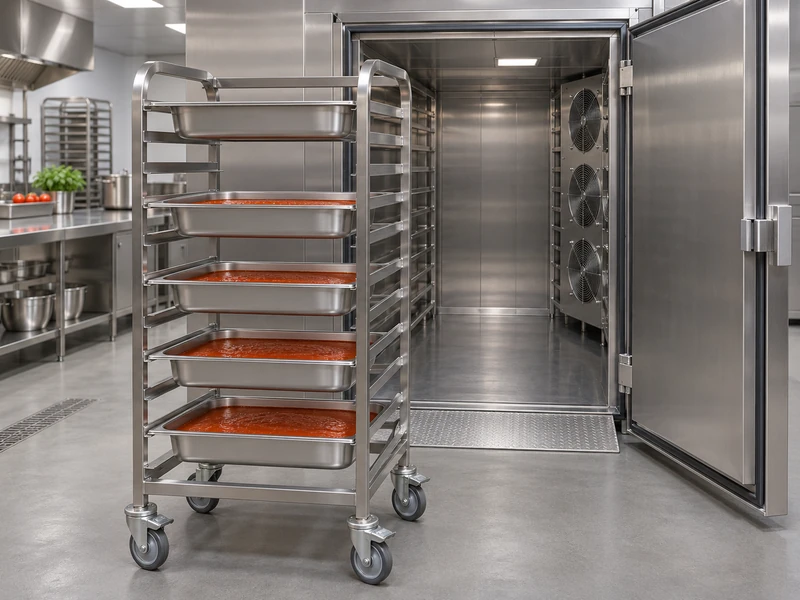
Why Pan Depth Matters in Central Kitchen Blast Chilling
When a central kitchen transfers cooked food into deep containers, the exposed surface begins cooling before heat has been adequately removed from the interior.
The difference becomes particularly important for thick sauces, rice, mashed vegetables, casseroles, and other densely packed foods.
Three product characteristics influence the cooling response:
- Consistency: Thick or viscous foods generally have less internal movement than freely flowing liquids.
- Filling depth: A deeper food layer increases the distance heat must travel from the interior toward a cooled surface.
- Product structure: Compact food masses and densely packed ingredients may restrict heat movement through the batch.
The University of Minnesota Extension explains the benefits of rapid cooling through shallow containers, including dividing food into smaller portions and using containers that facilitate heat transfer.
Although this guidance supports the underlying cooling principle, its household recommendations should not replace commercial food safety requirements or a validated industrial cooling process.
Specify the Food Depth Rather Than the Container Depth
The external dimensions of a food pan do not establish the actual thickness of the food inside it.
A pan with an internal depth of 150 mm might contain a 50 mm, 100 mm, or 130 mm food layer. Each filling arrangement presents a different cooling task.
A production specification should distinguish between:
| Parameter | Information Required |
| Pan dimensions | Internal length, width, and depth |
| Food filling depth | Maximum actual food thickness |
| Pan loading weight | Net food mass per container |
| Container material | Metal, plastic, or other approved material |
| Covering arrangement | Approved exposed or covered condition |
For irregular products, measure the thickest relevant section rather than relying only on average filling depth.
Where operators distribute cooked food manually, establish a measurable filling limit. Depending on the product, this may involve a validated fill line, portion weight, or another controlled method.
Compare Two Pan Depths Using the Same Production Batch
Consider a central kitchen preparing 36 kg of thick cooked sauce for subsequent refrigerated distribution.
The kitchen wants to determine whether using fewer, more deeply filled pans would reduce handling without compromising cooling performance.
Two separate trials are proposed using the same recipe, total food weight, pan type, and refrigeration programme.
Trial A: Shallow Filling
- Actual food depth: 50 mm.
- Food weight per pan: approximately 3 kg.
- Number of pans: 12.
- Total batch weight: 36 kg.
Trial B: Deep Filling
- Actual food depth: 100 mm.
- Food weight per pan: approximately 6 kg.
- Number of pans: 6.
- Total batch weight: 36 kg.
These quantities are illustrative assumptions based on identical pan footprints and approximately equal food density. Actual filling weights must be measured.
Although the total food mass remains unchanged, the shallow arrangement provides more exposed food surface and distributes the batch across more containers.
The deeper arrangement reduces pan handling but concentrates more heat within each container.
Because the number of pans also changes, the comparison represents two practical production configurations rather than an experiment isolating food depth alone.
What the Cooling Curves Can Reveal
The following hypothetical temperature records demonstrate how two loading arrangements might respond during cooked food batch chilling.
The temperatures represent the highest recorded product-core reading among the monitored pans at each checkpoint.
| Elapsed Time | 50 mm Food Depth | 100 mm Food Depth |
| Start | 57.2°C | 57.2°C |
| 1 hour | 30°C | 40°C |
| 2 hours | 17°C | 27°C |
| 3 hours | 8°C | 16°C |
| 4 hours | 4°C | 10°C |
| 5 hours | 3.5°C | 8.5°C |
| 6 hours | 3.5°C | 7°C |
Illustrative cooling data only. These figures are not measured trial results, equipment ratings, or recommended operating cycles.
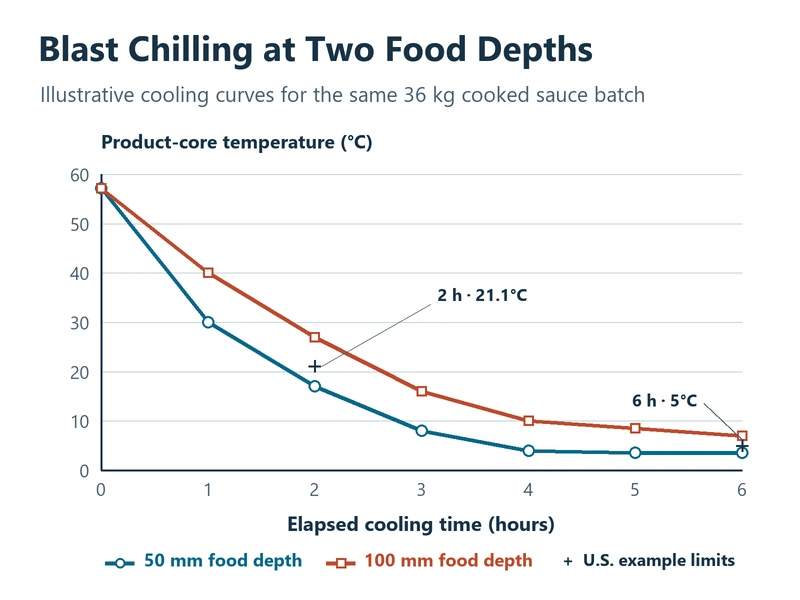
For comparison, the University of Minnesota Extension’s commercial kitchen time and temperature guidance describes the following U.S. foodservice cooling criteria:
- From 135°F (approximately 57°C) to 70°F (approximately 21°C) within two hours.
- At the six-hour checkpoint, measured from 135°F, the food must be no warmer than 41°F (5°C).
Applicable local regulations and approved product-specific food safety requirements take precedence.
Under this illustrative reference:
Trial A: The monitored temperatures satisfy both example cooling limits.
Trial B: The first-stage limit is missed, and the final temperature remains above the example endpoint after six hours.
The later hypothetical readings for Trial B demonstrate the unsuccessful cooling trend. They do not justify continuing a failed commercial batch without applying the approved corrective-action procedure.
A batch that eventually reaches its target temperature has not necessarily met the required cooling process.
Container Selection Changes Heat Transfer
Blast chiller pan depth should be evaluated together with the construction and covering of the container.
Stainless Steel Pans
Stainless steel containers are commonly used in commercial kitchens because they support hygienic handling, repeated cleaning, and heat transfer through their walls.
However, placing metal pans directly against one another can restrict the airflow available for cooling.
Plastic Containers
Food-grade plastic containers may be convenient for storage and distribution, but their thermal properties differ from those of metal pans.
A cooling process validated using metal containers should not automatically be transferred to plastic packaging.
Lids and Protective Covers
A cover can restrict heat and moisture movement from the food surface.
The appropriate arrangement must balance cooling efficiency with contamination protection. Establish the covering method through the approved process rather than assuming that either fully sealed or uncovered cooling is suitable for every product.
If food will be sealed after chilling, include that packaging operation in the production schedule and hygienic handling plan.
Fit the Pan Arrangement to the Trolley
Reducing filling depth may increase the number of pans required for the same batch weight.
In the illustrative 36 kg comparison, the shallow arrangement requires twice as many containers as the deep arrangement. This creates an additional consideration for trolley capacity and airflow distribution.
Review the loaded trolley for:
- Vertical spacing between adjacent pans.
- Available airflow above food surfaces.
- Clearance around container sides.
- Positions blocked by trolley frames or other containers.
- Differences between central and outer rack positions.
A shallow pan placed beneath another container with insufficient clearance may perform differently from the same pan in an unobstructed position.
Validate the arrangement under representative full-load conditions, including the actual number of trolleys planned for production.
If additional pans cannot be accommodated without restricting airflow, review the trolley layout and batch scheduling before increasing the permitted filling depth.
Locate the Warmest Food Regions Before Selecting Routine Probe Positions
The geometric center of a pan provides a useful initial measurement location, but it is not necessarily the slowest-cooling region.
During central kitchen cooling validation, temperature mapping should establish where heat remains longest under the proposed loading arrangement.
Potential measurement positions include:
- The central region of the thickest food layer.
- Upper, middle, and lower trolley positions.
- Pans located furthest from effective cooling airflow.
- Dense food portions or large solid ingredients within mixed dishes.
Use suitable calibrated food probes with hygienic placement procedures.
Avoid contact between the probe tip and the metal container, which may produce a reading that does not accurately represent the food.
The validation record should preserve individual temperature traces. An average across several pans can conceal an individual container that fails to meet the required cooling limits.
Include the Time Between Cooking and Chilling
The cooling process does not necessarily begin when the blast chiller door closes.
Cooked food may pass through portioning, weighing, trolley loading, transportation, and equipment availability checks before active chilling starts.
These activities can consume part of the permitted cooling period.
Record the actual production timeline, including:
- Completion of cooking or removal from controlled hot holding.
- Portioning and loading times.
- Relevant starting temperatures and cooling-clock reference.
- Blast chilling start and completion.
- Transfer into approved chilled holding.
The applicable food safety procedure must define when the cooling clock begins. Loading delays must not be concealed by resetting the recorded starting time at the equipment.
Production scheduling should therefore coordinate cooking output with available chilling capacity rather than allowing warm batches to accumulate while waiting for an occupied chamber.
Establish Separate Cooling and Holding Duties
A rapid chilling system must remove heat from incoming cooked batches within defined process limits. A chilled holding room primarily maintains food that has already reached its approved storage condition.
LINBLE’s commercial chiller rooms have a published general temperature range of 0–10°C, with 0–5°C identified as a reference storage range for prepared foods.
These are storage specifications, not validated hot-food cooling rates.
The project’s refrigeration design should establish the required process duty separately from holding capacity. The distinction between blast chiller and blast freezer rooms becomes relevant when specifying the outgoing product condition.
For a central kitchen purchasing both process cooling and storage equipment, the technical specification should identify:
- Maximum incoming cooked-food mass per batch.
- Highest permitted entry temperature.
- Validated pan depth and trolley configuration.
- Required cooling time and product temperature endpoint.
Request equipment performance at these design conditions rather than relying on nominal refrigeration capacity or room volume.
Batch Release Requires More Than a Completed Equipment Cycle
A practical release record connects the validated process to each production batch.
| Record Item | Required Evidence |
| Batch identification | Product, date, and lot number |
| Loading configuration | Food depth, pan count, and batch weight |
| Cooling record | Required time and temperature checkpoints |
| Deviations | Documented corrective action and disposition |
| Release decision | Authorized review and approval |
Where monitoring identifies a missed cooling limit, place the affected batch under the site’s approved hold procedure. Qualified food safety personnel must determine its disposition under applicable requirements.
Simply extending the chilling cycle or mixing the affected product with a compliant batch is not an acceptable substitute for that assessment.
After approved cooling, transfer food promptly into the designated holding environment. LINBLE’s restaurant cold room solutions include customizable layouts and chilled storage configurations that can be coordinated with trolley movements and downstream food preparation.
Frequently Asked Questions
Does Successful Blast Chilling Establish the Product’s Refrigerated Shelf Life?
No. Shelf life also depends on formulation, initial microbial conditions, packaging, subsequent storage, and distribution. Establish it separately through an appropriate product-specific assessment.
Can Vacuum-Packed Cooked Foods Follow a Conventional Open-Pan Cooling Programme?
Not automatically. Reduced-oxygen packaging introduces additional food safety considerations and different heat-transfer conditions. Such products require their own validated process and applicable regulatory controls.
Can Blast Chilling Replace a Validated Cooking Step?
No. Rapid chilling controls temperature conditions after cooking but does not provide an equivalent microbial destruction step. Cooking and subsequent cooling must each satisfy their respective food safety requirements.