
Before replacing a defrost heater on an icing cold room evaporator, check moisture entry, airflow, the defrost command and sequence, meltwater drainage, and the heater circuit itself. Ice on the coil is a symptom; it does not establish which component failed.
Start by recording the ice pattern and when it returns. For a LINBLE system, identify the actual evaporator model and defrost method first, because an electric-heater diagnosis does not apply unchanged to a water-defrost unit.
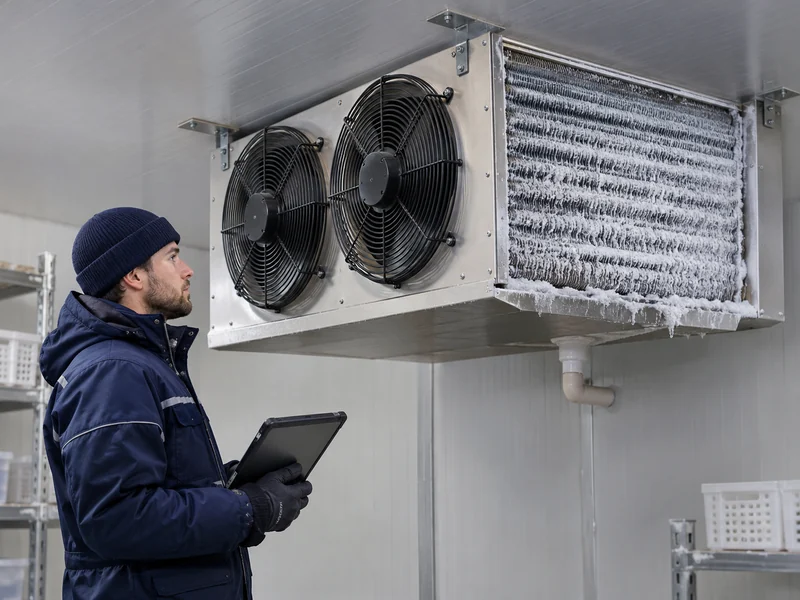
What Should Be Recorded Before the Ice Is Cleared?
Photograph the air-inlet side, visible coil face, fan guards, drain pan and drain outlet without removing guards or entering hazardous areas. Record room temperature, controller messages, recent loading and the time since the last observed defrost.
Note whether the ice is evenly distributed, concentrated at the bottom, or limited to one region. These observations guide the technician’s investigation, although no single frost pattern is a conclusive diagnosis.
Protect the stock and isolate unsafe equipment through the site’s procedures. Do not chip the coil with tools, apply an open flame or bypass a protective device to force a defrost.
The ASSP hazardous-energy control reference explains the purpose of controlling unexpected starting and stored energy. Electrical measurements, cover removal and heater replacement require appropriately qualified personnel.
Check One: Has the Moisture Load Changed?
Look for changes in door use, damaged seals, warm deliveries and cleaning practices. A sudden increase in moisture entering the room can create more frost than the previous operating routine produced.
Ask when the problem began and what changed at that time. A new delivery schedule, a door held open during picking or wet floors after cleaning can be more informative than the room’s age; LINBLE’s freezer-room ice prevention guide covers related enclosure checks.
- Observe door closure and inspect visible gasket damage.
- Check whether products are arriving warmer or wetter than the design brief assumed.
- Review how long the door remains open during peak activity.
- Look for unsealed penetrations or enclosure damage.
- Check whether cleaning leaves water that previously drained or dried away.
FAO’s good practices manual for the meat industry connects excess evaporator icing with operating factors including overloading, doors, insulation and cleaning water. Use those as investigation prompts, with the actual site’s conditions deciding the remedy.
Check Two: Can Air Move Through the Unit and the Room?
Inspect accessible stock positions and air paths, then have the technician check fan operation and coil condition safely. A blocked return route or fan problem can reduce useful airflow without any failure of the defrost heater.
Compare the current loading arrangement with the approved layout. Cartons stacked higher than planned, pallets pushed against a return-air path or material draped across a unit can change performance after a previously stable period.
LINBLE’s evaporator configurations include different discharge arrangements. Confirm the clearances and intended air path for the installed model rather than applying a rule from a differently shaped unit.
Coil geometry also belongs in a recurring-icing review. LINBLE’s article on evaporator fin spacing explains the relationship between frost accumulation and available airflow.
Check Three: Does the Defrost Sequence Actually Occur?
Have the service technician compare controller settings and recorded operation with the approved sequence. A scheduled defrost is not proof that the heaters were energized for the intended period.
Check the defrost command, refrigeration interlocks, termination sensor, maximum duration, drip time and fan delay as applicable to the system. A displaced or faulty sensor can end a cycle at the wrong point even when the heater itself is sound.
| Observation | Investigation Direction | Why a New Heater May Not Help |
| No observed defrost command | Schedule, controller inputs and operating mode | The existing heater may never receive a command |
| Cycle ends before ice clears | Termination conditions and sensor position | The replacement may stop at the same point |
| Fans resume with water still present | Drip time and fan-delay sequence | Water may be carried or refrozen after defrost |
| Ice returns after unusually wet loading | Moisture load and defrost suitability | The original operating assumptions may have changed |
Do not increase durations repeatedly without establishing what the cycle is doing. LINBLE’s explanation of defrost termination, drip time and fan delay helps organize the control review.
Check Four: Can Meltwater Leave Without Refreezing?
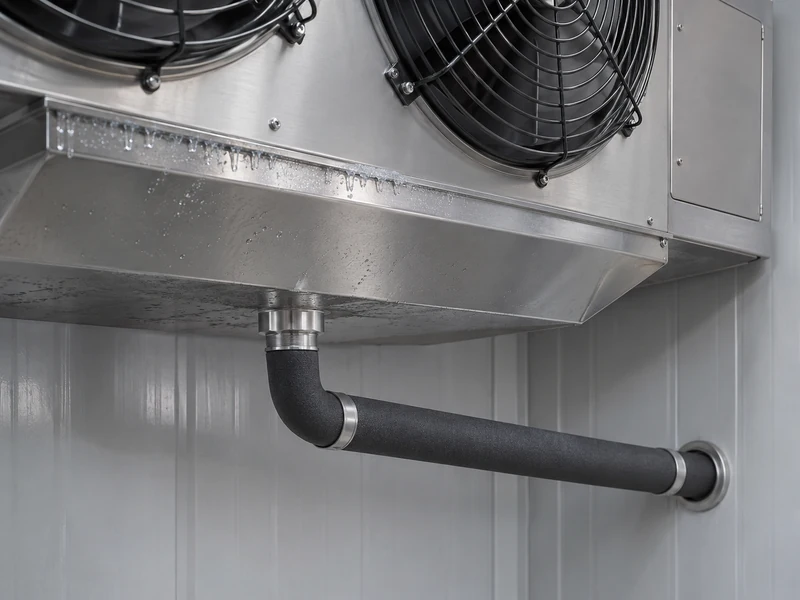
Inspect the drain pan and route as a complete system. Ice concentrated at the bottom can result from water that melts successfully but cannot leave the unit as intended.
Have the technician assess pan condition, outlet obstruction, pipe fall and freeze protection where required. Confirm any tray heater and drain-line heater separately from the coil heater.
A drain line routed through a freezing zone can remain troublesome after a coil-heater replacement. Equally, a working drain heater does not correct a blocked pipe or an unsuitable route.
For LINBLE’s available control and installation accessories, use the project component schedule to establish what was supplied. Do not assume every external section of site-installed drain pipe received heating as part of the evaporator order.
Check Five: Is the Heater Fault Proven Electrically?
The qualified technician should establish whether the specified supply reaches the heater when commanded, then assess the element and its associated circuit using the manufacturer’s procedures. Loss of heating can originate in switching, protection, connections or wiring as well as the element.
Record the heater identification and the actual findings. Continuity alone does not demonstrate correct heating performance or insulation condition, and the required tests depend on the assembly.
If replacement is justified, match the approved part, voltage, power, dimensions and mounting arrangement. Fitting a higher-wattage element as an improvised upgrade can change the thermal and electrical behavior beyond the design.
How Can the Timing of Icing Narrow the Investigation?
Write down when the unit is clear, when frost begins and when airflow or room temperature deteriorates. A timeline gives the technician a way to compare the complaint with loading, door activity and the defrost schedule.
If the problem follows a particular delivery, document that load’s condition and handling time. If it follows defrost, record whether water remained in the pan or appeared at the outlet before cooling resumed.
Do not interpret these associations as proof of a single cause. Their value is in directing measurements and observations during the period when the fault is likely to occur.
When Should the Original Selection Be Reviewed?
Review it after faults and operating changes have been assessed, particularly if the room now receives a different moisture or product load from the original brief. Repeatedly replacing functioning components cannot correct a duty mismatch.
Give the designer the current intake, product temperatures, packaging and traffic pattern. Include the control and service records so the review can distinguish a changed duty from an unresolved equipment fault.
For an illustrative case, a room converted from sealed frozen cartons to frequent wet-product loading may face a different frost burden. That does not establish a specific remedy, but it justifies checking whether the coil and defrost arrangement still suit the operation.
Document any approved changes and their acceptance conditions. A revised schedule or component should be followed through to observed operation, with the stock protected while the service team confirms the result.
What Information Helps LINBLE or the Service Team Respond?
Send the unit identification, room setpoint, photographs, control settings, operating timeline and technician’s findings. Add the incoming product condition and recent changes to door use or cleaning.
For example, ice that returns mainly at the pan after every defrost calls for a different investigation from a coil that never warms during a commanded electric-defrost cycle. Preserve that distinction in the service request instead of reporting only “evaporator frozen.”
After repair, observe a complete relevant operating cycle and confirm that ice clears, water drains and normal cooling resumes. Document the result under representative loading before declaring the fault resolved; replacing a part is one step, while verified operation is the outcome.