
A complete cold room evaporator quote should identify the selected unit and rating conditions, then state exactly which fans, defrost components, controls, valves, mounting items and delivery services are included. The lowest equipment line is not necessarily the lowest installed cost.
With LINBLE, first establish whether the enquiry is for an evaporator alone or a matched refrigeration package. A ceiling unit, a condensing unit and a field installation can appear on the same proposal while still having separate supply boundaries.
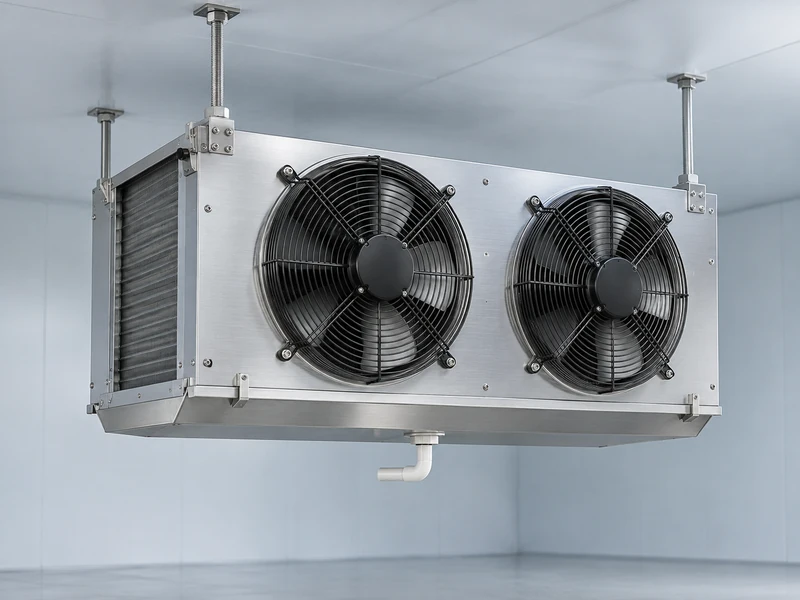
What Does “Complete Evaporator Unit” Mean in This Quote?
It should mean a written list of supplied parts, not an assumption about what usually comes in the box. Ask the seller to mark every item as factory fitted, supplied loose, optional or excluded.
| Quote Item | Detail Needed | Why It Changes the Comparison |
| Coil and casing | Model, dimensions, materials and connection positions | Determines fit and suitability for the environment |
| Fans | Quantity, motor type, voltage and electrical data | Affects wiring, operation and replacement support |
| Defrost | Method, coil and tray provisions, heater ratings where applicable | Changes electrical and drainage scope |
| Controls and valves | Exact supplied components and installation responsibility | These are not automatically inside the evaporator price |
| Mounting and drainage | Brackets, supports, drain connection and freeze protection | Site materials can remain outside the package |
| Delivery and support | Packing, delivery basis, documents and warranty terms | Determines landed cost and handover obligations |
LINBLE’s evaporator range includes different temperature duties, discharge arrangements and defrost methods. Those choices are useful for shortlisting, but they do not establish the contents of an individual order.
Are the Capacity Figures Being Compared on the Same Basis?
Compare refrigeration capacity only after matching the stated operating conditions. Two units described as “10 kW” may have been rated at different room temperatures, evaporating temperatures or refrigerant conditions.
Request the room-air temperature, refrigerant, evaporating temperature or defined temperature difference, and the applicable wet or dry rating basis. Have the supplier explain how the selected model meets the project’s calculated duty at those conditions.
AHRI’s unit-cooler performance standards provide a defined framework for rating the equipment covered by their scope. A reference to the standard does not mean a quoted product is AHRI certified; verify any certification claim separately.
Cooling area is an even rougher comparison. Room height, insulation, incoming product condition and door activity can differ substantially between rooms with the same floor area, so square meters should not be the final basis for selecting a model.
Does a Larger Nominal Capacity Always Justify a Higher Price?
No. A higher quoted rating is useful only if it is relevant to the required duty and the refrigeration system can support it.
An oversized evaporator selected for a deliberate lower temperature difference may be a sound design choice. An unexplained move to a larger catalogue number, without checking the condensing unit and control behavior, is much harder to evaluate.
Which Construction Details Belong in the Price?
Specify the environment before comparing materials and finishes. A dry packaged-goods store and a room exposed to aggressive cleaning chemicals can need different casing, coil protection and service-access provisions.
- Coil construction and any selected corrosion-protection treatment.
- Casing and drain-pan materials, with cleaning access described.
- Fin spacing appropriate to the duty and frost exposure.
- Overall dimensions, installed weight and mounting points.
- Discharge direction, fan arrangement and required free space.
- Availability of replacement fans, heaters and compatible controls.
Ask what cleaning method is permitted for the actual unit. A coating name is not a guarantee that any chemical, pressure washer or cleaning temperature will be suitable.
For frost-prone applications, compare the coil geometry as well as the price. LINBLE’s article on evaporator fin spacing explains why capacity and usable airflow need to be considered together.
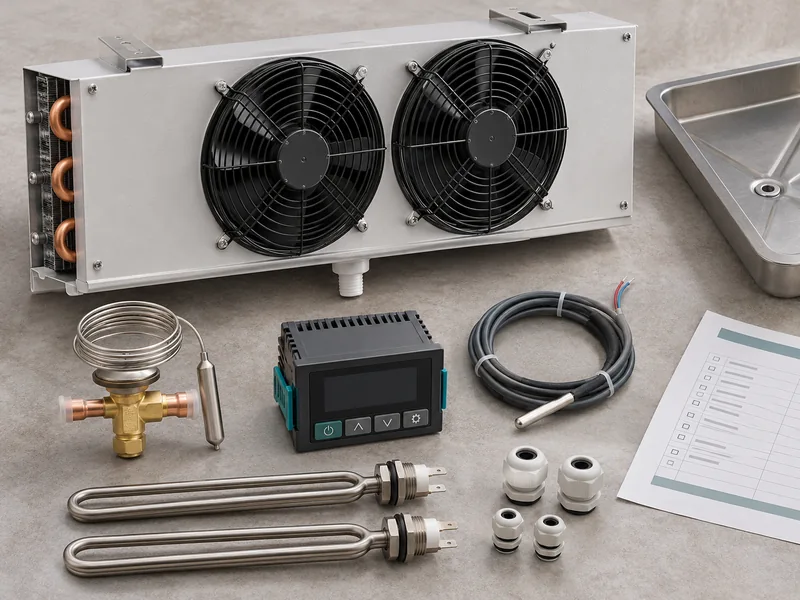
What Should the Defrost Line Include?
Ask for the selected method and its complete component schedule. For an electric-defrost model, identify coil heaters, drain-pan heaters, electrical ratings and the control devices included in the quotation.
Then ask about the drain line outside the unit. A heated pan does not automatically mean that the entire site-installed drain route is protected from freezing or included in the price.
For water defrost, establish the required water conditions, connection points and drainage obligations. Water piping, valves, controls and disposal capacity may cross several contracts, so a cheaper evaporator line can carry a larger site-work requirement.
Review the choice using LINBLE’s defrost-method comparison. The useful purchasing decision concerns the whole installed arrangement, including the site’s available utilities.
Are Valves and Controls Included or Merely Recommended?
Have the quotation name the components individually. An expansion valve, solenoid valve, sensors and controller may be supplied with a refrigeration package, selected separately or installed locally depending on the agreement.
For each component, confirm refrigerant compatibility, model or selection basis, connection size and installation responsibility. Avoid ordering a valve only because its connection appears to match the coil; the refrigeration designer must select it for the actual operating conditions.
If LINBLE is quoting a matched system, reference the selected condensing unit in the same technical schedule. The evaporator and outdoor equipment should be reviewed as a working pair, with piping and controls coordinated to the room duty.
How Can Two Proposals Be Compared Fairly?
Send both suppliers the same enquiry sheet and request a deviation list. Evaluate the two component lists against one agreed refrigeration duty, and price delivery on the same destination basis.
As an illustrative example, Proposal A might include fans and coil heaters while Proposal B also includes the tray heater, control sensors and selected valve. The price gap becomes meaningful only after the missing items and their installation costs have been identified.
Put the written warranty beside the parts schedule and check which failures and costs it actually covers. Record the covered parts, claim procedure, required commissioning records and responsibility for local labor or transport; “one-year warranty” alone leaves too much undecided.
State whether freight, taxes, refrigerant, field piping, wiring and commissioning are included. Do not invent a local installation allowance simply to make two totals look comparable: obtain a site quotation for the excluded work.
What Should Be Agreed About Documents and Spare Parts?
Request the dimensional drawing, wiring information and installation instructions for the quoted model before order confirmation. Check that the documents identify the selected fan supply and defrost arrangement rather than a generic product family.
Ask how the unit will be identified after delivery and what information is needed to obtain replacement components. A clear model and component record can save considerable time when a local technician needs to source a fan or heater later.
Where a spare-parts package is proposed, list its contents and quantities separately. Spares may be sensible for a remote installation, but their value depends on compatibility, storage conditions and the site’s ability to replace them.
Does Packing Belong in the Technical Review?
Yes, particularly when the unit travels with other cold room components. Agree the packing and handling provisions and confirm whether supplied-loose valves, sensors and fittings are identified on a packing list.
At receipt, photograph damage before unpacking further and compare the delivered parts with that list. A missing loose sensor is a delivery issue; discovering it only during commissioning can make the cause and responsibility harder to establish.
Keep the approved quotation, deviation list and component schedule together. They should tell the same story as the delivered unit, including the parts installed locally.
This is also why an apparently small difference in evaporator price deserves a scope check. The useful comparison includes what arrives, the documents that support it and the work still required to make it operate.
What Information Helps LINBLE Return a Useful Quote?
Provide the room dimensions and setpoint, incoming product condition, daily throughput, target cooling time, ambient conditions and electrical supply. Add a layout showing the proposed mounting location, stock height and available drain route.
Define an acceptance trial that specifies the arriving product temperature, batch quantity and loading pattern before installation begins. LINBLE’s commissioning checklist connects the quotation’s promises with a practical acceptance record.
A useful evaporator price can be traced from design duty to selected model, supplied parts and installed responsibility. Once those four things agree, the purchase becomes easier to defend and far less likely to produce unexpected site costs.