
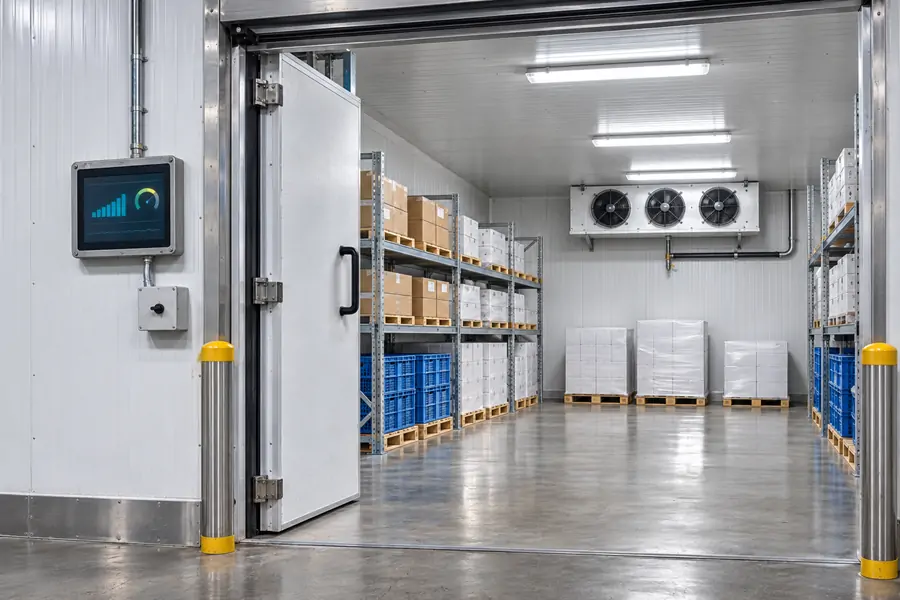
A 10-ton cold room can use very different amounts of electricity depending on whether it stores chilled or frozen products. The useful figure is daily kWh from the complete installation, not compressor horsepower.
This guide calculates cold room electricity consumption for a +5°C chiller and a −18°C freezer, both holding 10,000 kg of goods. Every numerical example uses stated assumptions, not LINBLE field measurements.
Define 10 Tons and the Storage Duty
Here, 10 tons means 10 metric tonnes (10,000 kg) of stored products, not a refrigeration plant rated at 10 tons of refrigeration (TR). One TR equals approximately 3.517 kW of cooling capacity, so 10 TR means 35.17 kW of heat removal—not 35.17 kW of electrical draw.
Storage mass does not determine room size; stacking, aisles and airflow clearance matter. Assume a 6 m × 4 m × 3 m internal room (72 m³).
| Design input | +5°C chilled room | −18°C freezer |
| Product capacity | 10,000 kg | 10,000 kg |
| Internal volume | 72 m³ | 72 m³ |
| Surrounding temperature | 30°C | 30°C |
| Assumed effective insulation U-value | 0.23 W/m²·K | 0.16 W/m²·K |
| Door usage | 12 openings/day, 45 seconds each | Same |
| Product arrival condition | Already near +5°C | Already frozen near −18°C |
| Operation and billing | 24-hour room, 30-day month | Same |
Assumption boundary: All enclosure surfaces are treated as exposed to 30°C for this simplified heat-gain check. Actual floor temperatures, thermal bridges and humidity require separate checks. This is holding storage, not initial pull-down or food freezing.
As a quick check, the six room surfaces total 108 m². Conductive heat gain can be approximated as:
Transmission heat (kWh thermal/day) = U × area × temperature difference × 24 ÷ 1,000
That gives 14.90 kWh thermal/day for the chiller and 19.91 kWh thermal/day for the freezer. These are thermal loads, not electrical use; infiltration and internal equipment add more heat. ASHRAE’s refrigerated-facility load guidance separates these sources when calculating required cooling capacity.
For full equipment sizing, use LINBLE’s cold room refrigeration capacity calculation guide. Electrical consumption depends on the subsequent equipment selection and runtime.
Split Running Loads by Equipment
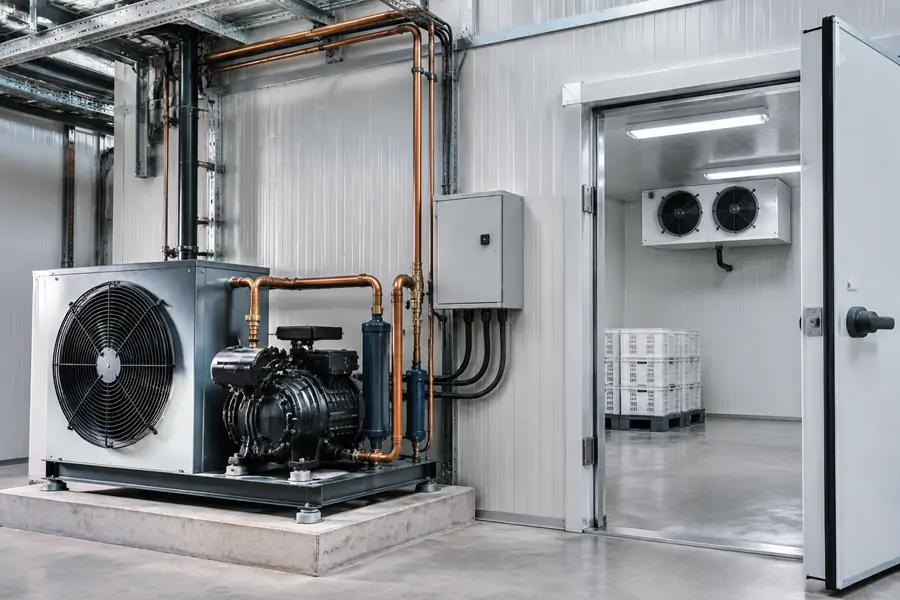
A cold room power consumption estimate needs each component’s power and operating hours. A defrost heater runs intermittently; a door-frame heater may run continuously.
The following values are hypothetical equipment inputs and schedules, selected to illustrate the method. They are not rated or guaranteed consumption figures.
| Equipment | Chiller: kW × hours/day | Chiller: kWh/day | Freezer: kW × hours/day | Freezer: kWh/day |
| Compressor only | 2.40 × 8 | 19.20 | 3.40 × 13 | 44.20 |
| Condenser fans | 0.25 × 8 | 2.00 | 0.30 × 13 | 3.90 |
| Evaporator fans | 0.22 × 24 | 5.28 | 0.32 × 22.5 | 7.20 |
| LED lighting | 0.08 × 5 | 0.40 | 0.08 × 5 | 0.40 |
| Electric defrost | Off-cycle; 0 | 0.00 | 2.40 × 1.5 | 3.60 |
| Door-frame heating | None; 0 | 0.00 | 0.12 × 24 | 2.88 |
| Controls and alarms | 0.04 × 24 | 0.96 | 0.04 × 24 | 0.96 |
| Daily total | 27.84 | 63.14 |
The chiller uses an assumed off-cycle defrost arrangement with no electric heater. The freezer’s evaporator fans are assumed off for the 1.5 total daily hours of electric defrost; its compressor runtime is separate from defrost time. Actual defrost controls and fan delays vary.
Avoid double counting. In this table, compressor input excludes the separately listed condenser fans. If a supplier quotes the complete condensing unit’s input power, check which motors it includes before adding fan energy again. Refrigeration capacity in kW, compressor electrical input in kW and energy in kWh are three different quantities.
Interior fan motors, lamps and electric defrost also release heat that refrigeration must remove. Their direct electrical kWh belong in the equipment table; the resulting thermal load helps determine compressor hours. This is not double billing: it becomes double counting only if you add another electricity charge for removing that heat after it has already been reflected in compressor runtime.
The University of Wisconsin Extension’s walk-in cooler energy estimator likewise treats refrigeration, circulating fans and lighting as separate contributors, while acknowledging site-specific assumptions.
Calculate kWh per Day and Monthly Running Cost
The basic cold room running cost calculator needs three equations:
Daily electricity (kWh) = Σ [equipment input (kW) × operating hours/day]
Monthly electricity (kWh) = daily kWh × number of days
Monthly energy charge = monthly kWh × tariff per kWh
Using a hypothetical flat electricity price of US$0.15/kWh and a 30-day month gives:
| Calculation | +5°C chiller | −18°C freezer |
| Cold room kWh per day | 27.84 | 63.14 |
| Cold room kWh per month | 835.20 | 1,894.20 |
| Energy charge per day | US$4.18 | US$9.47 |
| Energy charge per month | US$125.28 | US$284.13 |
For example, chiller electricity is 27.84 × 30 = 835.20 kWh/month, then 835.20 × $0.15 = $125.28/month. Substitute your local tariff.
These figures exclude demand charges, fixed fees, taxes, power-factor penalties, backup generation and other site loads. These are not actual bills or a universal 10 ton cold storage electricity consumption benchmark.
The compressor schedules also need an engineering check. If the chiller delivers an assumed 5.0 kW net cooling capacity while running, eight hours removes 40 kWh of heat. If the freezer delivers 4.5 kW net for thirteen hours, it removes 58.5 kWh. Compare these amounts with estimated daily transmission, air infiltration, product, fan, lighting and defrost heat. Use cooling capacity rated at the actual operating conditions, not horsepower.
LINBLE’s cold room condensing unit options cover chiller and freezer requirements, but equipment size alone cannot establish runtime.
Test Door Traffic and Ambient Temperature
Door activity changes both sensible heat gain and moisture infiltration. Hotter outdoor air increases the temperature difference across insulated panels and may make the condenser work at less favorable conditions. In freezers, humid air may increase defrost demand.
Recalculate affected components instead of applying arbitrary percentage increases.
| Illustrative operating case | Chiller kWh/day | Freezer kWh/day |
| Baseline: 30°C ambient; 12 openings × 45 s | 27.84 | 63.14 |
| Busy doorway: 30°C; 40 openings × 60 s | 33.14 | 75.28 |
| Hot ambient: 40°C; 12 openings × 45 s | 37.99 | 83.04 |
Busy doorway assumptions: Chiller compressor runtime rises from 8 to 10 hours; freezer runtime from 13 to 16 hours. The freezer’s electric defrost increases from 1.5 to 2 hours, reducing evaporator fan operation to 22 hours. Component power ratings otherwise stay unchanged. These are modeled runtime changes, not measured results.
Hot ambient assumptions: Chiller compressor electrical input increases to 2.60 kW for 11 hours; freezer input increases to 3.70 kW for 17 hours. Condenser fan powers stay at 0.25 and 0.30 kW, respectively; other schedules remain at baseline. This scenario excludes additional door traffic.
For example, the hot-weather chiller total is (2.60 × 11) + (0.25 × 11) + 5.28 + 0.40 + 0.96 = 37.99 kWh/day. The freezer similarly totals 83.04 kWh/day. Verify against equipment curves and site conditions.
Include Product Turnover Before Trusting the Estimate
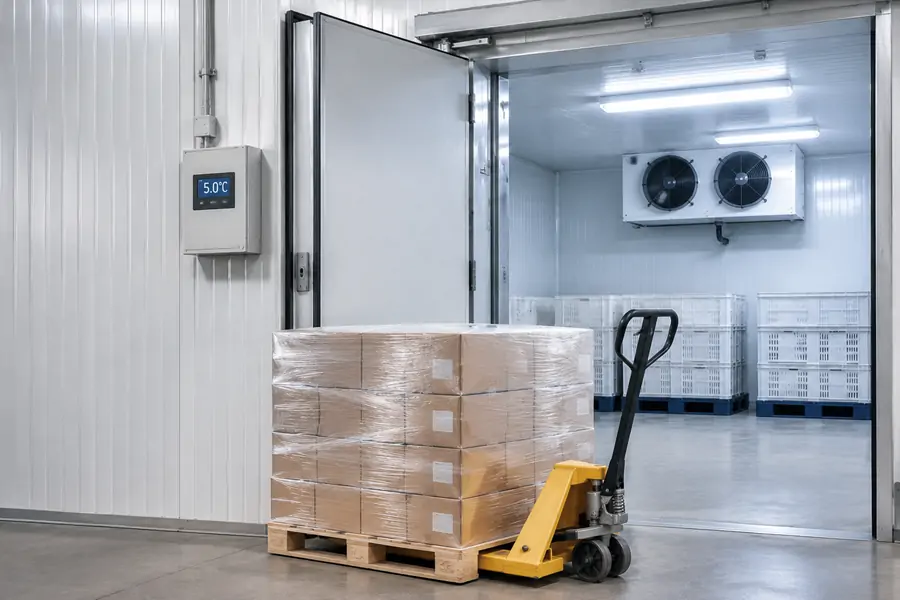
Holding 10 tonnes of already-cold stock is not the same job as cooling or freezing 10 tonnes every day. Warm arrivals add product load and compressor runtime.
For sensible cooling without phase change:
Product heat (kWh thermal) = mass (kg) × specific heat (kJ/kg·°C) × temperature change (°C) ÷ 3,600
As an illustrative calculation, suppose 1,000 kg of chilled goods arrive daily at 15°C and must reach +5°C. With an assumed specific heat of 3.8 kJ/kg·°C, the extra heat to remove is 10.56 kWh thermal. At the example chiller’s assumed 5.0 kW net capacity, that is roughly 2.11 additional compressor hours, if capacity remains unchanged.
With both the compressor and condenser fan running, this would add approximately (2.40 + 0.25) × 2.11 = 5.59 kWh/day. This increment is illustrative.
A freezer receiving 1,000 kg of already frozen product at −12°C would remove approximately 3.17 kWh thermal to reach −18°C if specific heat is assumed to be 1.9 kJ/kg·°C. Freezing unfrozen goods adds latent heat; do not use a holding-store budget for blast freezing.
Replace Estimates With Operating Data
Before signing off a monthly energy budget, request a load schedule and an electrical schedule for the actual equipment. One establishes heat gain; the other identifies electrical loads.
- Confirm the stock profile:Maximum inventory, daily turnover, arrival temperatures and whether freezing takes place inside the room.
- Record the enclosure:Internal dimensions, panel and floor construction, door size, seals, installation location and surrounding temperatures.
- Specify electrical inputs:Compressor-only versus whole-unit power, condenser and evaporator fan motors, defrost heater, door heaters and controls.
- Document operating sequences:Compressor starts, fan delays, door openings, defrost initiation and termination, and seasonal setpoints.
- Measure after commissioning:Submeter the cold-room circuits, log at least seven representative days, and compare daily kWh against door counts, product deliveries and ambient temperature.
Use longer records for seasonal forecasts. If the meter total is higher than the equipment sum, look first for omitted heaters, unexpected running hours or shared circuits before assigning a generic efficiency loss.
LINBLE’s cold room electrical requirements checklist helps buyers identify circuits that are easily missed when only a compressor rating appears on the quotation.
Estimate Your 10-Ton Cold Room Cost With LINBLE
For this assumed holding-storage scenario, the +5°C room uses 27.84 kWh/day, while the −18°C freezer uses 63.14 kWh/day. These are assumed results, not guaranteed ratings.
LINBLE designs custom cold rooms around storage temperature, dimensions, insulation, doors and refrigeration equipment. Share your product throughput, local ambient range and electricity tariff to request a project-specific load calculation and electrical equipment schedule.