
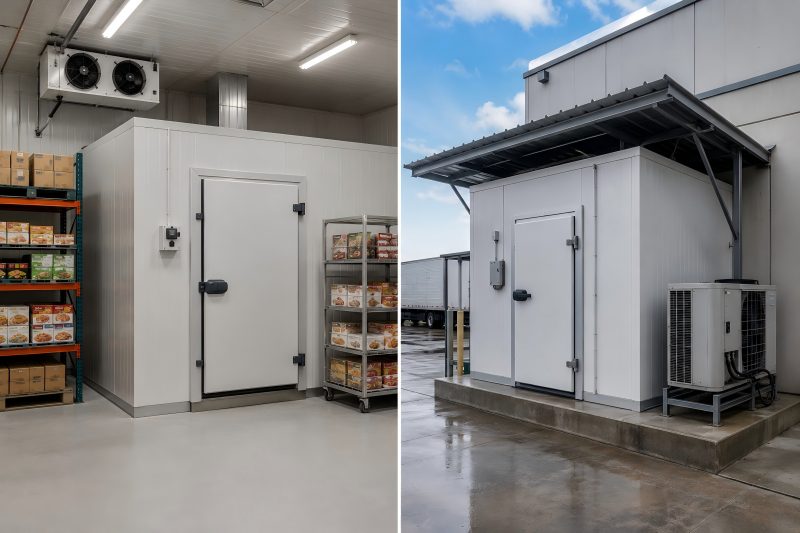
Indoor walk-in freezer cold rooms usually provide convenient access, stable surrounding conditions, and easier daily inspection. They are particularly effective for businesses with frequent product movement and enough internal floor space.
Outdoor walk-in freezers preserve indoor working space and offer greater flexibility for large capacities or future expansion. They require stronger weather protection, proper foundations, secure access, effective drainage, and a layout designed around actual working routes.
Indoor vs Outdoor Walk-In Freezer Cold Room
| Comparison Factor | Indoor Walk-In Freezer | Outdoor Walk-In Freezer |
| Installation location | Inside an existing building | Outside or beside the main building |
| Weather exposure | Low | High |
| Structural protection | Provided by the building | Requires independent protection |
| Insulation requirements | Standard or project-specific | Usually more demanding |
| Floor-space impact | Uses indoor production or storage space | Preserves indoor working space |
| Installation complexity | Depends on doors, corridors, and ceiling height | Depends on foundations, drainage, roofing, and permits |
| Maintenance access | Convenient in most facilities | May require protected outdoor service areas |
| Expansion potential | Limited by the existing building | Often easier when outdoor land is available |
| Condensation risk | Mainly around doors and surrounding rooms | Affected by weather, humidity, and temperature changes |
| Suitable applications | Restaurants, kitchens, supermarkets, small factories | Warehouses, processing plants, distribution centers, expanding facilities |
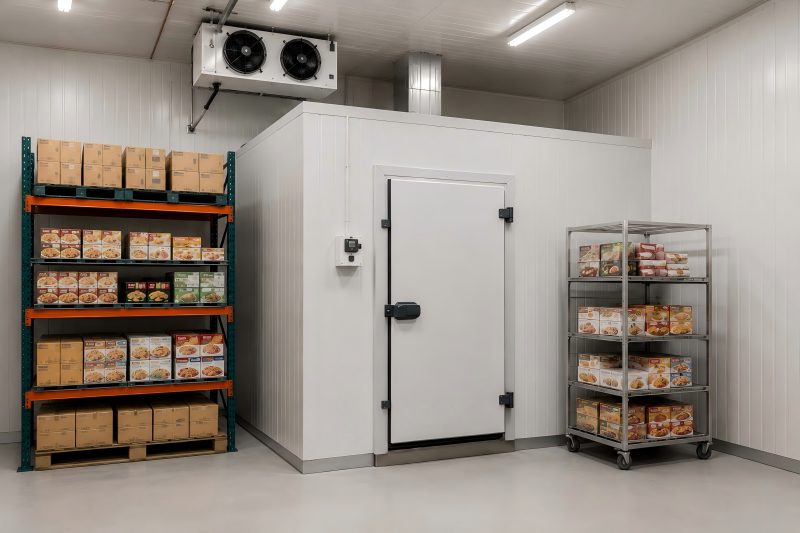
What Is an Indoor Walk-In Freezer Cold Room?
An indoor walk-in freezer is installed within an existing building envelope. Its insulated wall panels, ceiling panels, freezer door, evaporator, shelving, and refrigeration components are arranged inside a kitchen, warehouse, back room, food-processing area, or retail facility.
Because the surrounding building protects the freezer from sunlight, rain, wind, and major outdoor temperature changes, the enclosure generally operates under more stable external conditions. However, indoor installation can reduce usable floor space and may create design challenges involving ventilation, drainage, floor loading, and access routes.
Indoor freezer rooms are commonly selected when products need to move directly between preparation, processing, storage, and dispatch areas. The layout can shorten handling distances and make daily access more convenient for employees.
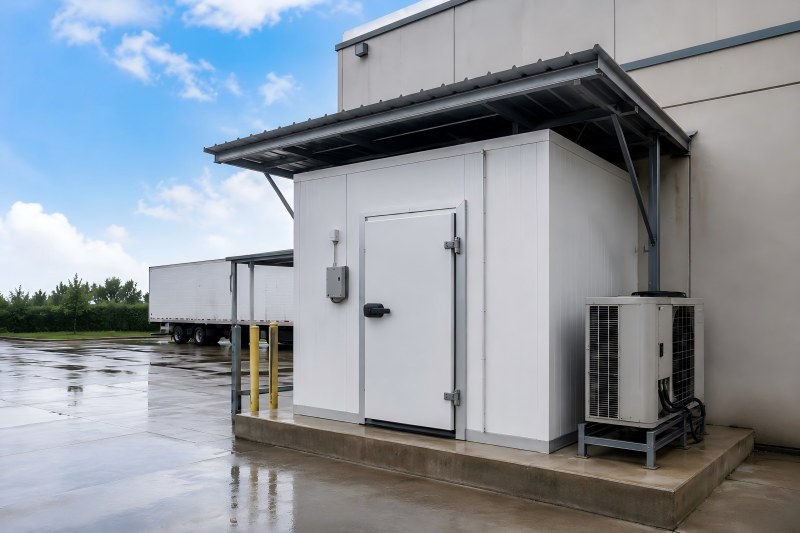
What Is an Outdoor Walk-In Freezer Cold Room?
An outdoor walk-in freezer is positioned outside the main building, either as an independent structure or as an insulated extension connected to the facility. It may be installed beside a kitchen, warehouse, supermarket, slaughterhouse, food factory, or logistics building.
Unlike indoor systems, outdoor freezer rooms must withstand changing temperatures, rain, sunlight, wind, snow, dust, and ground moisture. The cold room therefore needs suitable roofing, weatherproof sealing, corrosion-resistant materials, drainage, structural support, and protection for refrigeration equipment.
Outdoor installation is often considered when indoor space is limited or when the company expects storage demand to grow. It can free valuable production space, but its successful operation depends on a more complete site and climate assessment.
Installation Space and Building Layout
Indoor Freezer Space
An indoor freezer occupies floor area that could otherwise be used for food preparation, shelving, production equipment, packing, or general storage. In facilities with limited space, the freezer may interfere with staff movement or create narrow working routes.
The installation team must confirm that insulated panels can pass through building entrances, corridors, elevators, and loading doors. Ceiling height should also allow enough space above the cold room for installation, airflow, pipework, lighting, and maintenance.
An indoor cold room should not be forced into the largest possible footprint. Leaving sufficient service clearance around important components usually creates better long-term value than gaining a small amount of additional storage volume.
Outdoor Freezer Space
An outdoor freezer does not consume valuable indoor production area. This suits growing businesses needing extra frozen storage without relocating or rebuilding existing facilities.
However, available land alone does not make a location suitable. The site must support foundations, delivery access, drainage, electrical connections, refrigeration lines, service access, and safe employee movement.
The freezer should also be positioned to minimize travel between the cold room and the working area. A poorly located outdoor unit may save indoor space but increase labor time every time products are stored or collected.
Weather and Environmental Protection
Weather exposure clearly distinguishes outdoor freezer rooms from indoor installations.
Indoor systems operate within a relatively controlled building environment. Although kitchens and processing rooms can be warm or humid, the freezer enclosure is not normally exposed to rain, direct sunlight, strong wind, or freezing outdoor conditions.
Outdoor cold rooms require additional protection. Solar heat can increase the temperature around the enclosure, while heavy rain and poor drainage can allow water to collect around the base of the panels.
In cold climates, snow and ice can block doors, affect roof loading, and make service access difficult. In hot climates, direct sunlight can increase refrigeration demand and accelerate aging of exposed seals, coatings, cables, and external components.
A roof or weather canopy should be treated as part of the outdoor cold-room system rather than as an optional accessory. Shielding the freezer from harsh weather improves reliability and reduces unnecessary maintenance.
Insulation and Thermal Performance
Both indoor and outdoor walk-in freezers require properly selected insulated panels. The required panel thickness and material depend on the target temperature, ambient conditions, freezer size, operating hours, product load, and door-opening frequency.
Indoor freezers benefit from the surrounding building, which acts as an additional environmental barrier. Outdoor rooms experience wider temperature differences between the frozen interior and the external environment.
Panel joints, corners, floors, ceilings, service penetrations, and door frames should all be sealed carefully. Even high-quality panels cannot maintain stable performance when warm, humid air enters through poorly installed joints.
Outdoor freezers may also need protective external finishes selected for sunlight, rain, salt, industrial pollution, or coastal conditions. The correct finish should match the actual site rather than being chosen only for appearance.
Energy Consumption
It is easy to assume that every outdoor freezer consumes more energy than an indoor model. In practice, the result depends on climate, insulation, door use, refrigeration selection, product loading, and installation quality.
An outdoor freezer in a mild climate with good shading and limited access may operate efficiently. An indoor freezer beside ovens, cooking equipment, steam lines, or high-temperature processing machinery may face a considerable heat load.
The surrounding temperature should therefore be assessed at the actual installation point. Average regional temperature alone does not show how much heat the freezer will experience during daily operation.
Door use can be equally important. A well-insulated freezer may still waste energy when staff leave the door open, move products slowly, or organize shelving in a way that blocks airflow.
Access and Workflow Efficiency
Indoor Access
Indoor freezer rooms generally support faster access. Staff can move products without going outside, which is useful in restaurants, commercial kitchens, supermarkets, and food-processing facilities.
Shorter travel distances can improve handling speed and reduce the risk of products warming during transfer. Indoor access is also more comfortable during rain, snow, extreme heat, or nighttime operations.
However, frequent traffic can introduce warm air, moisture, dirt, and packaging debris into the freezer. Door location should be planned carefully so that it does not open directly into a high-temperature or high-humidity area when another arrangement is possible.
Outdoor Access
An outdoor freezer may require employees to pass through an external doorway or covered passage. This can increase handling time and expose staff and products to changing weather.
A covered connection between the building and cold room can reduce these problems. For high-frequency operations, the connection should be considered during the original design instead of being added after installation.
Outdoor rooms can work well when pallets or bulk frozen products arrive directly from trucks. Locating the freezer close to the unloading area may reduce internal transport and simplify warehouse operations.
Floor and Foundation Requirements
Indoor freezer rooms may be installed on an existing floor, but the floor still requires careful assessment. It must support stored products, shelving, carts, pallets, and handling equipment.
Low-temperature rooms can cause condensation or frost problems beneath the floor when insulation and vapor protection are insufficient. In some installations, floor heating or frost-prevention measures may be required to protect the slab.
Outdoor freezer rooms usually need a prepared concrete foundation. The surface must be level, stable, well drained, and capable of supporting the complete structure.
The foundation should also keep the cold room above standing water. Installing an outdoor freezer on an unsuitable base can lead to panel movement, damaged seals, door misalignment, water penetration, and reduced insulation performance.
Refrigeration Equipment Placement
Indoor refrigeration equipment must be arranged so that rejected heat does not raise the temperature around the freezer. Condensing units may need a separate mechanical room, outdoor location, or properly ventilated service area.
Limited ventilation can cause high condensing temperatures and unstable operation. Noise should also be considered when equipment is installed near offices, retail areas, dining rooms, or residential buildings.
Outdoor installations offer more flexibility for condensing-unit placement, but the equipment still requires protection. Rain, snow, falling debris, direct sunlight, dust, and accidental impact can affect performance.
Service technicians need enough working clearance around compressors, fans, electrical panels, valves, and piping. A compact layout that prevents proper maintenance may reduce the initial footprint but increase future repair costs.
Maintenance and Cleaning
Indoor freezer rooms are usually easier to inspect because they are located within the main facility. Staff can quickly notice damaged door seals, frost buildup, blocked drains, lighting problems, or unusual refrigeration noise.
Outdoor systems may receive less frequent visual attention. Small problems can remain unnoticed until they affect temperature control or product safety.
Outdoor maintenance areas should remain accessible in all weather conditions. The design should avoid placing critical components behind fences, narrow gaps, roof runoff points, or areas where snow and water collect.
Internal cleaning requirements are similar for both designs. Floors, shelves, door seals, evaporator guards, drains, and wall surfaces should be accessible and made from materials suitable for the stored products.
Security and Safety
An indoor freezer benefits from the security of the main building. Outdoor cold rooms may require additional locks, lighting, cameras, access control, protective barriers, or fencing.
Employee safety should also be considered. Walk-in freezer doors need reliable internal emergency-release mechanisms so that a person cannot be trapped inside.
Outdoor pathways should have suitable lighting, slip-resistant surfaces, drainage, and weather protection. Where forklifts or delivery vehicles operate nearby, physical barriers can help prevent impact damage to panels and refrigeration equipment.
Alarm systems should monitor temperature changes, door status, power failure, and refrigeration faults. Remote alerts are particularly valuable for outdoor freezers that are not continuously visible to staff.
Construction and Permission Requirements
Indoor installation may involve changes to floors, walls, ceilings, drainage, electrical systems, fire protection, or ventilation. The building structure must be checked before panels and equipment are installed.
Outdoor rooms may require planning approval, building permission, foundation work, stormwater control, property-line checks, and structural calculations. Local requirements vary, so site preparation should be reviewed before manufacturing begins.
The purchasing process should not separate the freezer from the building work. Cold-room panels, refrigeration equipment, drainage, electrical supply, foundations, and access routes must function as one system.