
Whole fish and fillets change cold room design through their effective thickness, exposed surface, packaging and handling route. A room receiving iced whole fish needs space and drainage for the complete box-and-ice load; one receiving packed fillets needs a layout and cooling process suited to those packs, with particular attention to protection from drying and temperature variation.
For LINBLE, the most useful specification starts with the form arriving at the door and the form leaving it. “Fish storage” can mean chilled holding, tray freezing, block freezing or storage of finished frozen cartons, and these are not interchangeable equipment duties.
What Is the Real Unit Being Cooled?
Use the complete box, tray or pack as the unit of analysis. The thickness of an individual fillet does not describe a deep stack of fillets sealed inside an insulated carton.
Whole fish vary widely in body thickness and size distribution. Fillets can offer a shorter heat-transfer path when arranged in thin layers, but the advantage can disappear when they are packed densely into a thick block.
The FAO guidance on chilled fish handling shows why layer thickness and proximity to ice matter. Ice visible at the top of a box does not prove that fish in its centre have reached the intended condition.
Give LINBLE a package drawing or sample with dimensions, net product mass and any ice or liner arrangement. If the product changes seasonally, identify the largest or most resistant pack that the room must accommodate.
What Should Be Recorded at Receiving?
Record product condition rather than only vehicle or room air temperature. A cold delivery space can contain stock that has not completed the required cooling step.
- Species, size range and whether fish are whole, gutted, headed or filleted.
- Actual entry temperature and required product endpoint.
- Box, tray, liner and package dimensions.
- Ice quantity and intended replenishment method where relevant.
- Arrival rate, holding period and the next processing operation.
These details establish the duty for a LINBLE fish cold room. They also make quotations easier to compare because the suppliers are responding to the same product rather than different interpretations of a tonnage figure.
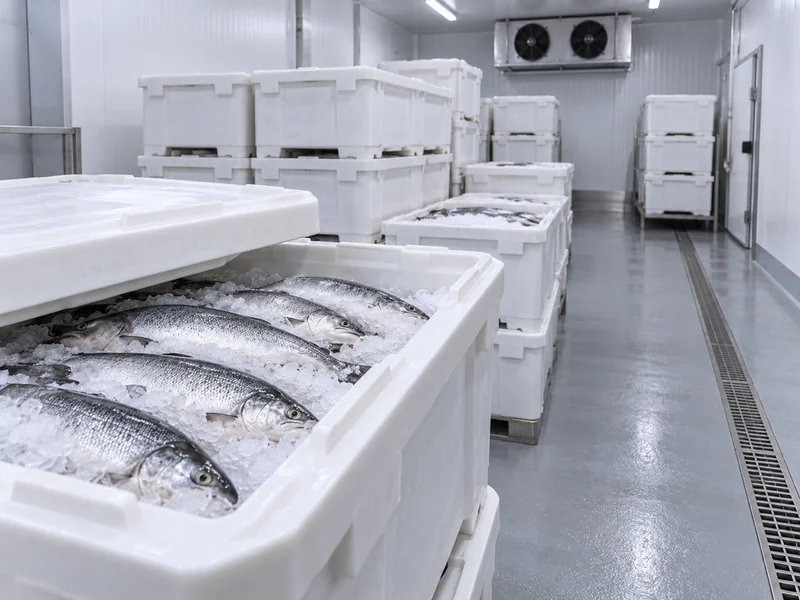
How Does an Iced Whole-Fish Flow Change the Room?
It adds handling mass, water management and access for inspection or re-icing. Calculate usable capacity from the loaded containers, not from fish weight alone.
Keep meltwater on an approved drainage route and prevent it from contaminating other stock or creating persistent wet working areas. Box outlets, stack arrangement and building drainage should be coordinated so that water does not simply pass through unsuitable lower containers.
Reserve enough access for staff to inspect the ice condition and move boxes without dragging them across a dirty floor. A dense arrangement that makes re-icing impractical may defeat the intended holding method.
LINBLE’s article on why chilled fish still needs ice in a cold room explains the complementary roles of ice and room refrigeration. The room reduces the surrounding heat load; the product-handling programme still has to maintain suitable conditions within each container.
Consider floor finish, cleaning access and material compatibility where salt, brine or aggressive cleaning agents are present. The appropriate selection depends on the actual exposure, rather than a blanket claim that every metallic component is equally suitable for seafood service.
What Changes When Fillets Enter in Shallow Packs?
The layout shifts toward protecting the cut product and maintaining the intended pack arrangement. Shallow layers can help temperature response, but they need sufficient rack or trolley space and cannot be crowded together until the air route disappears.
Exposed fillet surfaces are vulnerable to moisture loss and handling damage. Define whether product is covered, wrapped, sealed or otherwise protected at each stage, especially during waits between cutting, cooling and packing.
Position the cold room evaporator around that handling plan. A strong discharge onto open trays may create a surface-drying problem while leaving the centre of a densely loaded trolley insufficiently cooled.
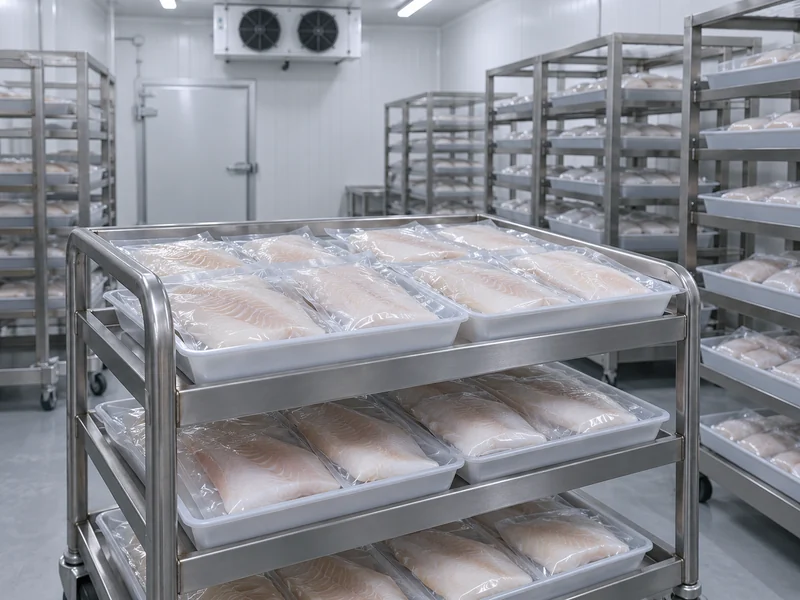
Packaging can introduce additional food-safety controls. In particular, reduced-oxygen fish packs need a validated product-specific storage and handling programme; a vacuum seal does not establish a safe shelf life or remove the need for temperature control.
Does Filleting Automatically Reduce Required Storage Space?
It can increase the edible product held within a given space, but the complete workflow decides the result. Trays, cartons, protective packaging and extra order-picking positions all consume volume.
Compare equivalent business quantities: incoming whole-fish mass, saleable fillet output and the inventory actually retained at each step. A tonne of whole fish and a tonne of finished fillets represent different process outputs.
| Product Form | Capacity Detail That Is Easy to Miss |
| Iced whole fish | Ice and container volume, drainage access and inspection space. |
| Fresh fillets in trays | Usable trolley positions with the required spacing and surface protection. |
| Fillet blocks for freezing | Block thickness, forming equipment and complete freezing-cycle time. |
| Frozen finished cartons | Pallet positions, picking access and separation from warm incoming product. |
Use that comparison before fixing the chamber dimensions. LINBLE’s seafood-plant capacity discussion can help connect throughput with the number of usable positions.
How Does Product Form Affect the Freezing Stage?
It changes freezing time and may change the most suitable equipment. Uniform flat packs or formed blocks offer different heat-transfer and handling possibilities from irregular whole fish.
The FAO chapter on fish freezing time identifies product dimensions, packaging and process conditions as important influences. A time quoted for one arrangement should not be reused after changing the block thickness or wrapper.
For an air-blast room, define the loaded trolley or pallet arrangement and the available airflow paths. Where a plate-freezing process is being considered, confirm package geometry and contact requirements with the equipment specialist.
Keep frozen holding capacity separate from the batch-freezing calculation. Finished stock may need to leave the freezing stage quickly so that the next production batch can enter without delay.
LINBLE’s explanation of core temperature during blast freezing sets out why product measurements matter. The thickest and slowest-cooling position should be included in the acceptance trial.
How Should a Mixed Whole-Fish and Fillet Day Be Planned?
Consider an illustrative plant receiving whole fish in the morning, preparing fillets during the shift and dispatching chilled packs later that day. The store may need distinct receiving, intermediate and finished-product positions even when all three quantities never reach their maximum together.
Draw the sequence with time beside it. A morning whole-fish peak can overlap with yesterday’s finished packs, while a late vehicle can leave today’s fillets occupying space intended for the next intake.
Identify which waits are expected and which are exceptions. The room can then be sized for the agreed buffer, with an escalation plan for delays rather than an assumption that every operation always runs exactly on schedule.
Keep product-contact equipment and cleaning routes consistent with the facility’s hygiene plan. A container returning from whole-fish receiving should not drift into finished-pack storage because it happens to fit an empty trolley position.
The refrigeration calculation should follow the temperature and mass of each stream, including the ice, containers and packaging that actually enter. Avoid adding all nominal process tonnages as if they were separate simultaneous warm loads when some describe the same fish at different stages.
For a LINBLE proposal, that time-based drawing clarifies both the busiest storage condition and the cooling work required. It also allows a reviewer to see whether a larger chamber would solve the bottleneck or whether the more useful change lies in the freezing cycle, packing schedule or dispatch arrangement.
What Should the Final Design Review Follow?
Follow one representative lot from delivery to dispatch, including its packaging changes. At each stop, identify who handles it, how its temperature is maintained and where water or waste leaves the process.
Then repeat the exercise for the busiest combination of lots. Whole fish awaiting processing, packed fillets awaiting orders and frozen cartons awaiting collection may peak at different times, allowing a more useful arrangement than a single large undifferentiated room.
Give LINBLE the product-form schedule together with the site plan, utilities and cleaning requirements. The resulting proposal should explain the cooling duty, usable capacity and interfaces for each form, so that changing from whole fish to fillets becomes a planned operating decision rather than an unexpected refrigeration problem.