
Chilled fish may still need ice inside a cold room because ice cools close to the fish surface while refrigeration controls the surrounding environment. The two functions complement each other: a cold room does not automatically replace the product’s specified icing method. Ice quantity, contact, cleanliness, drainage, and handling time must be considered together.
This article concerns fish held under an approved chilled, iced-storage procedure. Frozen fish, live seafood, specialist slurry systems, and products whose packaging must remain dry require different arrangements and should not be treated as interchangeable applications.
What Does Ice Do That Cold Air Does Differently?
Ice absorbs heat as it melts and can maintain close contact with the product. Refrigerated air reduces the surrounding heat load, but the heat-transfer path through a box, its contents, and any packaging can limit how quickly the fish responds.
FAO’s explanation of ice for fresh fish handling describes its cooling capacity, moisture protection, and practical use around fish. It also notes that contaminated ice can contaminate the product, making ice quality part of the handling process rather than a separate utility issue.
For operations, the implication is straightforward: measure success at the product and its approved process. A cold-feeling room is not evidence that every fish in a deep, tightly loaded container is cooling as intended.
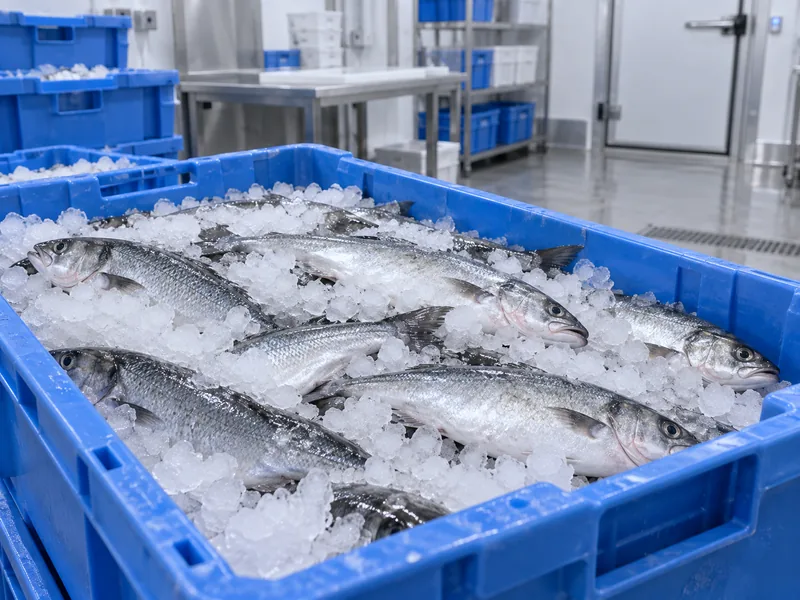
How Do the Two Cooling Roles Fit Together?
| Part of the System | Its Main Contribution |
| Ice around the fish | Local heat absorption and contact with the product during the specified chilled process |
| Refrigerated room air | A controlled surrounding environment that reduces incoming heat |
| Box and stacking arrangement | Support for product protection, ice distribution, drainage, and handling |
| Operating routine | Timely icing, identification, movement, and response when conditions depart from the procedure |
A fish cold room should be considered within this complete workflow. Describing only the room setpoint leaves out the product condition on arrival and the work that still has to happen inside each box.
Why Does Ice Contact Matter More Than a White Top Layer?
A visible layer of ice is useful evidence that ice is present, but it does not describe its distribution around the load. The fish below may have a different contact arrangement from the fish visible at the surface.
FAO notes that flake ice can bridge and leave air spaces. The lesson is to follow the specified packing and layering method rather than judging the whole container by how its top looks.
What Can an Overfilled Box Change?
Overfilling can make the intended arrangement difficult to maintain and can interfere with stacking or the box lid. It also encourages workers to improvise when moving the load, especially if ice or product extends above the container’s designed capacity.
Keep loading instructions tied to the actual container and product. A packing method that works for one fish size should not automatically be copied to a different size merely because both batches use the same room.
Our article on cold room airflow explains why the arrangement outside the boxes also matters. Good circulation around a stack cannot correct a poorly arranged load inside it, and appropriate icing does not justify obstructing the room’s air path.
Why Must Meltwater Have a Defined Route?
In a drained icing arrangement, meltwater needs a suitable path away from the product and toward the intended collection or drainage system. The route should not pass over other exposed fish, clean equipment, or neighbouring batches.
Water accumulating unexpectedly is a reason to examine the arrangement, not to assume that more water means better chilling. Intentional chilled-water or slurry systems are separate controlled processes; a blocked box outlet does not turn a drained process into one of those systems.
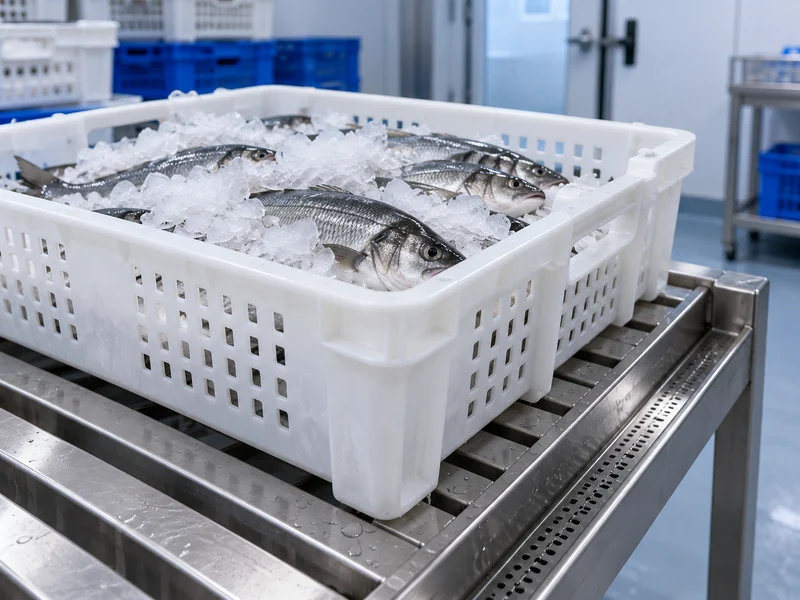
What Does the Whole Drainage Path Include?
Think beyond the hole in the container. The path includes the box outlet, its support, the stacking arrangement, any channel or collection point, and the room drainage serving that area.
- Keep the designed outlet from being covered by liners or the supporting surface.
- Use the approved stacking arrangement rather than directing runoff onto another exposed load.
- Keep access available for the cleaning and drain-care procedure.
- Identify unexpected pooling before the next batch uses the same position.
Our discussion of water leakage in a chiller room addresses other possible water sources. Separating product meltwater from equipment drainage or condensation helps the team investigate the correct part of the operation.
How Much Ice Does a Batch Need?
There is no reliable universal scoop count for every batch. Incoming fish temperature, duration, container performance, surrounding conditions, and handling exposure all influence the duty, so the operating amount should come from a validated process.
FAO’s account of fishery production engineering discusses why ice requirements vary with the product, container, and storage circumstances. This supports using a defined process basis rather than borrowing a ratio without its original assumptions.
Why Is the Replenishment Routine Part of the Answer?
The initial amount is only one point in the batch’s journey. Define who observes the condition during holding, what information they record, and which approved response applies when replenishment or further assessment is required.
Do not let responsibility disappear during a shift change. A batch that was correctly prepared at arrival can still develop an information gap if later staff assume someone else is monitoring it.
What Does a Busy Receiving Example Reveal?
Imagine a processor receiving two similar batches on the same afternoon. This is an illustrative comparison: one batch moves directly into its allocated chilled position, while the other waits during sorting and is rearranged several times.
Both eventually occupy the same cold storage room. Their later room-air readings can match even though their earlier exposure and the work demanded from their ice were different.
What Would a Useful Investigation Compare?
Compare arrival condition, timing, container arrangement, ice handling, and any measured product information. Keep the product identity and batch reference attached to those observations.
If the second batch performs differently, do not immediately blame its final shelf position. The delay before storage is a competing explanation that deserves attention before anyone changes the refrigeration controls.
A practical improvement could be to allocate receiving space before the truck arrives and separate identification from prolonged sorting. Evaluate whether that change reduces waiting under the real shift pattern, rather than attaching an invented cooling-time saving to it.
Which Common Shortcuts Create False Confidence?
Does a Colder Room Eliminate the Need for the Approved Icing Method?
No: a different setpoint is not automatically an equivalent process. A room held below the intended chilled range can introduce unwanted freezing or change how the icing arrangement behaves.
Keep chilled and frozen processes distinct. Our overview of chiller, freezer, and blast freezer rooms explains the different duties behind those names.
Does Fresh Ice Restore Fish That Has Been Mishandled?
No: adding ice does not reset the product’s history or prove that it is suitable for release. Follow the site’s product disposition procedure when time, temperature, or contamination control has been uncertain.
Likewise, neither appearance nor smell alone should be used to declare a questionable batch acceptable. The responsible assessment needs the relevant handling record and the controls required for that product.
Can One Room Sensor Represent Every Box?
It describes the air at its measurement location, not every product temperature. Use the monitoring method specified for the process and identify what each reading represents before interpreting it.
How Can the Cold Room and Icing Routine Work as One Process?
Give each stage a defined owner: preparing clean ice and containers, arranging the load, moving it to storage, managing meltwater, and handing it to the next stage. Record departures from the normal sequence while the details can still be recovered.
The goal is not simply to see ice in a cold room. It is to maintain the intended chilled condition around each batch through a repeatable combination of product contact, controlled surroundings, hygienic drainage, and timely handling.