
Cold room evaporator fin spacing should be selected around moisture exposure, coil operating temperature, required cooling duty, and the intended defrost schedule. Closely spaced fins can provide more surface within a compact coil, while wider passages offer more room for frost before airflow becomes restricted. The right choice is the coil that can deliver the required duty through the working cycle under your actual conditions.
Fin spacing is therefore a selection detail to discuss with the supplier, not a shortcut for choosing an evaporator by room temperature alone. This guide explains the tradeoff and the information a buyer should bring to that discussion.
What Does Evaporator Fin Spacing Describe?
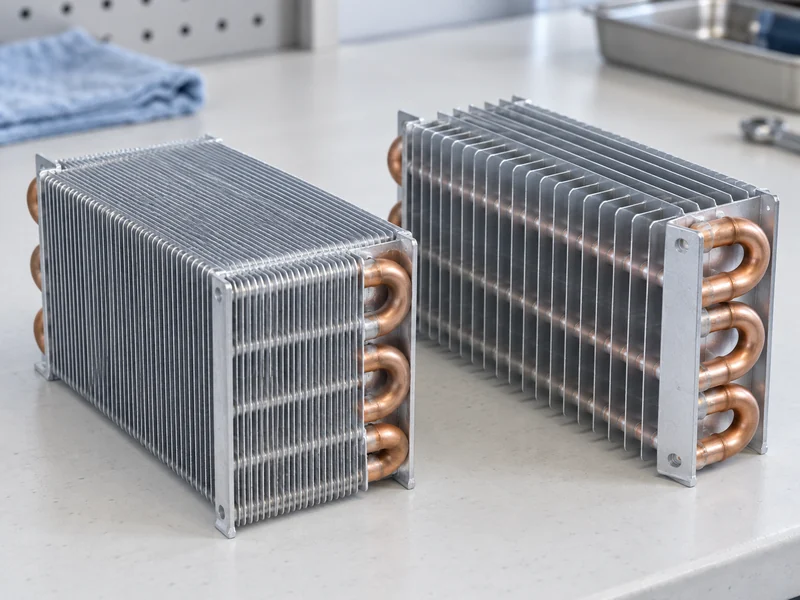
Fin spacing describes how frequently the thin metal fins are arranged along the coil tubes. Catalogues may express it as a distance in millimetres or as fins per inch, so confirm the convention before comparing quotations.
If the quoted dimension is the pitch between equivalent points on neighboring fins, an approximate conversion is 25.4 divided by the fins per inch. A clear gap between fin faces is a different measurement because it excludes the metal thickness.
For example, a nominal four fins per inch corresponds to about 6.35 mm pitch. That conversion explains the notation; it does not establish which spacing your room needs.
Ask whether spacing is uniform through the coil or varies between sections. Comparing only the front edge can be misleading when a design deliberately uses a more open inlet section.
Why Can More Fins Become a Disadvantage?
More fins can increase available heat-transfer surface within a given coil envelope, but the air still needs an effective passage through that surface. Once frost narrows those passages, performance depends on the combined coil and fan behavior.
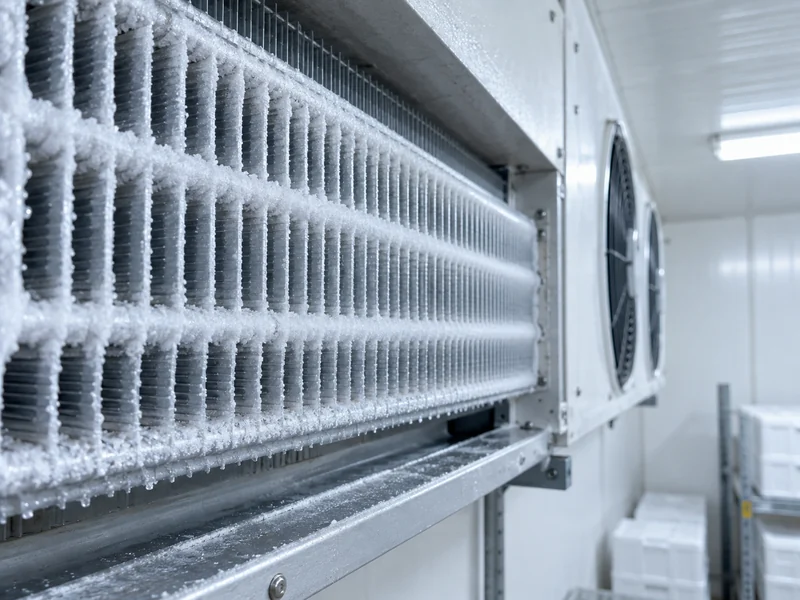
Warm, moist air entering the room introduces a recurring moisture load. When conditions at the cold coil support frost formation, deposits accumulate on the surfaces through which the air must travel.
A closely spaced coil may look attractive when comparing clean-coil ratings. The useful procurement question is how the selected assembly will perform as frost develops between scheduled defrosts.
FAO’s discussion of cold-store air ingress and defrosting describes wider inlet fin spacing as a way to accommodate frost without prematurely obstructing airflow. This supports considering frost tolerance, but does not establish one spacing for every installation.
Our recommendation is to evaluate the full operating cycle instead of treating the largest clean rating as the automatic winner. An evaporator selection should state its assumptions clearly enough for the owner to recognize when those assumptions no longer match daily use.
Does Every Freezer Need the Same Fin Spacing?
No: rooms with the same setpoint can face very different moisture loads and operating patterns. Product handling and access can matter as much as the nominal temperature category.
| Operating Situation | Issue to Discuss | Useful Selection Evidence |
| Packaged stock with limited access | Stable duty with relatively controlled moisture entry | Capacity rating and agreed operating cycle |
| Frequent door openings | Repeated moisture infiltration | Frost allowance and practical defrost frequency |
| Wet or uncovered incoming goods | Additional moisture released inside the room | Product condition and loading assumptions |
| Batch blast freezing | Product heat load and sustained airflow through the batch | Cycle duty, fan performance, and loading layout |
These are questions for selection, not fixed rules assigning a millimetre value to each application. The supplier should consider the coil geometry, operating temperature, refrigerant, fan, and defrost arrangement together.
LINBLE supplies different cold room evaporator configurations for chilling, freezing, and blast freezing. Request the specific coil data for the proposed model rather than assuming that a product family name tells you its fin spacing.
What About a Chiller Operating Above Freezing?
A positive room temperature does not automatically mean that its evaporator surface stays above freezing throughout operation. Have the designer explain the intended coil conditions and the associated defrost strategy.
This is also why a room-temperature reading cannot answer every coil question. Ask which operating conditions were used for the quoted duty and whether they match the intended product and humidity requirements.
What Else Must Be Compared Alongside Fin Spacing?
Compare complete evaporator selections at equivalent rating conditions. Two units with different temperature differences, airflow arrangements, or duty definitions cannot be fairly ranked by their headline kilowatts.
- Required cooling duty and the assumptions behind the load calculation.
- Room and evaporating temperatures used for the selection.
- Air volume, useful air throw, fan power, and available pressure where relevant.
- Coil dimensions, service space, and access for cleaning.
- Defrost method, drainage arrangement, and control sequence.
- Material or coating compatibility with the room environment.
The selected evaporator also has to work with the condensing unit under the intended design conditions. Installing a more open coil without checking the system match does not guarantee improved refrigeration performance.
For a broader specification review, use our guide to choosing a cold room evaporator. Fin spacing should be one named item within that review, rather than an isolated purchase decision.
Can Wider Spacing Replace Proper Defrosting?
Wider spacing gives frost more room to accumulate, but does not remove the moisture or the need to manage it. A coil can still become obstructed when defrost is ineffective or the moisture load exceeds the design assumptions.
As an illustrative operating scenario, consider a room that performs normally in the morning but loses airflow after repeated afternoon deliveries. Before changing the evaporator, compare door events, frost development, fan operation, and the actual defrost sequence over that period.
A qualified technician can distinguish between an inappropriate selection and a fault in an otherwise suitable installation. The owner’s observations are valuable when they describe timing and conditions instead of only reporting that the room feels warm.
Record whether ice remains after a completed defrost, where it appears, and whether drainage is clear. Our explanation of defrost termination, drip time, and fan delay can help organize the questions you ask during service.
Do not bend fins apart, chip ice with a sharp tool, or alter heater settings to imitate a different coil design. Those actions can damage equipment and obscure the original cause of the problem.
Which Operating Changes Can Overwhelm a Previously Suitable Coil?
Changes that bring more moisture, restrict the air path, or alter the required duty can make the original selection less suitable. Review those changes before assuming that the equipment itself has deteriorated.
- Deliveries become more frequent or the door remains open longer.
- Uncovered or wetter goods replace sealed packaged stock.
- Racks move closer to the coil inlet or discharge.
- Cleaning leaves substantial moisture inside the room.
- Incoming product temperature or daily throughput increases.
- Operators shorten or repeatedly interrupt scheduled defrosts.
Before requesting a replacement coil, give the engineer two descriptions: the loading and access pattern assumed when the room was ordered, and the pattern observed during the recent periods of heavy frost or weak airflow. If the business has changed, the engineer needs the new conditions before recommending a different evaporator or revised operating strategy.
Keep loading geometry in that discussion. Guidance on arranging products inside a freezer room is relevant because clear coil passages alone cannot overcome a blocked room circulation path.
What Should You Send With an Evaporator Enquiry?
Send an operating description detailed enough to expose the moisture and airflow demands. Dimensions and target temperature are a starting point, but rarely describe the complete selection problem.
Include product type, packaging, daily intake, arrival temperature, access frequency, surrounding conditions, and the proposed shelving or trolley layout. Add any restrictions on defrost timing, noise, ceiling space, drainage, and maintenance access.
For a replacement enquiry, provide the existing model information and a dated account of the symptoms. Photographs of the accessible coil and load arrangement can help, provided they are obtained without removing guards or approaching moving parts.
Ask the supplier to return a documented selection with fin spacing, rating conditions, fan data, and the intended defrost method. A clear explanation of why that combination fits your duty is more useful than a universal claim that either tight or wide spacing is always best.