
A cold room refrigeration cycle moves heat from the stored space to another location. In a conventional vapour-compression system, refrigerant absorbs heat at the evaporator, receives work from the compressor, releases heat at the condenser, and passes through an expansion device before returning to the evaporator. The room becomes colder because energy leaves it, while electrical energy keeps that transfer going.
Following the heat makes the equipment easier to understand than memorizing a list of components. It also explains why a cold room needs a working heat-rejection side even when the problem first becomes noticeable indoors.
Where Does the Heat Begin Its Journey?
Heat enters or is generated in the cold room through several routes, including the enclosure, incoming air, products, lights, people, and equipment. The refrigeration system must remove the combined load under the actual operating conditions.
Imagine placing a warmer sealed carton into a chilled room. Heat travels from the contents through the packaging to the surrounding air, and circulating air carries that energy toward the cooler.
The temperature at the controller describes one point in that environment. It does not directly reveal how much heat remains in the centre of the carton or how quickly that heat can reach the air.
For context on the complete assembly, our introduction to the main parts of a freezer room identifies the enclosure and supporting components as well as the refrigeration equipment. Here, the focus is the energy path connecting them.
Stop One: How Does the Evaporator Collect Heat?
The evaporator brings room air into thermal contact with refrigerant through the metal surfaces of its coil. During normal cooling, the refrigerant is at conditions that let it absorb heat as liquid boils into vapour.
The room air and refrigerant remain physically separate in a sound coil. Fans move the air across the outside surfaces; refrigerant flows inside the tubing.
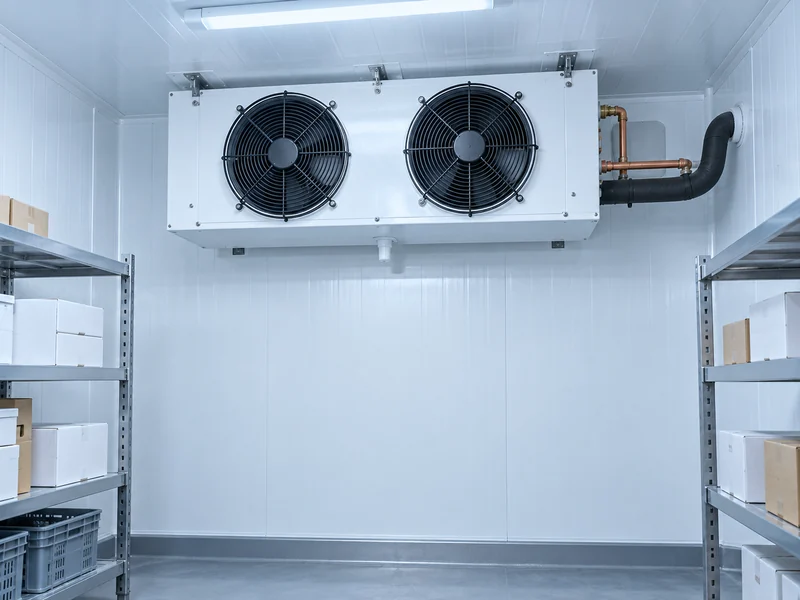
A cold room evaporator therefore does two connected jobs: it provides heat-transfer surface and, in a fan-assisted unit, moves air through that surface. A clear air path around the load matters because heat cannot reach the coil effectively if the room circulation is obstructed.
What Lets Room Heat Reach the Coil?
The air must meet a colder coil surface for heat to travel into the refrigerant. A coil that is colder than the surrounding air can receive heat from it; the size of that difference influences how the system performs.
The coil temperature and the room setpoint are consequently different quantities. Our explanation of evaporator surface temperature versus room temperature explores that distinction in more detail.
Moisture can also collect on a cold coil and, under suitable conditions, freeze there. That is why the refrigeration cycle must operate alongside a defrost strategy rather than being imagined as uninterrupted cooling at every moment.
Stop Two: What Does the Compressor Add?
The compressor draws in refrigerant vapour and raises its pressure, using mechanical work supplied by its motor. This establishes conditions that allow the refrigerant to reject heat at a temperature above the receiving air or water.
It does not simply squeeze cold air from the room into an outdoor pipe. The compressor handles refrigerant, while separate fans move the room air and, in an air-cooled system, the condenser air.
Pressure and boiling temperature are related for a given refrigerant, which is central to the cycle. The lower-pressure side supports heat absorption at low temperature, while the higher-pressure side supports heat rejection at a higher temperature.
Why Must the Compressor Receive the Right Refrigerant Condition?
A conventional refrigeration compressor is intended to compress vapour rather than a flow of liquid refrigerant. Refrigerant feed and system controls therefore matter as much as the compressor itself.
Terms such as superheat describe the refrigerant’s condition relative to saturation at its pressure. They are service and design quantities, not alternative names for the room’s temperature setting.
This article explains the principle without assigning universal pressure or superheat values. Those values depend on the refrigerant, equipment, application, and manufacturer’s instructions.
Stop Three: Why Does the Condenser Give Off Warm Air?
The condenser releases the heat absorbed indoors together with energy added through compression. In an air-cooled unit, air passing over the condenser carries that energy into the surroundings.
FAO’s description of mechanical refrigeration and its components explains the condenser as the heat-rejection part of the cycle. The refrigerant changes from vapour toward liquid as heat is removed under the intended condensing conditions.
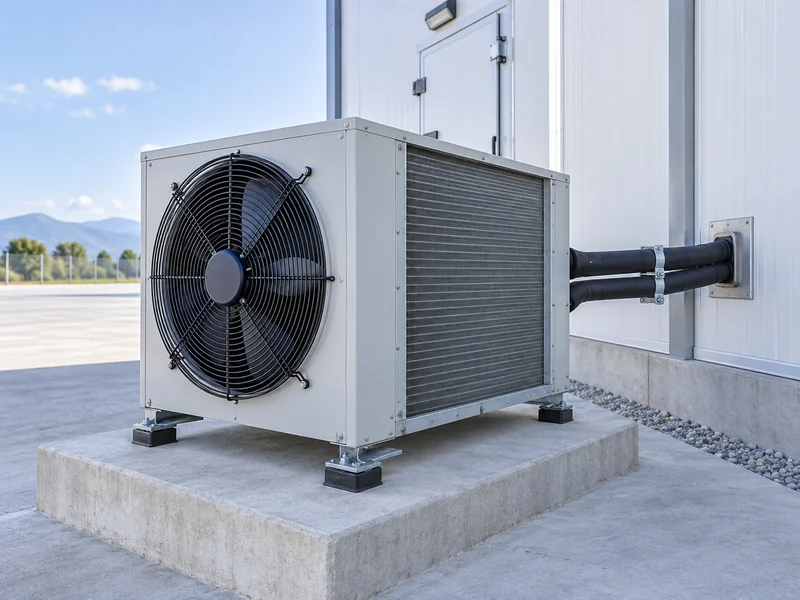
A condensing unit commonly groups the compressor, condenser, and associated components into an assembly. The name describes that assembly; it does not mean the condenser and compressor perform the same function.
The air leaving its condenser can be warmer than the entering air even while the cold room operates normally. Covering that discharge or enclosing the unit without an engineered ventilation arrangement interferes with the destination for the heat.
Does Every System Reject Heat Directly to Outdoor Air?
No: some systems use water-cooled or evaporative arrangements, and larger installations can have more elaborate heat-rejection circuits. The common requirement is a suitable path for the rejected energy.
For an air-cooled installation, recirculating warm discharge air back to the coil changes the conditions the equipment experiences. The cycle depends on the local air reaching the condenser, not merely on a weather report for the surrounding area.
Stop Four: What Happens at the Expansion Device?
The expansion device meters refrigerant into the lower-pressure part of the system. Across that restriction, pressure falls and some of the liquid can flash into vapour, leaving a cold mixture available for further evaporation in the coil.
The device does not perform the same job as the compressor in reverse. It creates a controlled pressure drop rather than recovering the compressor’s work as useful mechanical energy.
FAO’s account of refrigeration equipment in meat cold stores describes the expansion valve and its role in refrigerant supply. Different systems use different metering and control arrangements, so a basic cycle explanation should not be mistaken for adjustment instructions.
Once refrigerant has absorbed heat and returned as vapour, the loop continues. The physical circuit is closed during normal operation; refrigerant is not a fuel that should be consumed as the room cools.
Why Can the Condenser Reject More Heat Than the Room Loses?
The compressor’s work adds energy to the process. A simplified steady-state balance therefore combines evaporator heat absorption with compressor work to describe condenser heat rejection.
Illustrative balance: 10 kW absorbed at the evaporator + 3 kW of compressor work entering the refrigerant = approximately 13 kW rejected at the condenser.
This is a teaching example, not a LINBLE equipment rating. Real calculations must define the system boundary and account for relevant losses, fan power, and other inputs.
The same example helps distinguish capacity from consumption. The 10 kW cooling duty describes the rate of heat removal; it is not the same quantity as the electrical input shown on an equipment specification.
It also explains why the surroundings of the condensing unit can become warmer. The system transfers the room’s heat to that location and adds energy required to operate the cycle.
How Does the Cycle Explain Familiar Operating Behaviour?
Everyday observations become easier to interpret when they are connected to the heat path. An observation alone still does not identify a fault or justify changing a control setting.
Why Does Opening the Door Add Work?
Air exchange brings a new thermal and moisture load into the room. The refrigeration system must deal with the effect after the door closes, even though the original stored goods may already be cold.
Why Does the Temperature Sometimes Rise During Defrost?
Defrost deliberately changes the normal cooling sequence to remove accumulated ice from the coil. The resulting air-temperature trend must be interpreted alongside that operating event.
Our guide to defrost termination, drip time, and fan delay explains the sequence that returns the evaporator to useful cooling. The timing of these stages matters because cooling, draining, and fan restart serve different purposes.
Does a Lower Setpoint Always Mean Faster Product Cooling?
No: the rate also depends on available refrigeration capacity and the heat-transfer path through the product, package, and air. A colder target cannot remove a packaging bottleneck or an obstructed circulation route.
Thinking in terms of heat movement keeps the parts connected: product to air, air to evaporator, refrigerant through the compressor, and heat out through the condenser. The expansion device then prepares the refrigerant for another pass through the low-temperature side.