
When comparing an air blast freezer vs. a plate freezer for fish, start with the shape of the finished product. Flat, uniform blocks favor contact freezing, while irregular whole fish often favor air blast freezing.
For seafood processors, the critical question is whether each SKU can maintain reliable thermal contact or sufficient airflow throughout freezing. Packaging, thickness, loading arrangements and changeovers can reverse an apparently obvious equipment choice.
Why Product Geometry Changes the Freezing Method
In an air blast freezer, refrigerated air removes heat from exposed product or package surfaces. In a plate freezer, heat travels into refrigerated metal plates through the contact surfaces of the fish or its packaging. Both methods must also remove heat from the interior of the product.
A horizontal plate freezer is particularly suitable for uniform rectangular packs with parallel faces. A vertical plate freezer can instead form bulk fish into blocks between upright plates, including whole fish where the required output is a consolidated block rather than individually frozen pieces.
The FAO’s guidance on fish freezing equipment and methods describes these applications and emphasizes the importance of effective plate contact. This is technical guidance, not a regulatory requirement.
For irregular fish blast freezing, the advantage is that refrigerated air can reach curved surfaces without flattening the fish. However, adjacent fish can shield one another. A rack designed around the maximum individual fish width may still perform poorly if the actual loading pattern creates sheltered areas.
Thickness and Contact Must Be Assessed Together
Consider a flat block cooled effectively from both broad faces. Its central region is approximately half the block thickness away from either cooling face. If one face loses effective contact, heat removal becomes less symmetrical and the slowest-cooling region may shift.
Uneven filling, protruding portions and poorly fitted liners can undermine the expected advantage of plate freezing. In air blast equipment, the corresponding risk is an arrangement that allows air to travel around the load rather than through its product channels.
As the FAO discussion of factors affecting fish freezing time explains, packaging and trapped air also influence thermal resistance. A colder freezer setting cannot be assumed to compensate for poor contact or an unsuitable package.
Air Blast Freezer vs. Plate Freezer for Fish: Product Selection Matrix
Use the following comparison when evaluating fish freezing equipment. The preferred method depends on the saleable product leaving the freezer, not simply the species entering it.
| Product Form | Preferred Freezing Method and Reason | Loading Arrangement | Acceptance Basis |
| Individually frozen whole fish | Air blast; accommodates curved bodies and variable shapes | Trays or racks with clear air passages | Slowest-cooling fish reaches specified temperature; individual pieces remain separable if required |
| Uniform rectangular fillet blocks | Horizontal plate; broad, consistent contact faces | Fully formed packs or molds within the permitted thickness range | Thermal endpoint, block dimensions and acceptable surface integrity |
| Whole fish sold in bulk blocks | Vertical plate; forms consolidated blocks | Fish loaded into suitable plate compartments | Thermal endpoint, block mass, integrity and release condition |
| Fillets packed in paperboard cartons | Horizontal plate if cartons are contact-compatible; air blast if contact is unreliable and airflow trials succeed | Matched plate openings or spaced carton racks | Temperature at the slowest-cooling location inside the actual carton; packaging remains intact |
Paperboard cartons deserve particular attention. A rigid, uniformly filled carton designed for contact freezing behaves differently from a corrugated shipping carton containing loosely stacked fillets. The air spaces inside the latter remain a resistance even when cold air circulates freely outside it.
If the commercial packaging must stay unchanged, test that exact configuration. If packing can occur after freezing, compare the alternative workflow, including additional handling, packaging labor and protection of the exposed fish.
Two SKU Examples: Different Products, Different Equipment Decisions
Both scenarios use illustrative assumptions, not customer data or rated equipment performance.
SKU A: Individually Frozen Whole Mackerel
Assume an order requires 800 kg per batch of whole mackerel, with maximum body thickness varying from 45 to 80 mm across size grades. The finished fish must retain its individual form rather than be consolidated into a block.
A batch blast freezer room is the stronger initial candidate. Evaluate a trolley arrangement that separates fish adequately and maintains air passages even when the largest grade is loaded. Specify the usable fish mass per tray at the approved spacing rather than filling each tray to its physical limit.
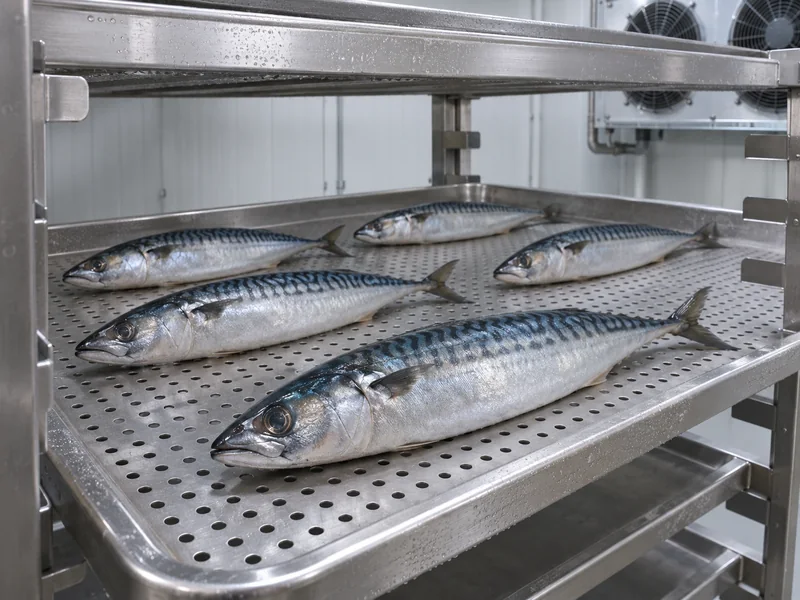
The trial should include the thickest fish within the permitted grade, distributed among positions that experience different airflow conditions. Assess surface dehydration, physical damage and whether adjacent fish freeze together. If the largest grade cannot meet the agreed cycle, test a revised loading pattern or a separate recipe before increasing refrigeration capacity.
SKU B: Rectangular Fish Blocks with Fixed Dimensions
Assume a second order calls for 5 kg rectangular fillet blocks measuring approximately 400 × 250 × 50 mm, formed in consistent contact-compatible cartons. The customer accepts a compact block with controlled dimensions.
Here, a horizontal fish block freezer based on plate contact is a credible first choice. Confirm that loaded packs have sufficiently flat faces, that the carton tolerates the contact conditions and that the plate opening matches the actual filled-pack thickness.
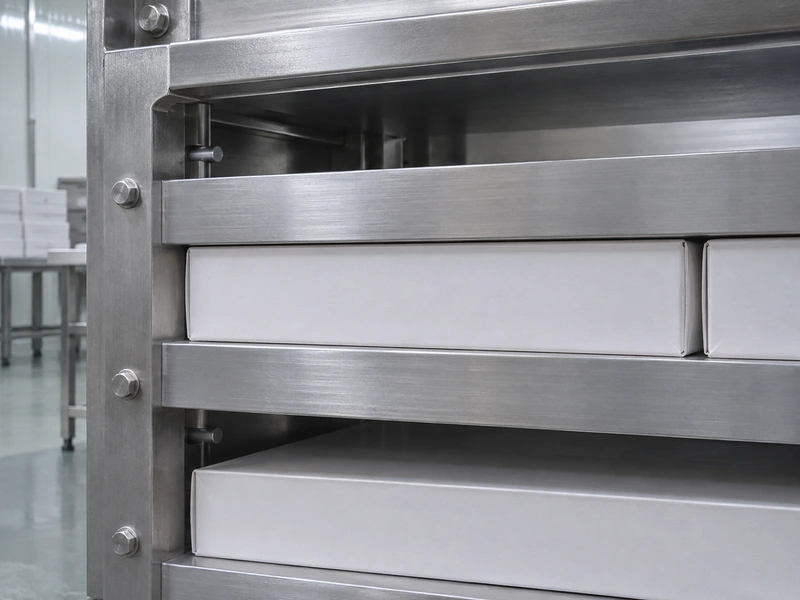
If these blocks are to share the air blast room used for SKU A, test them on dedicated shelves. Maintain clearance around cartons and investigate whether the shelf design restricts cooling from below. Do not adopt the whole-fish freezing schedule for the blocks.
For plants alternating between orders, compare trolley exchanges with plate spacing adjustments, pack preparation and block release. A shared chamber is attractive only when both recipes meet their acceptance criteria. For continuous production alternatives, see the separate comparison of spiral and batch blast freezing.
Translate the Product Trial Into an Equipment Specification
LINBLE’s industrial blast freezer rooms have a published room-temperature range of approximately −25°C to −45°C, with freezing throughput specified for individual projects. A common product core target is −18°C, subject to the application’s requirements. Neither figure establishes a guaranteed cycle for a particular carton or fish grade.
The blast freezer evaporator specifications list model DJ-23.8/140(B) with a reference refrigeration capacity of 23.8 kW, 140 m² of heat exchange surface, two fans each rated at 10,000 m³/h and two 1.5 kW fan motors.
The evaporator page describes applications from −35°C to −25°C; its suitability at −45°C cannot be assumed. These catalog values are not a selection for either example.
Request the actual coil duty at the proposed evaporating and room temperatures, refrigerant conditions and frost allowance. The catalog airflow must also be checked against the resistance of the installed, loaded trolley arrangement. A quoted fan volume alone does not establish velocity over the fish.
Compare Usable Output Rather Than Nameplate Capacity
For a fish freezing machine quotation, specify the saleable kilograms discharged per complete operating cycle. Include loading, freezing, unloading, necessary defrost or release operations, and any changeover work within the stated measurement boundary.
For example, as an illustrative assumption, a trial yielding 800 kg of acceptable product with a total measured electricity use of 160 kWh would correspond to 0.20 kWh/kg. This is an arithmetic example, not a predicted consumption figure.
The evaporator’s 23.8 kW reference capacity describes heat removal rate; the fan motor ratings describe motor power, not the complete refrigeration system’s electrical demand. Compare metered kWh using equivalent product endpoints, loading conditions and electrical boundaries for both methods.
Specify a Trial Load Before Approving the Freezer
An empty-room temperature test cannot demonstrate freezing performance with actual fish. Use representative commercial packs and agreed worst-case conditions. The FAO reference on temperature measurement in fish processing explains why the last region to reach the target temperature may not coincide with the geometric center.
The following acceptance record can be incorporated into the purchase specification:
| Trial Record | Information to Document |
| Product identity | SKU, species, grade, maximum thickness, carton construction and net mass |
| Starting conditions | Product entry temperature range, batch mass, room or plate operating conditions |
| Load configuration | Tray pattern, carton clearances, plate contact conditions where applicable, and photographs |
| Temperature evidence | Calibrated product probes at justified slow-cooling locations, with recorded temperature curves |
| Operational results | Time to the specified endpoint, complete cycle duration, accepted mass and metered electricity |
| Quality and repeatability | Agreed physical quality criteria and repeated results under the approved loading conditions |
Test the most thermally demanding credible configuration, not merely the most convenient sample. Include partial loads if they are part of normal operation; their airflow distribution may differ from full loads. Define the maximum permitted cycle time and minimum accepted output before the test, and record deviations rather than averaging away individual failures.
The supplier should identify which conditions are guaranteed, which require a site trial, and what changes invalidate the approved loading recipe. A factory test without representative fish cannot replace an agreed loaded performance test.
Before the design is finalized, have qualified specialists check the refrigeration circuit, electrical provisions, structural supports and every component that will operate under pressure. The processor’s food safety team must separately validate product handling and any parasite-control process; a general freezing endpoint does not establish food safety compliance.
Choose a Freezing Room Around Your Fish SKUs
If your product geometry favors air blast freezing, discuss your seafood freezing project with LINBLE. Share fish dimensions, filled-carton drawings, batch quantities and acceptance targets so we can assess a customized fish and seafood cold room configuration for your actual product mix.