
Cold room evaporator TD selection determines how much heat-transfer capability a coil needs and how aggressively it may remove moisture, even when competing quotations offer the same refrigeration capacity.
Read the Temperature Conditions Behind the Quoted Capacity
A quotation stating that an evaporator delivers 5 kW is incomplete without its rating conditions. The same coil may provide substantially different cooling capacities at different evaporating temperatures.
For conventional direct-expansion unit coolers, the rating TD commonly refers to the entering air temperature minus the refrigerant saturation temperature associated with the evaporator outlet pressure.
The ASHRAE guidance on air cooler capacity ratings explains this convention and notes that some equipment ratings use different reference conditions.
Three entries deserve particular attention on a selection sheet:
- Entering air temperature: The design air temperature at the evaporator inlet.
- Saturated suction temperature (SST): The refrigerant saturation reference used for rating the coil.
- Rating TD: The difference between these temperatures, expressed in kelvin (K).
When comparing room air vs. saturated suction temperature, remember that entering air temperature may differ from the room controller reading. Likewise, refrigerant saturation temperature is not the measured temperature of superheated suction gas.
For refrigerant blends with temperature glide, establish whether the manufacturer uses a dew-point or mean saturation temperature. Comparing TD values without aligning their conventions can produce an incorrect equipment comparison.
Our explanation of the difference between evaporator surface temperature and cold room temperature provides background terminology. For procurement, however, the manufacturer’s refrigerant rating reference must govern the calculation.
One Cold Room at 2°C, Two Different Coil Selections
Suppose a produce distributor needs an evaporator for a chilled holding room. The products arrive precooled, and the purchasing team wants to limit unnecessary dehydration during storage.
Use the following illustrative assumptions, not actual LINBLE equipment ratings or universal produce storage recommendations.
| Selection Input | Option A | Option B |
| Entering air temperature | +2°C | +2°C |
| Rating TD | 5 K | 8 K |
| Refrigerant saturation temperature | −3°C | −6°C |
| Required total cooling duty | 5 kW | 5 kW |
| Target room RH | 90% | 90% |
| Refrigerant and rating convention | Identical | Identical |
The evaporating temperatures follow directly from subtracting the respective TD values from +2°C. Both proposals must satisfy the same project requirements, including the required sensible cooling duty and intended operating schedule.
The 5 K proposal works with a smaller temperature driving force. It will generally require greater effective heat-transfer capability to achieve the same duty. The 8 K proposal may use a more compact coil, but its colder refrigerant condition can increase the tendency to extract moisture.
Neither proposal is a confirmed equipment selection. Obtain manufacturer-calculated capacity at each operating point rather than assign the same catalog model to both columns.
Keep product loads, packaging, room layout and condenser design conditions identical. Different airflow arrangements are acceptable if both satisfy the room’s distribution requirements.
What Does the Smaller TD Cost in Coil Size?
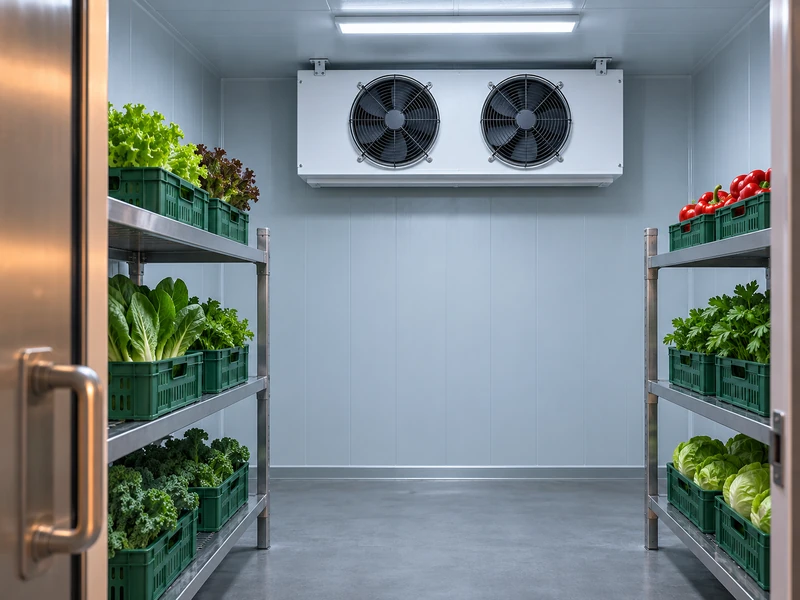
A low-TD evaporator is not simply a standard unit operated at a different pressure. It needs enough heat-transfer capability at the smaller driving temperature difference.
Where other heat-transfer characteristics are comparable, a larger effective coil surface can compensate for the reduced temperature difference. Manufacturers may also change coil geometry, refrigerant distribution or airflow to achieve the required performance.
This changes the purchasing comparison in several ways:
- Equipment envelope: A larger coil may occupy more ceiling space.
- Air delivery: Capacity must not rely on excessive airflow across exposed goods.
- Fan demand: Compare the electrical input of each fan arrangement.
- Capital cost: Assess the complete evaporator and matched refrigeration system.
A warmer evaporating condition can also reduce compressor pressure lift when the condensing condition remains unchanged. The possible efficiency benefit must be checked against actual compressor performance data and fan requirements.
Do not assume that a larger coil always removes more moisture. Its operating temperature, airflow, refrigeration capacity and runtime determine how it interacts with the room air.
Likewise, avoid converting 5 K and 8 K into a fixed coil-area ratio. Real heat exchangers have different heat-transfer characteristics and may operate with different moisture and frost conditions.
For coil selection for fresh produce, the objective is enough cooling at a suitably mild operating condition, not the largest available evaporator or the smallest achievable TD.
Why a 5 K TD Cannot Guarantee 90% Relative Humidity
A refrigeration coil affects humidity by removing water vapor from circulating air. Its moisture-removal tendency depends partly on how cold its effective surface is relative to the entering air’s dew point.
Under comparable conditions, a lower TD can reduce unnecessary moisture extraction. However, actual relative humidity (RH) depends on air temperature and the balance of moisture entering, leaving and accumulating within the room.
Cooling capacity must also be divided conceptually into two parts:
- Sensible capacity: Lowers the temperature of air and goods.
- Latent capacity: Removes heat associated with moisture changing phase.
Two coils with identical total cooling ratings may therefore deliver different sensible capacities under humid operating conditions. A quotation for a humidity-sensitive room should address that distinction.
A Simple Moisture-Balance Example
Consider the following illustrative operating conditions:
- Moisture entering or released into the room: 0.6 kg/h.
- Moisture removed by refrigeration: 0.8 kg/h.
- Net moisture loss: 0.2 kg/h.
At a stable room temperature, this moisture imbalance can gradually reduce relative humidity (RH).
Potential consequences include:
- Increased product moisture loss.
- Reduced product weight.
- Deterioration in product appearance.
- Acceptable room temperature but insufficient humidity.
For effective cold room humidity control, evaluate the following factors when selecting an evaporator:
- Operating conditions: Compare normal holding and peak receiving periods.
- Moisture balance: Account for frost accumulation, defrost drainage and moisture returning to the air.
- Product requirements: Establish the target RH according to commodity and packaging characteristics.
- Coil performance: Evaluate moisture removal alongside refrigeration capacity.
When selecting an evaporator TD for a high-humidity cold room, remember that neither 5 K nor 8 K guarantees a specific RH level.
The objective of humidity control for fresh produce cold storage is to limit unnecessary dehydration without creating excessive surface moisture.
Read a Real Evaporator Catalog Without Overinterpreting It
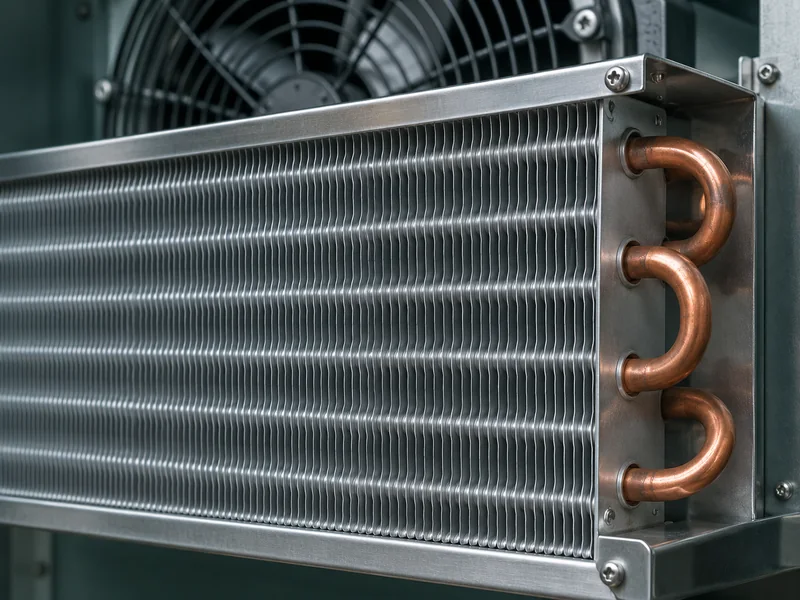
LINBLE’s chiller evaporator specifications list the DL series for chiller applications, including models DL-5.2/25 and DL-8.2/40. Their published refrigeration capacities are 5.2 kW and 8.2 kW, respectively.
These are real catalog entries, but the public table does not state their rating TD. It would be incorrect to conclude that either model automatically delivers 5 kW at the illustrative −3°C or −6°C evaporating condition.
Request a project-specific selection sheet containing:
- Refrigerant and saturation temperature convention.
- Entering air temperature and humidity.
- Total and, where available, sensible cooling capacity.
- Effective heat-transfer surface and physical dimensions.
- Airflow and fan electrical input.
- Gross or net capacity definition and applicable corrections.
The listed cooling area should also be clarified with the supplier before using it as a measure of effective coil surface.
Check that fan heat and defrost heat are accounted for consistently in the load calculation and capacity definition.
Cooling capacity in kW measures heat removal, electrical input in kW measures power demand, and kWh measures electrical energy consumed over time.
An evaporator does not operate independently of the condensing unit. Request confirmation that the complete system delivers the required duty at the selected evaporating and condensing conditions.
ASHRAE’s discussion of commercial refrigeration equipment design highlights the importance of matching equipment to operating requirements and clarifying rating conventions for refrigerant blends. Its application-specific recommendations should not be treated as universal produce storage requirements.
Evaluate the Coil During Both Holding and Receiving
A successful low-TD selection must work beyond a single steady-state catalog point. Include two distinct operating periods in the project’s acceptance plan.
During Normal Holding
Check whether the room maintains its agreed temperature and humidity range without excessive drying near the evaporator discharge.
Log temperature and RH together at representative product locations. Compare readings near the coil with those from more distant storage positions.
During Stock Replenishment
Observe recovery after representative deliveries and door activity. Compare the recovery time with the agreed project requirements rather than expecting the same humidity reading throughout the event.
The commissioning record should identify:
- Actual entering air conditions.
- Refrigerant saturation reference and observed TD.
- Refrigeration operating time.
- Temperature and RH trends.
- Defrost events.
Record whether measurements were obtained under stable or changing loads.
Where product dehydration is commercially important, repeatable sample-weight measurements may complement environmental monitoring, provided the sampling method accounts for packaging and handling differences.
Acceptance limits and measurement methods should be agreed before purchase. Refrigeration specialists must verify the system match, operating pressures and control strategy; qualified food-storage personnel should approve commodity-specific conditions.
Do not alter pressure controls or safety settings simply to imitate the lower TD option.
Specify the Duty Twice Before Choosing Your LINBLE Coil
Instead of asking for one evaporator based on room temperature, ask for a comparison at two technically feasible TD values.
When reviewing LINBLE’s cold room evaporator options, prepare the information that directly affects this comparison:
- Target room temperature and RH.
- Product and packaging details.
- Calculated refrigeration duty.
- Available coil installation space.
- Intended refrigeration system.
A useful selection response should explain the capacity available at each proposed condition, the equipment size implications and any unresolved moisture-control requirements.
Compare the candidates at the proposed duty and evaporating temperature. Select a coil that provides the needed cooling while limiting moisture loss from the stored goods, and ask the supplier to confirm performance at both holding and receiving conditions.
If you are evaluating a low-TD coil for humidity-sensitive stock, discuss your cold room project with LINBLE using those operating conditions rather than a catalog capacity alone.