
Freezer burn develops when frozen food loses moisture from its exposed surface during storage. The food can remain frozen while its edges become dry, pale, or tough, so an acceptable room-temperature reading does not by itself prevent the problem. Protection depends on the product’s packaging, its exposure to moving air, temperature stability, and the time it spends in storage.
For a commercial cold room, the useful question is where that moisture can escape and which part of the handling routine leaves the product vulnerable. Lowering the controller setting without understanding those conditions may leave the original problem unresolved.
Is the White Material on Frozen Food Always Freezer Burn?
No: loose surface ice, a protective ice glaze, and dehydrated food are different things. Appearance offers clues, but it does not establish the product’s complete temperature history or its suitability for release.
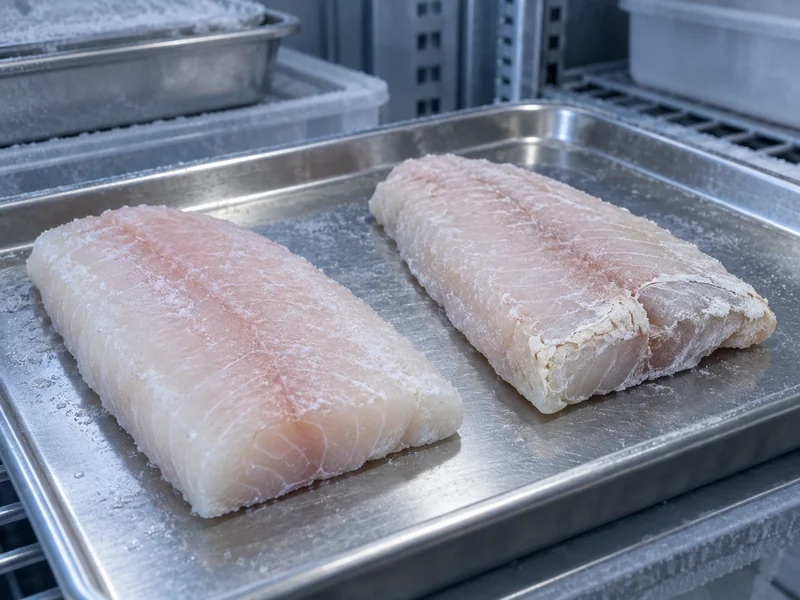
Imagine a carton containing individual frozen fish portions. A few ice crystals on the inside of its liner do not tell the same story as a fillet corner that has become visibly dry and leathery beneath the ice.
| What You Notice | What It May Represent |
| Loose crystals on a bag or food surface | Moisture that has deposited as ice; investigate the handling history |
| An intentional, continuous ice coating | A protective glaze used for certain frozen products |
| Dry, dull, discoloured edges | Possible surface dehydration associated with freezer burn |
| Changes in odour or appearance after an unknown temperature excursion | A separate quality or safety assessment, not a freezer-burn diagnosis alone |
These distinctions prevent two opposite mistakes: treating every ice crystal as ruined food, or assuming that a frozen-looking product must have been handled correctly. Commercial release decisions should follow the site’s product specifications and food-safety procedures.
How Can Food Lose Water Without Thawing?
Ice can pass directly into water vapour through sublimation. Moisture leaving a food surface can move into the surrounding air and eventually settle on colder surfaces elsewhere.
Iowa State University Extension’s explanation of freezer burn describes that moisture loss and the resulting changes in surface colour and texture. It also distinguishes this quality defect from a food-safety conclusion.
Inside a package, the amount of exposed food and the space around it influence the environment immediately next to the product. Outside the package, the room’s refrigeration and air circulation create conditions that the wrapping must resist over the intended storage period.
This is why two cartons in the same freezer room can leave storage in different condition. One may have intact close-fitting protection, while the other has an open liner or a puncture that repeatedly exposes a small area.
Why Can Corners Look Worse Than the Centre?
A thin edge has relatively little product behind its exposed surface. Local damage can therefore look severe even when the entire item has lost only a modest amount of weight.
FAO’s discussion of weight loss during frozen fish storage highlights the importance of exposed area, wrapping, air movement, and position within the store. Its fish examples explain why inspecting only total carton weight can miss localized deterioration.
For operations, this suggests keeping the location of a defect in the record. “Dry on the outer corners of the top layer” is more informative than a general note that a batch looked old.
Which Protection Layer Does Each Job?
Product protection works best when packaging and room operation support each other. Treating one as a substitute for the other creates avoidable weak points.
What Does the Packaging Contribute?
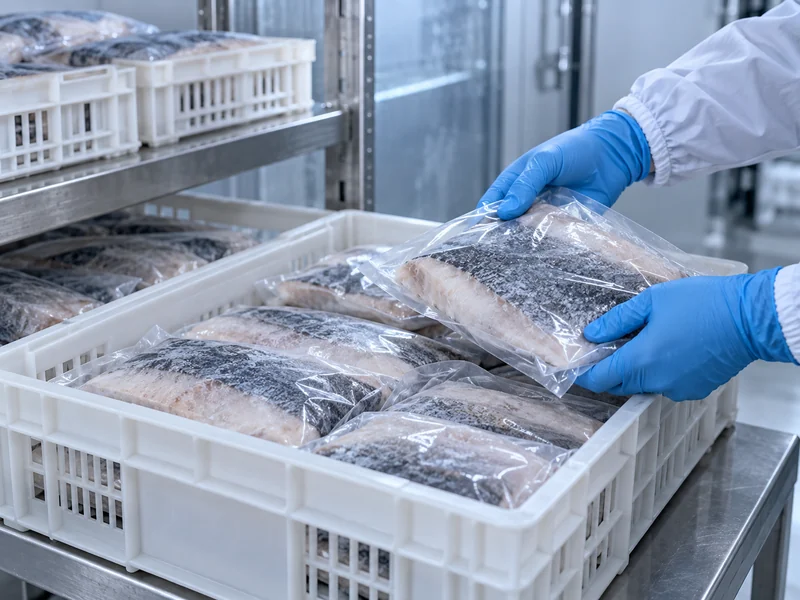
The wrapper provides a barrier around the food itself. Its suitability depends on the material, closure, handling resistance, and storage conditions, rather than on whether the package merely looks substantial.
- Use packaging specified for the product and its frozen storage life.
- Keep seals and closures intact during picking and handling.
- Follow the product’s packing instructions for reducing unnecessary trapped air.
- Protect sharp product edges or carton features that could damage the liner.
A corrugated outer box may protect against handling damage while still relying on an inner liner for moisture protection. When that liner is opened for partial picking, closing only the carton lid may not restore the original barrier.
What Does the Room Contribute?
The room maintains the required storage environment around the packages. Good packaging cannot compensate indefinitely for avoidable warming, prolonged exposure during handling, or a storage period beyond the agreed product specification.
Air circulation must reach the stock without turning unprotected product into a permanently exposed target in the cooler discharge. Our guide to freezer room loading and airflow explains why clear circulation paths remain necessary.
The cold room evaporator removes heat, but its fan arrangement should be understood in the context of the complete room. Blocking the unit with cartons or switching its fans off is not a sound way to protect exposed food from drying.
What Can Three Everyday Storage Situations Teach Us?
The following examples are illustrative operating situations, not LINBLE customer cases or measured performance claims. Their purpose is to show how the same symptom can arise from different routines.
What Happens to a Partly Used Carton?
A picker opens a lined carton, removes several portions, and returns the remainder with the liner folded loosely. The remaining food now has a different level of protection from the unopened cartons beside it.
The practical response is a defined procedure for partial packs, including permitted reclosure and identification. Repeatedly opening every carton to look for damage would itself create extra handling and exposure.
Why Might Only One Shelf Position Be Affected?
If similar packages behave differently by location, review their exposure and movement history together. Position is useful evidence, but it should not immediately be treated as proof that a particular fan is at fault.
A carton at the front may also be picked more frequently, left outside longer, or contain stock from an older delivery. Comparing like-for-like stock avoids confusing an inventory difference with a refrigeration difference.
What If Damage Appears After a Busy Dispatch Period?
Frequent transfers can create repeated opportunities for the product to warm before it returns to storage. Organizing orders before opening cartons and keeping transfer routes ready can reduce unnecessary exposure.
Use time and location records to distinguish a one-off event from a recurring pattern. If temperature varies across the room, temperature mapping can help describe the environment that different stock positions experience.
Which Common Responses Miss the Real Cause?
Several intuitive remedies address the appearance of the problem while leaving its mechanism untouched. The aim is to preserve a controlled process, not to chase a single visual sign.
- Turning the setpoint down repeatedly: this does not close a damaged liner or establish the correct storage conditions for the product.
- Stopping room airflow: this can undermine temperature distribution and should not replace packaging protection.
- Spraying water into the freezer: improvised wetting introduces other operating problems and is not an approved glazing process.
- Judging safety from freezer burn alone: the defect does not establish whether the cold chain was maintained.
Rapid freezing and protected frozen storage also serve different purposes. Our explanation of blast freezing time and product core temperature covers the freezing stage; successful completion of that stage does not remove the need for protection afterwards.
How Can the Daily Routine Reduce Recurrence?
Build prevention into the points where the product changes hands: packing, receiving, partial picking, dispatch, and return to storage. For every transfer, specify who closes the liner, where a partial carton returns, and how staff identify stock that needs attention before the next pick.
Track damaged packaging and visible dehydration by product, batch, location, and time in storage. Those records help separate packaging failures, slow stock rotation, and location-specific exposure without claiming that one room setting explains every loss.
A useful improvement is one that staff can repeat during the busiest shift. Intact product protection, a workable circulation path, and controlled handling time usually deserve attention together when the room is cold but the food is drying out.